Skip to main content
Lesson starters
Give the lesson a question worth exploring. Use something pupils can notice and compare. Let their first explanation tell you where to take the lesson next.
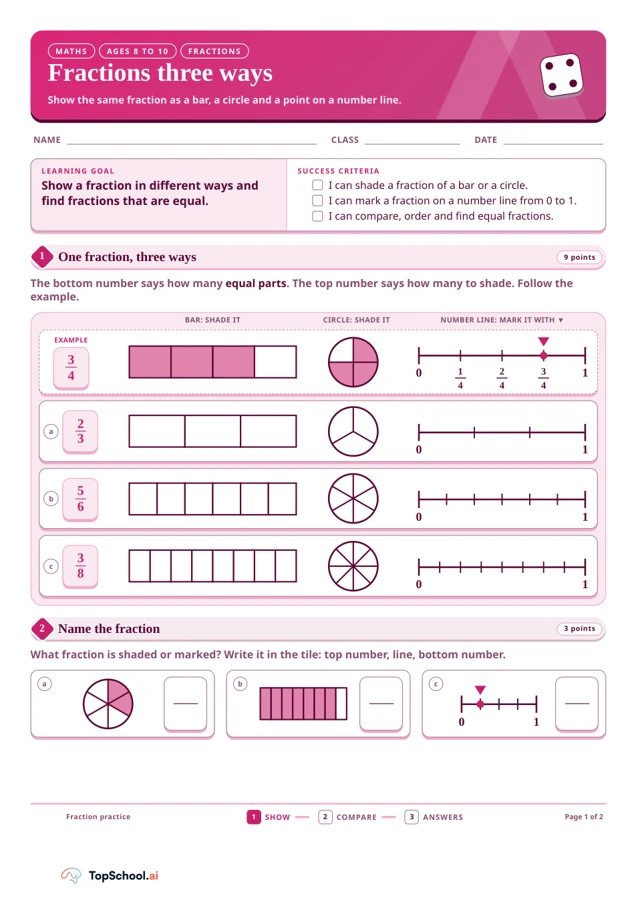
Fractions three ways: show, compare and share. Pupils aged 8 to 10. English PDF. Let a comparison open the conversation. Keep the whole the same size. Show one half and two quarters, then ask pupils what they notice before naming the relationship.
A different partition gives you another question: what changed, and what stayed the same?
Open the fractions worksheet Prepare a lesson-opening request Help me prepare a primary lesson starter using the fraction models I supply. Ask for my year group and learning goal. Keep equal wholes, invite a prediction and ask pupils to explain their comparison. Add an optional sentence starter without giving the explanation.
Copy request Review and copy the request into PLAI™ with the material you want to use.
Compare the same whole in two ways.
Two quarters Three sixths Four eighths
Do they show the same amount? What makes you say that?
Open the fractions worksheet Play the comparison sequence Represent Compare and explain
Fractions three ways: show, compare and share Use bars, circles and a number line to represent fractions. Leave something for pupils to explain. Use the supplied fraction wall to compare one third and one half. Ask for a drawing or explanation that keeps the whole equal.
Listen to the first idea. Ask what in the model supports it.
Offer another way in. Use a paper strip, counters or oral rehearsal.
Keep a question independent. Check whether pupils can explain a fresh comparison.
Open the lesson in a different way. A scenario, a story or an investigation can give pupils another starting point.
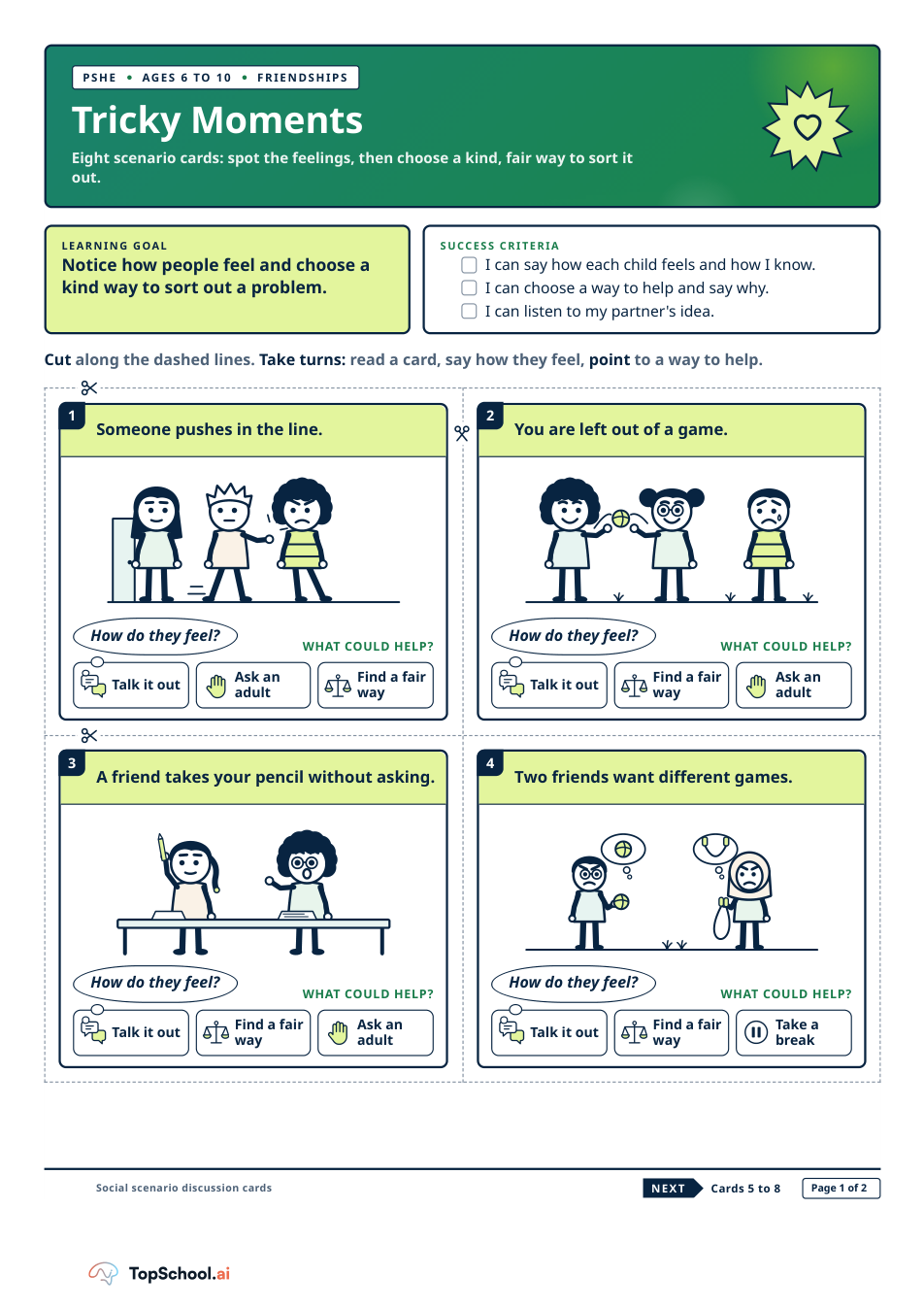
Discuss a possible response. Tricky Moments
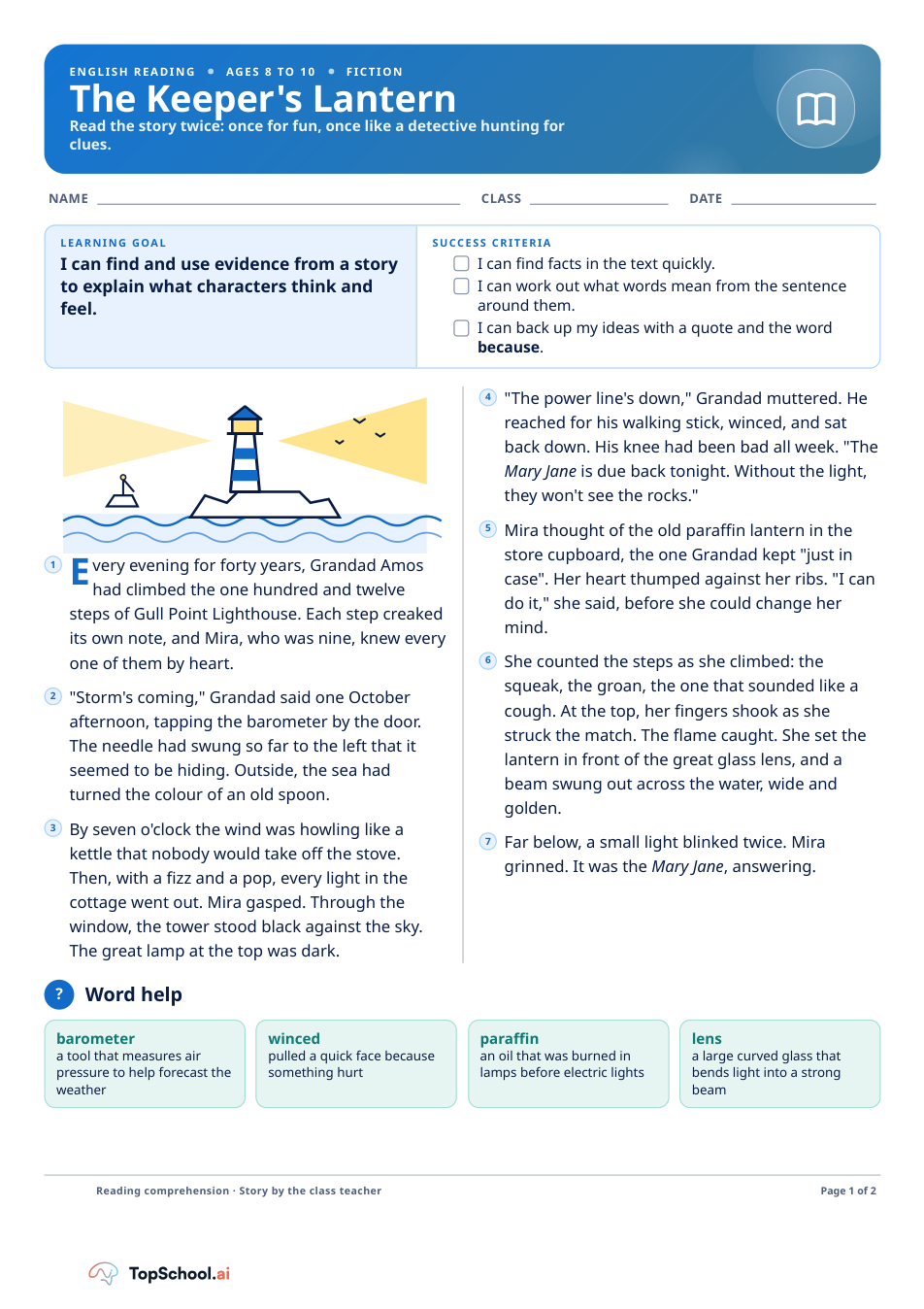
Pupils aged 6 to 10 · English PDF Open the material Find a clue in a story. The Keeper’s Lantern
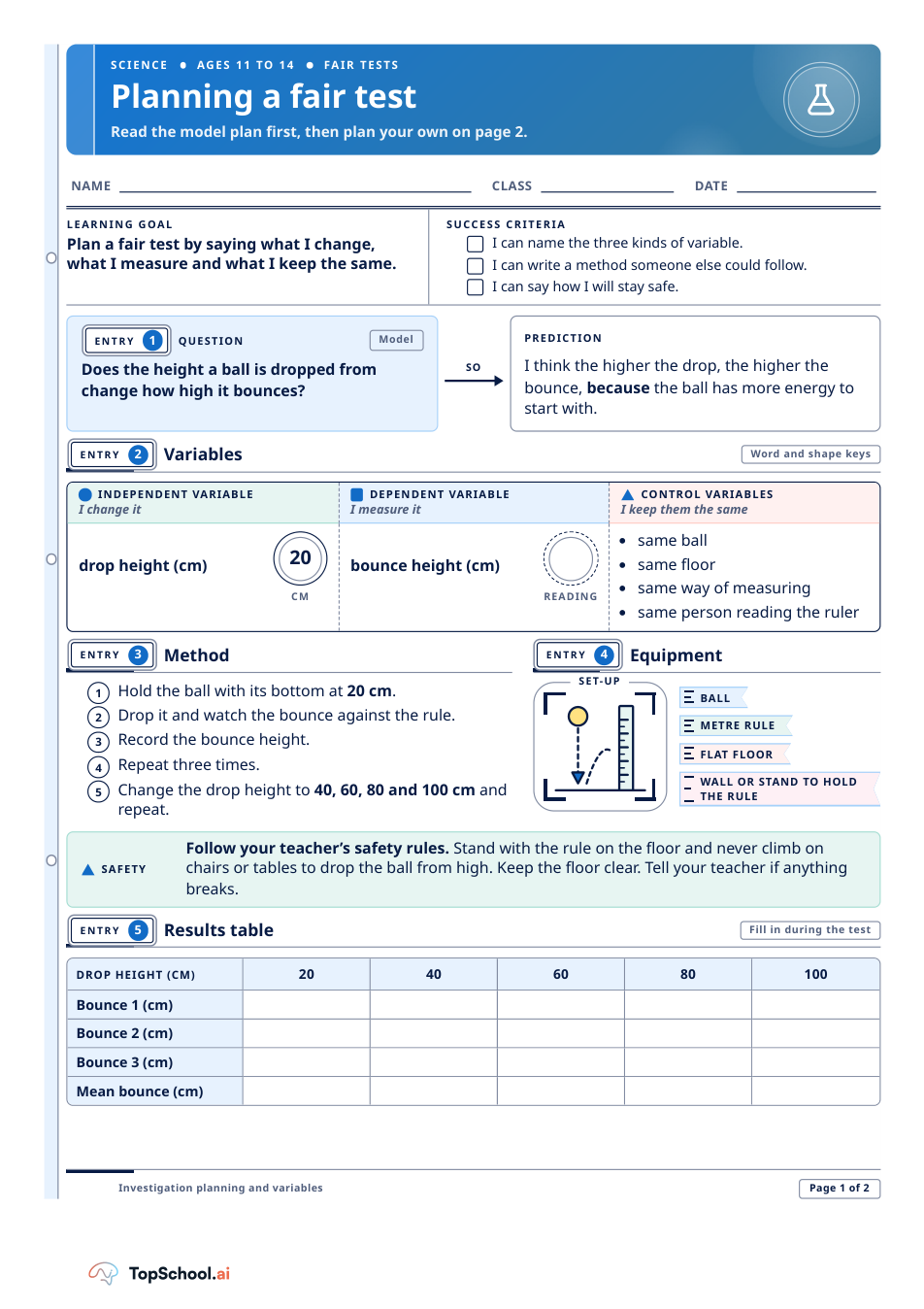
Pupils aged 8 to 10 · English PDF Open the material Ask what makes a test fair. Plan a fair test: variables, method and results
Pupils aged 11 to 14 · English PDF Open the material Find an opening worth exploring. Choose one prompt, short recall task or first prediction. These are ways into the materials, rather than a requirement to complete the whole resource.
Take a closer look ↗ The teaching purpose Bees and pollination: know, wonder and learn Use an inquiry chart to connect prior ideas, questions and information learned from a short text. Open the preview ↗ Take a closer look ↗ The teaching purpose Circuit lab: series and parallel Compare how a break in one bulb’s path affects a series circuit and a parallel circuit, using the model diagram and readouts to support an explanation. Open the preview ↗ Science · Interactive activity
Take a closer look ↗ The teaching purpose Classroom English: talk and learning cards Start with one classroom phrase and a supported speaking exchange. Open the preview ↗ Languages and literacy · Cards/display
Take a closer look ↗ The teaching purpose Debate a school rain-garden location Open with one rain-garden location choice before developing the debate. Open the preview ↗ Geography · Cards/display
Take a closer look ↗ The teaching purpose Devising deck: stimulus cards and constraints Choose a stimulus card and one constraint to begin a short drama exploration. Open the preview ↗ Music and performing arts · Cards/display
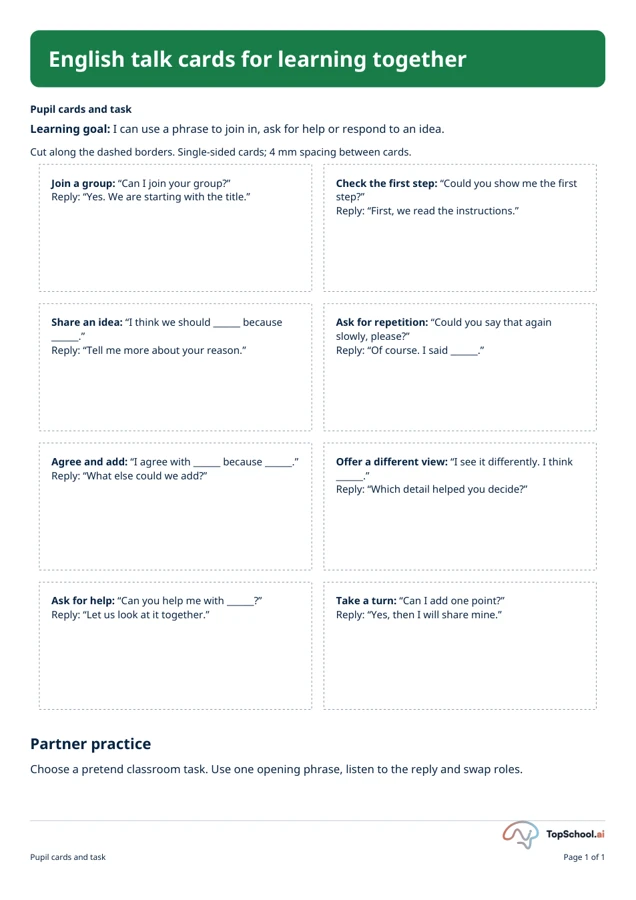
Take a closer look ↗ The teaching purpose Do now fluency grid: practise across the week Practise a range of number calculations accurately and notice which skill needs more practice. Open the preview ↗ Take a closer look ↗ The teaching purpose English talk cards for learning together Use one talk card to rehearse classroom language with a partner. Open the preview ↗ Languages and literacy · Cards/display
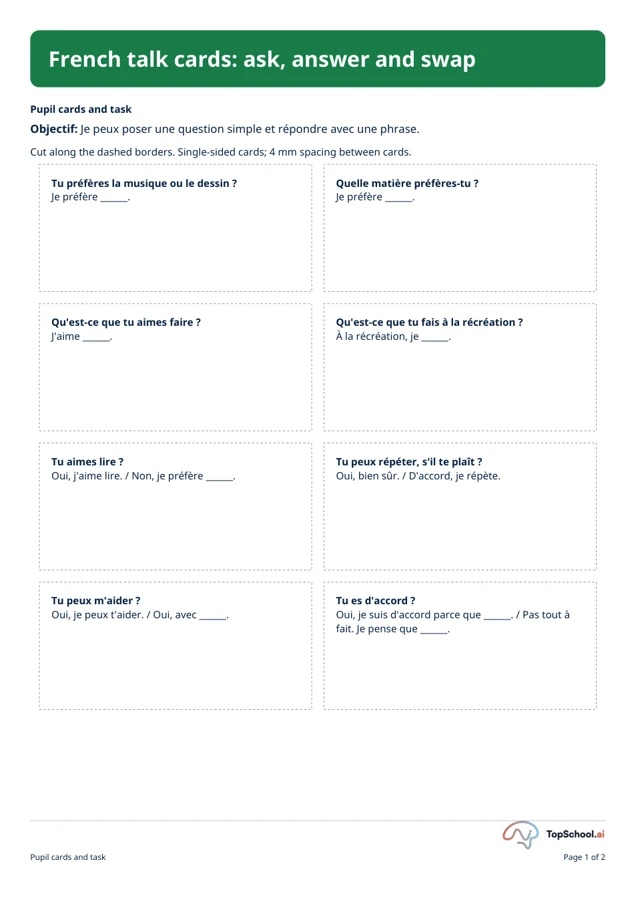
Take a closer look ↗ The teaching purpose Fractions three ways: show, compare and share Start with one fraction representation and ask pupils to explain what it shows. Open the preview ↗ Take a closer look ↗ The teaching purpose French talk cards: ask, answer and swap Begin with one French question-and-answer exchange before swapping partners. Open the preview ↗ Languages and literacy · Cards/display
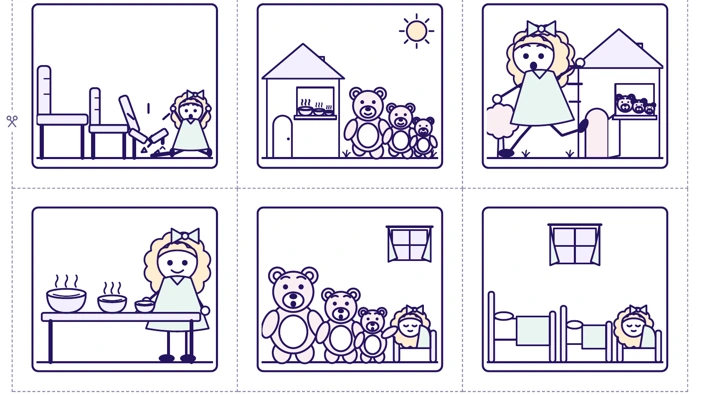
Take a closer look ↗ The teaching purpose Goldilocks cards Choose one Goldilocks card for a short retelling before extending the story. Open the preview ↗ Languages and literacy · Cards/display
Take a closer look ↗ The teaching purpose Instrument cards: meet the orchestra families Use one instrument card to gather an initial classification and reason. Open the preview ↗ Music and performing arts · Cards/display
Take a closer look ↗ The teaching purpose KS4 Science retrieval grid: four topics and a second go Pupils should show recall, calculations and explanations across the four topics, score each row out of ten and identify a topic to revisit. Their second-go record should name a missed question, include a checked answer and capture a useful revision tip. Open the preview ↗ Take a closer look ↗ The teaching purpose Nature vocabulary: six English picture cards Choose one nature picture card to introduce or revisit its English word. Open the preview ↗ Languages and literacy · Cards/display
Take a closer look ↗ The teaching purpose Oral language and conversation cards Choose one conversation prompt and make room for a short spoken response. Open the preview ↗ Languages and literacy · Cards/display
Take a closer look ↗ The teaching purpose Orbit lab: launch and compare Investigate how changing one starting condition affects a simulated planetary path, and use the readout to describe the resulting orbit. Open the preview ↗ Science · Interactive activity
Take a closer look ↗ The teaching purpose Parabola explorer: quadratic and sine graphs Pupils should predict a graph change, vary one coefficient and explain the result using both the equation and a feature. They should recognise linear or constant cases when the quadratic coefficient is zero and check rounded readouts against exact working where appropriate. Open the preview ↗ Maths · Interactive activity
Take a closer look ↗ The teaching purpose Phonics sound cards Say the initial sound for each pictured item and connect that sound with the supplied example words, using clear oral practice with familiar names. Open the preview ↗ Languages and literacy · Cards/display
Take a closer look ↗ The teaching purpose Photosynthesis lab Pupils should predict and explain how changing one input affects this model’s index, including a tie between lowest inputs. They should identify a limiting input without assuming that raising only one of several tied inputs will increase output. Open the preview ↗ Science · Interactive activity
Take a closer look ↗ The teaching purpose Spelling the shun sound Recognise the -tion ending, break a word into parts, spell target words from memory and use them in a sentence. Open the preview ↗ Languages and literacy · Worksheet
Take a closer look ↗ The teaching purpose States of matter: a particle model Pupils should describe how water particles become more separated during boiling while remaining water molecules. They should distinguish temperature change from a phase-change plateau and explain that energy transfer changes intermolecular attractions while temperature and average kinetic energy remain constant on the plateau. Open the preview ↗ Science · Interactive activity
Take a closer look ↗ The teaching purpose Story prompt cards: look, talk, imagine Choose one picture card for an opening conversation before pupils develop their own story. Open the preview ↗ Communication and language · Cards/display
Take a closer look ↗ The teaching purpose Talk it through: discussion and debate cards Choose one discussion card and invite an initial response with a reason. Open the preview ↗ Languages and literacy · Cards/display
Take a closer look ↗ The teaching purpose Tamil letter match and picture cards Begin with one letter-and-picture match before extending the Tamil practice. Open the preview ↗ Languages and literacy · Cards/display
Take a closer look ↗ The teaching purpose The Keeper’s Lantern Read the opening of the story and gather initial ideas before returning to its clues. Open the preview ↗ English reading · Worksheet
Browse all resources in the full Library .
Resource preview Close ×
Bring the question your class will explore. Keep the learning goal clear and give pupils room to show what they think.
Start with PLAI™ Still finding your starting point? Explore a lesson starter, worksheet or teaching visual.
Visit teaching tasks Looking for practice? Find a worksheet to adapt for your class.
Visit worksheets Have an idea to explain? Explore a visual that makes the thinking easier to see.
Visit teaching visuals Rather start with a template? Find a template, read the notes and make it your own.
Visit the Library Your analytics choice May we use analytics cookies to understand which teaching resources are useful? Your choice does not affect access to the Library. You can change it below in Analytics choices.
Read our cookie policy No analytics Allow analytics