
Languages and literacy
French talk cards: ask, answer and swap
Use eight French question cards and a clearly fictional exam-style role-play to practise preferences, school life, clarification and turn-taking with a partner.
Read the material
Use eight French question cards and a clearly fictional exam-style role-play to practise preferences, school life, clarification and turn-taking with a partner.
Pupil cards and task. Use the preview for diagrams and layout.
Page 1
French talk cards: ask, answer and swap
Pupil cards and task
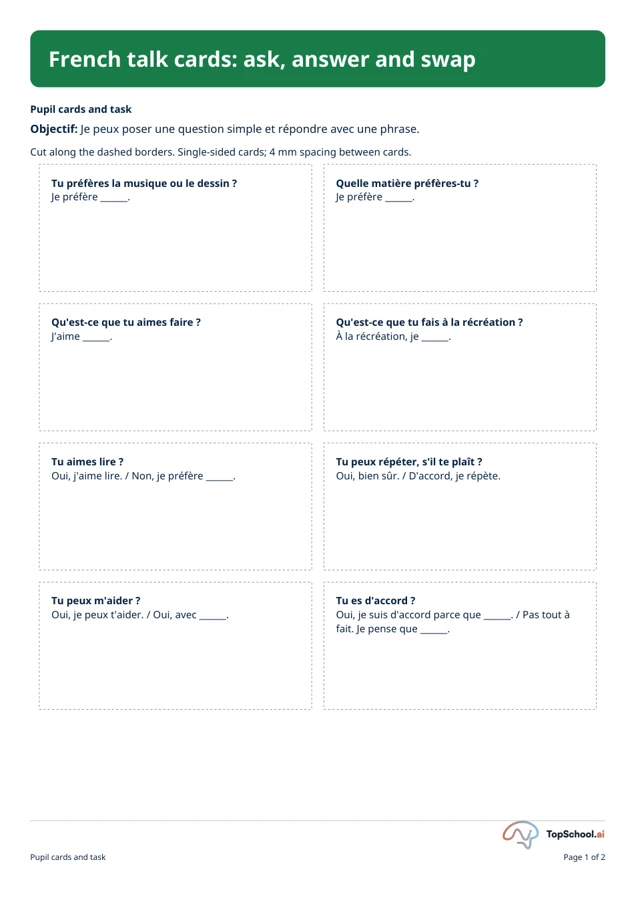
Objectif: Je peux poser une question simple et répondre avec une phrase.
Cut along the dashed borders. Single-sided cards; 4 mm spacing between cards.
Tu préfères la musique ou le dessin ?
Je préfère ______.
Quelle matière préfères-tu ?
Je préfère ______.
Qu'est-ce que tu aimes faire ?
J'aime ______.
Qu'est-ce que tu fais à la récréation ?
À la récréation, je ______.
Tu aimes lire ?
Oui, j'aime lire. / Non, je préfère ______.
Tu peux répéter, s'il te plaît ?
Oui, bien sûr. / D'accord, je répète.
Tu peux m'aider ?
Oui, je peux t'aider. / Oui, avec ______.
Tu es d'accord ?
Oui, je suis d'accord parce que ______. / Pas tout à
fait. Je pense que ______.
Pupil cards and task
Page 1 of 2
Page 2
French talk cards: ask, answer and swap
Ask, answer, swap
1. Partner A asks one question.
2. Partner B answers with a full phrase.
3. Swap roles and try a new card.
Fictional exam-style role-play practice
This is a made-up classroom speaking task, not an official exam or an exam-board format. Choose pretend
answers; do not share private information.
Situation: You and a partner are classmates planning a pretend lunchtime activity. Choose from drawing,
reading or music.
-
Role A: Ask which activity your partner prefers, what they like doing at break and whether they like
reading. Use the question cards.
-
Role B: Answer with fictional details and a full phrase. For example: “Je préfère le dessin.” “À la récréation,
je dessine.” “Oui, j'aime lire.”
-
Swap roles: Ask and answer three questions, then use “Tu peux répéter, s'il te plaît ?” if you need a
question repeated.
Challenge
Join two answers with et or parce que, then ask one follow-up question about your partner’s fictional answer.
Pupil cards and task
Page 2 of 2
Page 1
French talk cards: ask, answer and swap
Teacher key and guidance supporting this exact edition
Teacher check
Listen for a relevant answer and a clear turn exchange. Model the liaison and pronunciation patterns used in
your class.
Teacher companion
Page 1 of 1
A teaching sequence
Ask and answer familiar French questions in a full phrase, take turns and use a clarification request when needed.
Ask and answer a card
Choose a card and read the question to a partner. The partner answers with the starter and may add one detail.
Can your partner answer with the printed starter and one fictional detail?
Swap speaking roles
Swap roles. Both pupils ask and answer at least one card.
Has each partner both asked and answered?
Rehearse the lunchtime exchange
Try the fictional exam-style role-play below. Use the clarification card if a word is unclear, then try the exchange again.
Which clarification phrase helps when a question is unclear?
Before you teach
Look for the thinking behind an answer, choose the support your class needs and leave room for an independent response.
What to look for
Expected exchange: “Quelle matière préfères-tu ?” / “Je préfère les sciences”; “Tu aimes lire ?” / “Oui, j’aime lire.” In the fictional role-play, Role B might answer “Je préfère le dessin” and “À la récréation, je dessine.” Follow up: swap roles, ask a different card and give one relevant full-phrase answer; personal details are not needed.
Give a little support
Keep the answer starter beside each question. Model the pronunciation in chunks and let pupils rehearse quietly or point to a response choice before speaking.
Take the idea further
Join two answers with et or parce que, then ask a follow-up question using the same topic.
Things to keep in mind
The cards practise short spoken turns with rehearsed or fictional answers. Pupils can use a sentence starter and are not asked to share private information.
Keep the idea. Make it yours.
Bring your topic, learning goal and class context to PLAI™, then review what you create.
Ideas to try with your class
Sample teaching perspectives on what to try, what to adapt and what to watch for.
Meet The Creators
Meet a creator whose teaching interests connect with this template.

Chalk Dust & Checklists
The French cards include preferences, activities, break time, reading, asking for repetition or help, and agreeing or disagreeing. The role-play explicitly uses fictional lunchtime details and says not to share private information.
Coffee Before Copies
The two-page routine asks partners to ask, answer and swap, then join two responses with et or parce que. The scenario is expressly made up and not an official exam format.
Clear Example
The clarification card “Tu peux répéter, s’il te plaît?” gives pupils a phrase to use when they miss a question. Fictional answers preserve speaking practice for pupils who do not want to discuss personal preferences.
Tea at Breaktime
Keep the fictional-role-play and privacy note with the cards if they are separated for printing. Confirm French forms and pronunciation with the taught course, and do not describe this practice as exam-board material.