
Languages and literacy
English talk cards for learning together
Practise short English phrases for joining a group, asking for clarification, sharing an idea and responding to a partner.
Read the material
Practise short English phrases for joining a group, asking for clarification, sharing an idea and responding to a partner.
Pupil cards and task. Use the preview for diagrams and layout.
Page 1
English talk cards for learning together
Pupil cards and task
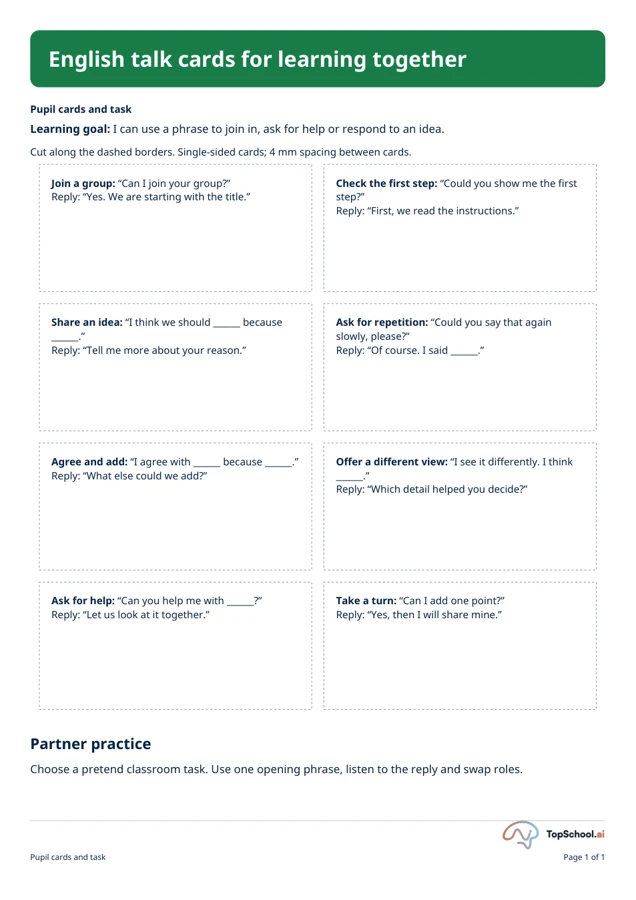
Learning goal: I can use a phrase to join in, ask for help or respond to an idea.
Cut along the dashed borders. Single-sided cards; 4 mm spacing between cards.
Join a group: “Can I join your group?”
Reply: “Yes. We are starting with the title.”
Check the first step: “Could you show me the first
step?”
Reply: “First, we read the instructions.”
Share an idea: “I think we should ______ because
______.”
Reply: “Tell me more about your reason.”
Ask for repetition: “Could you say that again
slowly, please?”
Reply: “Of course. I said ______.”
Agree and add: “I agree with ______ because ______.”
Reply: “What else could we add?”
Offer a different view: “I see it differently. I think
______.”
Reply: “Which detail helped you decide?”
Ask for help: “Can you help me with ______?”
Reply: “Let us look at it together.”
Take a turn: “Can I add one point?”
Reply: “Yes, then I will share mine.”
Partner practice
Choose a pretend classroom task. Use one opening phrase, listen to the reply and swap roles.
Pupil cards and task
Page 1 of 1
Page 1
English talk cards for learning together
Teacher key and guidance supporting this exact edition
Teacher check
Notice whether the phrase helps the speaker enter or continue the task. Invite pupils to choose a card
privately if they do not want to perform for the whole group.
Teacher companion
Page 1 of 1
A teaching sequence
Use a clear English phrase to enter a conversation, ask for clarification and respond to a partner’s idea.
Choose a classroom situation
Choose a situation card: joining a group, checking the first step, sharing an idea or asking for repetition.
Which phrase helps someone join in or ask for repetition?
Practise an opening and reply
Partner A reads or says the opening phrase. Partner B gives a helpful reply.
Does the reply respond helpfully to the request?
Swap and add a reason
Swap roles and add a reason or follow-up question.
Which detail helped you offer a different view?
Try a phrase in a task
Choose one phrase to use in the next classroom task and reflect on whether it helped.
Did the chosen phrase help you communicate what you needed?
Before you teach
Look for the thinking behind an answer, choose the support your class needs and leave room for an independent response.
What to look for
Expected exchange: “Could you show me the first step?” / “First, we read the instructions.” Follow up: swap roles and try “Can I join your group?” / “Yes. We are starting with the title.” Check that the reply gives the partner a useful next turn.
Give a little support
Keep the phrase visible, let pupils rehearse quietly first and offer two response choices. A pupil can point to a card before saying it.
Take the idea further
Ask pupils to paraphrase a partner’s idea before adding their own: “I heard you say… I would add…”
Things to keep in mind
The cards practise English classroom talk. Pupils may rehearse or read a phrase aloud, and should not be asked to disclose personal experiences.
Keep the idea. Make it yours.
Bring your topic, learning goal and class context to PLAI™, then review what you create.
Ideas to try with your class
Sample teaching perspectives on what to try, what to adapt and what to watch for.
Meet The Creators
Meet a creator whose teaching interests connect with this template.

Organised Pile
The EAL card set models requests for joining a group, checking the first step, sharing an idea and asking for repetition or clarification. Each request has a sample partner reply.
The Curious Pencil
The paired examples let pupils practise both entering a conversation and responding to someone else. Phrases such as asking for the first step support participation in a task without replacing the task instructions.
Tea at Breaktime
Rehearse one request and its reply before group work, then leave the cards available as a reference. Accept a pupil's own clear phrase alongside the printed sentence starter.
Chalk & Chai
The examples are prompts, not rules for every classroom interaction. Ensure the group responds respectfully and that asking for help leads to an actual explanation.