
Science
KS4 Science retrieval grid: four topics and a second go
Recall and apply science knowledge across cells, solutions, speed and measurements, then return to missed questions. Four pupil pages include a first-attempt grid, a second-go table and spaces for a new grid. The companion gives a 40-mark key and criteria for reviewing newly written questions.
Read the material
Recall and apply science knowledge across cells, solutions, speed and measurements, then return to missed questions. Four pupil pages include a first-attempt grid, a second-go table and spaces for a new grid. The companion gives a 40-mark key and criteria for reviewing newly written questions.
Pupil worksheet. Use the preview for diagrams and layout.
Page 1
KS4 Science retrieval grid: four topics and a second go
Pupil activity
Audience: Years 9 to 11 Science pupils
Recall and apply methods from four Science topics, score each row out of ten and use a second attempt to choose a revision target.
KS4 Science retrieval grid: first attempt
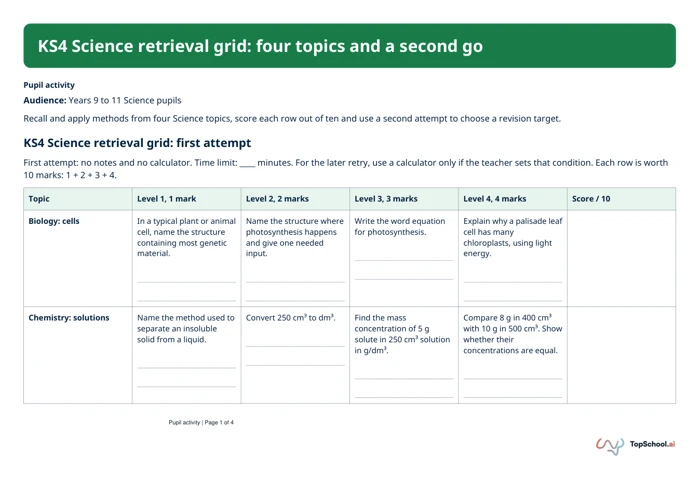
First attempt: no notes and no calculator. Time limit: ____ minutes. For the later retry, use a calculator only if the teacher sets that condition. Each row is worth
10 marks: 1 + 2 + 3 + 4.
Topic
Level 1, 1 mark
Level 2, 2 marks
Level 3, 3 marks
Level 4, 4 marks
Score / 10
Biology: cells
In a typical plant or animal
cell, name the structure
containing most genetic
material.
Name the structure where
photosynthesis happens
and give one needed
input.
Write the word equation
for photosynthesis.
Explain why a palisade leaf
cell has many
chloroplasts, using light
energy.
Chemistry: solutions
Name the method used to
separate an insoluble
solid from a liquid.
Convert 250 cm³ to dm³.
Find the mass
concentration of 5 g
solute in 250 cm³ solution
in g/dm³.
Compare 8 g in 400 cm³
with 10 g in 500 cm³. Show
whether their
concentrations are equal.
Pupil activity | Page 1 of 4
Page 2
KS4 Science retrieval grid: four topics and a second go
Topic
Level 1, 1 mark
Level 2, 2 marks
Level 3, 3 marks
Level 4, 4 marks
Score / 10
Physics: speed
Write the equation linking
speed, distance and time.
Substitute distance 150 m
and time 12 s into the
equation.
Calculate the speed, with
a unit.
Calculate the distance
travelled at 12.5 m/s for
20 s, showing equation
and unit.
Working scientifically:
measurements
Name an instrument for
measuring temperature.
Find the mean of 10 °C, 12
°C and 11 °C.
Four times are 12 s, 16 s,
14 s and 18 s. Find the
mean.
Explain how repeated
measurements help spot
an anomalous result and
judge whether results are
consistent.
Score: biology __ / 10; chemistry __ / 10; physics __ / 10; measurements __ / 10. Total __ / 40. Topic to revisit first: ________
Pupil activity | Page 2 of 4
Page 3
KS4 Science retrieval grid: four topics and a second go
Second go
Question code missed
Second attempt
Answer checked
Tip to remember
Build a new grid
Choose four topics from the current Science unit. Write one 1-mark, one 2-mark, one 3-mark and one 4-mark retrieval question for each. Score each topic out of
ten.
Topic
1 mark
2 marks
3 marks
4 marks
Pupil activity | Page 3 of 4
Page 4
KS4 Science retrieval grid: four topics and a second go
Topic
1 mark
2 marks
3 marks
4 marks
Pupil activity | Page 4 of 4
Page 1
Teacher companion
KS4 Science retrieval grid: four topics and a
second go
Biology, 10 marks
Q1 nucleus (1). Q2 chloroplast (1) and one appropriate input, light/carbon dioxide/water (1). Q3 word
equation: carbon dioxide + water → glucose + oxygen. Award both correct reactants together (1), both
correct products together (1), correct direction/arrow (1): exactly3marks. Q4 near upper surface (1), many
chloroplasts linked to more chlorophyll (1), light absorption (1), use of light energy in photosynthesis (1).
Chemistry, 10 marks
Q1 filtration (1). Q2 1dm³=1000cm³ (1),250cm³=0.25dm³ (1). Q3 concentration=mass/volume (1),5/0.25
(1),20g/dm³ (1). Q4 both conversions0.4/0.5dm³ (1),8/0.4=20 (1),10/0.5=20 (1),equal concentrations (1).
Physics, 10 marks
Q1 speed=distance/time (1). Q2 identify150m and12s (1),150/12 (1). Q3 method (1),12.5 (1),m/s (1). Q4
distance=speed×time (1),12.5×20 (1),250 (1),m (1).
Measurements, 10 marks
Q1 thermometer (1). Q2 total33 (1),mean11°C (1). Q3 total60 (1),divide4 (1),15s (1). Q4 repeating
(1),comparing readings (1),spotting a possible anomaly (1),judging consistency without claiming accuracy
proven (1).
Retry and total
Each topic1+2+3+4=10. Four topics total40. Pupil second-go table records missed code, second attempt,
checked answer and tip. New-grid task follows the same1/2/3/4mark structure; educator verifies each newly
written question and answer. Calculator/time conditions are set by the teacher.
Teacher companion | Page 1 of 1
A teaching sequence
Pupils should show recall, calculations and explanations across the four topics, score each row out of ten and identify a topic to revisit. Their second-go record should name a missed question, include a checked answer and capture a useful revision tip.
Retrieve with working and units
Complete the first grid without notes or calculator, recording working and units where required. Ask pupils to leave a trace of their method rather than only a numerical answer.
Which written method supports your numerical answer?
Score and locate the difficulty
Use the companion’s marking points to score each topic out of ten and total out of 40. Identify the missed question codes and distinguish a knowledge gap from a calculation or unit error.
Was the missed point a knowledge, calculation or unit error?
Try again with a specific tip
Choose a topic to revisit and complete the second-go table under the agreed retry conditions. Check the new answer and write a specific tip linked to the original difficulty.
What corrected step addresses the original difficulty?
Build a checked science grid
Build a grid for four current science topics using the same mark progression. Have the educator verify each question, answer and allocation before using the new grid with others.
Has the educator verified each new question, answer and mark allocation?
Before you teach
Look for the thinking behind an answer, choose the support your class needs and leave room for an independent response.
What to look for
Useful checked answers include 0.25 dm³ for 250 cm³, 20 g/dm³ for 5 g in that volume, and 12.5 m/s for 150 m in 12 s. If a pupil says repeats prove accuracy, ask what comparing readings actually shows: consistency and possible anomalies, while accuracy still needs further evidence.
Give a little support
After the first attempt, choose one missed method and rehearse it step by step. For concentration, convert the volume before division; for speed, identify distance and time with units. Record that method as a short retry tip while keeping the first-attempt answer available for comparison.
Take the idea further
Write a pair of questions that test the same concept at different mark levels and provide a marking guide for each. Ask a partner what extra reasoning earns the additional marks, then revise any question whose demand or answer does not match its allocation before educator review.
Things to keep in mind
The teacher checks new questions and answers. A retrieval score is a record for revision, not proof of wider learning outcomes.
Keep the idea. Make it yours.
Bring your topic, learning goal and class context to PLAI™, then review what you create.
Ideas to try with your class
Sample teaching perspectives on what to try, what to adapt and what to watch for.
Meet The Creators
Meet a creator whose teaching interests connect with this template.
Good Question
The four-page science grid for Years 9 to 11 asks pupils to complete a first attempt without notes or calculator, with each topic row worth ten marks. A later retry records a missed question, checked answer and useful revision tip.
Glue Stick Club
The first attempt samples recall and application across four science topics; the second go gives pupils a structured way to revisit a specific gap. The stated point pattern, 1+2+3+4, makes each row's scoring visible.
Chalk & Chai
Set the first-attempt conditions with the teacher, then use the answer check to choose one missed question for the retry. Use a calculator on the later attempt only if the teacher sets that condition.
Kindly Red Pen
The time limit and calculator conditions should be set by the teacher, not assumed. One grid samples selected topics and does not establish secure KS4 science knowledge overall.