
Communication and language
Story prompt cards: look, talk, imagine
Start with something a child notices. Let one illustrated scene become a conversation, then a story of their own.
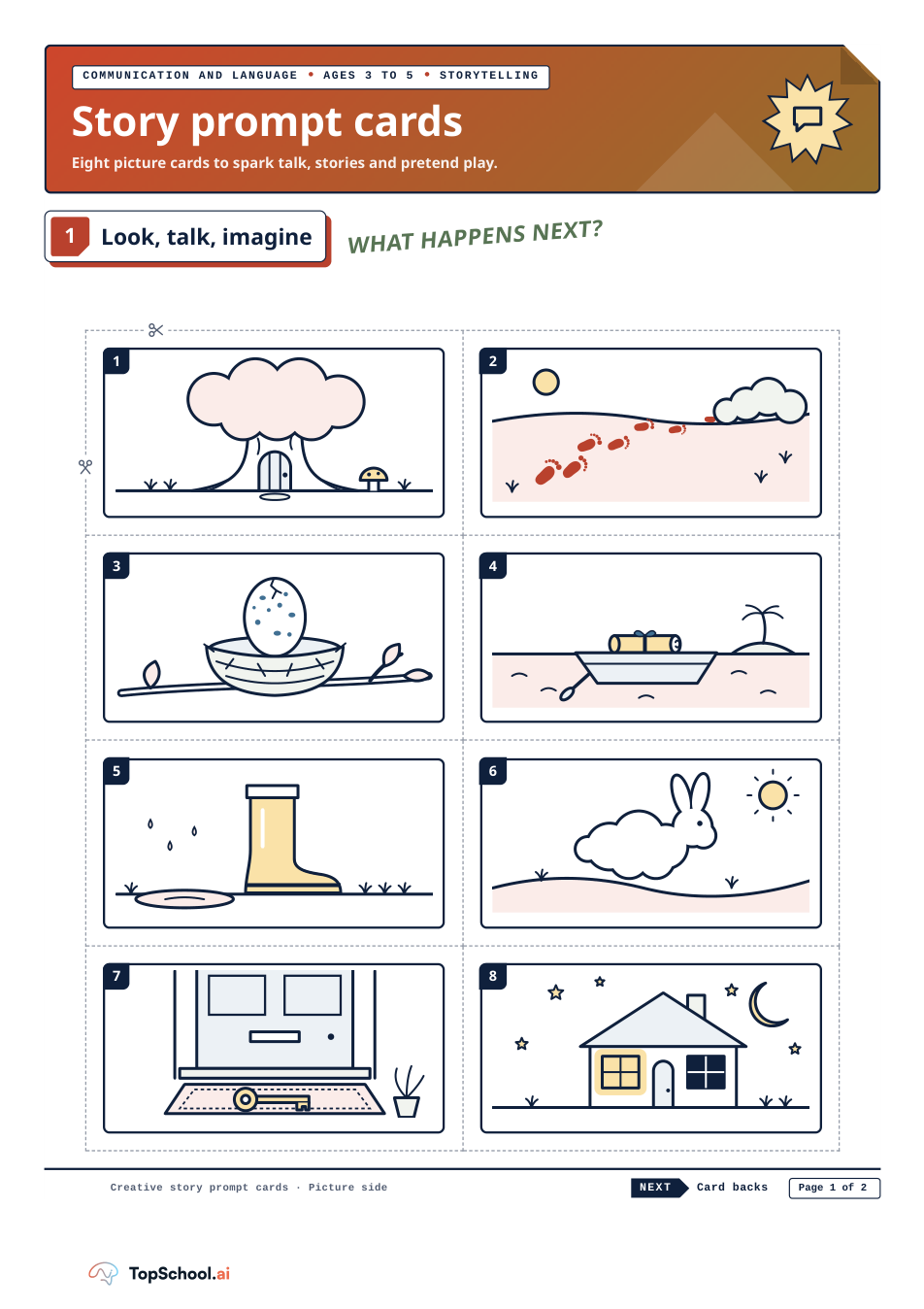
A little door. A big possibility.
Notice first. Imagine next.
Read the material
Use eight illustrated scenes to invite young children to notice details, imagine what might happen and practise descriptive language. The A4 set pairs illustrated scenes with adult questions and word prompts, with instructions for double-sided printing or joining the backs by hand.
Shared activity record. Use the preview for diagrams and layout.
Page 1
Look, talk, imagine
Creative story prompt cards · Picture side
Card backs
COMMUNICATION AND LANGUAGE
AGES 3 TO 5
STORYTELLING
Story prompt cards
Eight picture cards to spark talk, stories and pretend play.
1
WHAT HAPPENS NEXT?
NEXT
1
2
3
4
5
6
7
8
Page 1 of 2
Page 2
Print this page on the back of page 1 (double-sided, flip on long edge). The backs are mirrored on purpose:
card 1 sits top right here, so it lands behind picture 1. Or cut both pages and glue each back to the picture with
the same number.
Creative story prompt cards · Talk side
Adult guide
ADULT SIDE
STORY PROMPT CARDS
Card backs: questions to ask
The footprint trail
?
Who made these footprints?
?
Where do they lead?
?
How does the walker feel?
WORDS TO MODEL
trail
follow
tiptoe
far away
The little door
?
Who lives behind the door?
?
What happens when it opens?
?
How does the visitor feel?
WORDS TO MODEL
tiny
knock
creak
roots
The boat and the map
?
Who owns this boat?
?
Where does the map lead?
?
How do they feel at sea?
WORDS TO MODEL
row
island
treasure
waves
The big egg
?
Who is inside the egg?
?
What happens when it cracks?
?
How does the baby feel?
WORDS TO MODEL
speckled
nest
crack
hatch
The animal cloud
?
What animal can you see?
?
Where is the cloud going?
?
How does it feel up high?
WORDS TO MODEL
fluffy
float
sky
shape
The lost boot
?
Whose boot is this?
?
Where is the other boot?
?
How does the owner feel?
WORDS TO MODEL
puddle
splash
lost
muddy
The glowing window
?
Who is in the house?
?
What are they doing so late?
?
How do they feel at night?
WORDS TO MODEL
glow
dark
cosy
moon
The key on the mat
?
Who dropped the key?
?
What does the key open?
?
How do they feel now?
WORDS TO MODEL
shiny
lock
unlock
secret
NEXT
2
1
4
3
6
5
8
7
Page 2 of 2
Page 1
Story prompt cards: look, talk, imagine
Teacher companion
Cross-curricular | Children aged 3 to 5 with an adult
Use with the exact 2-page original file. Keep pupil or staff activity pages separate from this teacher companion.
When to use it
Use the cards for an adult-supported conversation or storytelling moment with children aged 3
to 5. Print both pages as a pair and check their alignment before cutting; the adult prompts
are invitations, not questions every child must answer.
Purpose
Describe an illustrated scene, practise new vocabulary and invent a spoken story about what
may happen next.
Start here
Show one illustrated card and ask the child what they notice before turning to the matching
adult question card.
A teaching sequence
1. Choose one of the eight numbered illustrations and talk about what is visible before
imagining a story.
2. Turn to the same-numbered back and choose a question about who, where, what happens
or how a character feels.
3. Offer one or two words from its word bank and invite the child to use or change them.
4. Ask “What happens next?” and let the child add an event, character or ending of their own.
Ask, “What might they find next?” Follow the child’s idea and notice which pictured detail
shaped it.
Checking guidance
Notice whether the child names a visible detail, adds an imagined event and uses language in
a meaningful way. Ask a follow-up that keeps the story open, such as “What might they find
next?” Do not treat one vocabulary response or story as a language assessment on its own.
An adult can start with “What can you see?” then “What happens next?” Keep the child’s own
event or ending, even when it differs from the adult’s first idea. There is no fixed story answer.
Support
Use one card, allow pointing or gesture as a response and offer the matching word bank
without requiring repetition. Follow the child’s lead, shorten the questions and accept a home
language or other communication method where appropriate.
Take it further
Invite the child to choose two cards and connect them into a longer story with a beginning,
change and ending. They can draw a new card or invent a different question for one scene.
Things to keep in mind
The adult-facing questions are open prompts and should be adapted to each child. Check
alignment if printing the illustrations and prompts double-sided.
Story prompt cards: look, talk, imagine
Teacher companion | Page 1
A teaching sequence
Describe an illustrated scene, practise new vocabulary and invent a spoken story about what may happen next.
A little door. A big possibility.
Notice first. Imagine next.
Look closely
Show one illustrated card. Ask what the child notices before turning to the matching adult prompt.
What can you see?
tiny · knock · creak · roots
Words to offer, with room for the child’s own.
Make room for talk
Choose a question from the matching back. Offer one or two words without requiring the child to repeat them.
Who lives behind the little door?
What happens next?
Follow the child’s idea. There is no fixed story answer.
Follow the imagination
Ask what happens next. Keep the child’s event or ending, and notice which pictured detail shaped it.
What might they find next?
Before you teach
Look for the thinking behind an answer, choose the support your class needs and leave room for an independent response.
What to look for
Notice whether the child names a visible detail, adds an imagined event and uses language in a meaningful way. Ask a follow-up that keeps the story open, such as “What might they find next?” Do not treat one vocabulary response or story as a language assessment on its own. An adult can start with “What can you see?” then “What happens next?” Keep the child’s own event or ending, even when it differs from the adult’s first idea. There is no fixed story answer.
Give a little support
Use one card, allow pointing or gesture as a response and offer the matching word bank without requiring repetition. Follow the child’s lead, shorten the questions and accept a home language or other communication method where appropriate.
Take the idea further
Invite the child to choose two cards and connect them into a longer story with a beginning, change and ending. They can draw a new card or invent a different question for one scene.
Things to keep in mind
The adult-facing questions are open prompts and should be adapted to each child. Check alignment if printing the illustrations and prompts double-sided.
Keep the idea. Make it yours.
Bring your topic, learning goal and class context to PLAI™, then review what you create.
Another starting point
Explore a different teaching task from this selection.
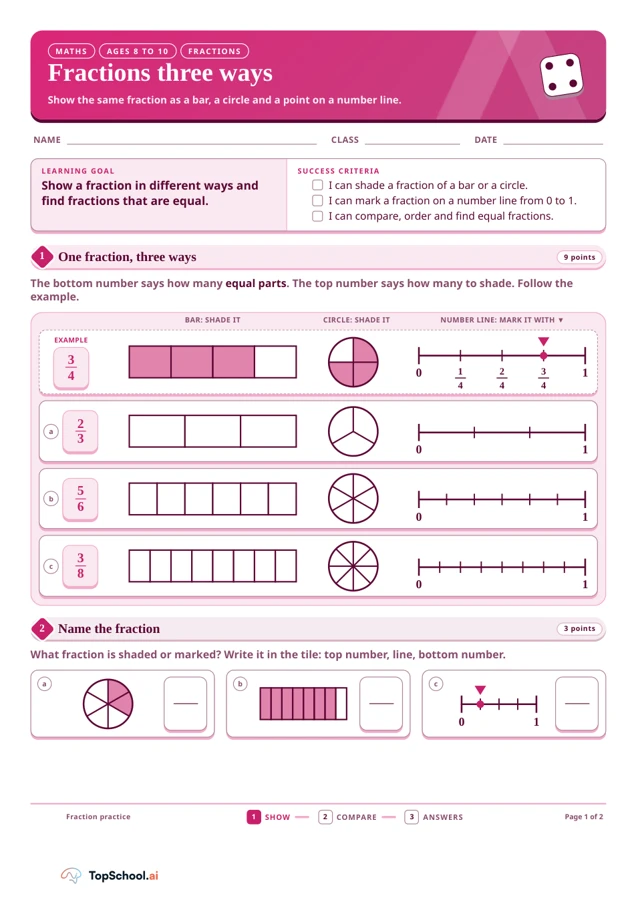
Fractions three ways
Show the same fraction three ways. Use equal wholes to compare values and explain your thinking.
Explore resource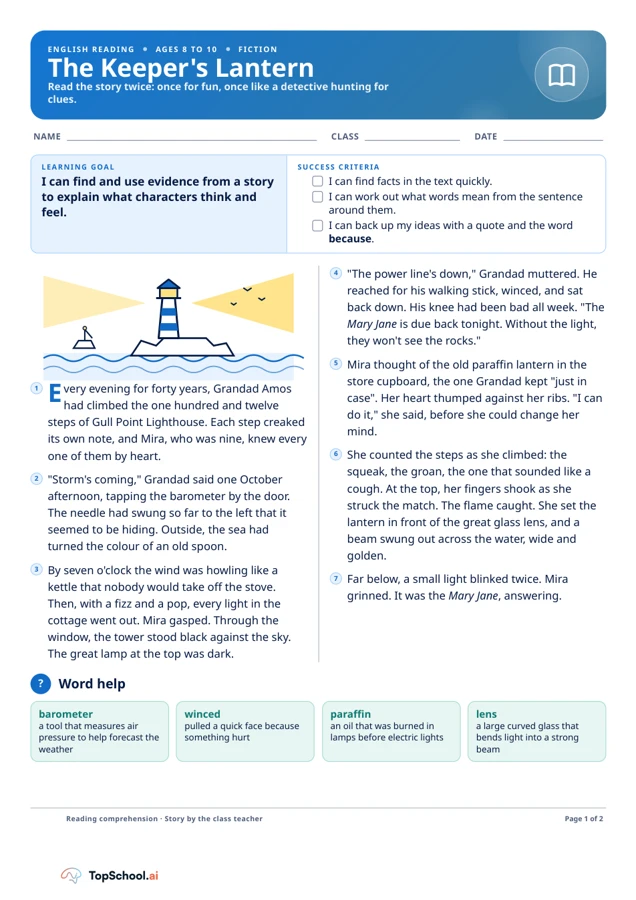
The Keeper’s Lantern
Read the lighthouse story, find a clue and use a quotation with “because” to explain your answer.
Explore resourceIdeas for using this resource
Sample teaching perspectives on what to try, what to adapt and what to watch for.
Meet The Creators
Meet a creator whose teaching interests connect with this template.
Glue Stick Club
Eight picture cards pair scenes such as footprints, a little door, a boat and map, or a large egg with adult-side questions and model vocabulary. The number labels show which mirrored card back belongs behind each image.
Little Lightbulbs
For ages 3 to 5, the prompts invite description, pretend play and a possible next event, with three short questions per scene. The adult words (“tiptoe”, “creak” or “speckled”) offer language to model during the conversation.
Pocketful of Stories
An adult can choose one question and wait for a child’s description before introducing more vocabulary. The cards support spoken storytelling without requiring a child to produce a complete written story.
Tea at Breaktime
Print the back page double-sided, flipping on the long edge, or glue same-numbered fronts and backs; the mirrored layout is intentional. Check card alignment before cutting so the adult prompts stay matched to the pictures.