
Maths
Topic retrieval grid
Recall methods from number, algebra, geometry and statistics, score the attempt and identify what to revise. A second page invites pupils to retry selected questions and create a fresh grid for later practice. Use it after checking the questions.
Read the material
Recall methods from number, algebra, geometry and statistics, score the attempt and identify what to revise. A second page invites pupils to retry selected questions and create a fresh grid for later practice. Use it after checking the questions.
Activity. Use the preview for diagrams and layout.
Page 1
NAME
CLASS
DATE
LEARNING GOAL
Recall key methods from four
maths topics, from memory.
SUCCESS CRITERIA
I can recall methods from four topics.
I can show working for each step.
I can use my scores to plan revision.
1
The retrieval grid
40 points
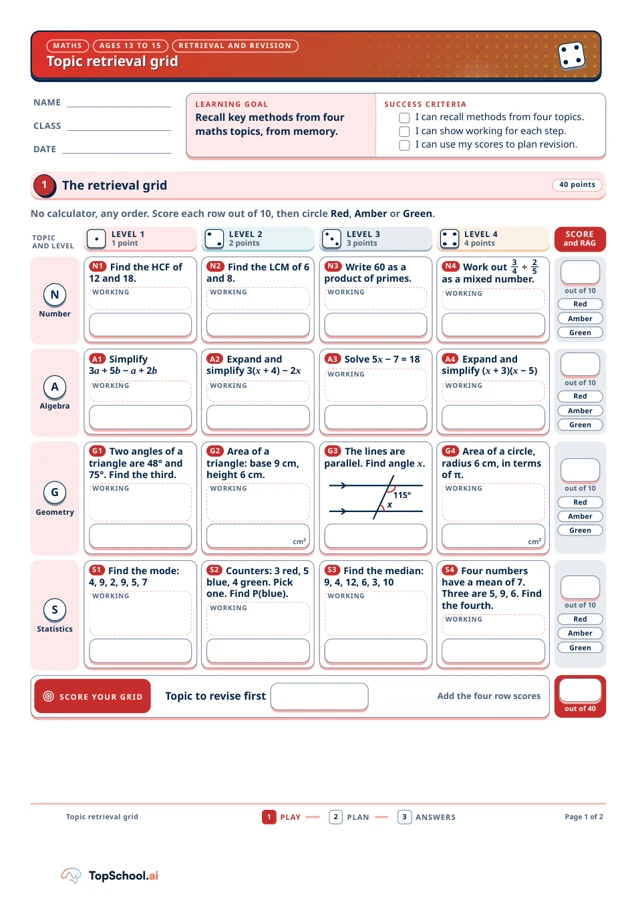
No calculator, any order. Score each row out of 10, then circle Red, Amber or Green.
TOPIC
AND LEVEL
LEVEL 1
1 point
LEVEL 2
2 points
LEVEL 3
3 points
LEVEL 4
4 points
SCORE
and RAG
N
Number
N1 Find the HCF of
12 and 18.
WORKING
N2 Find the LCM of 6
and 8.
WORKING
N3 Write 60 as a
product of primes.
WORKING
N4 Work out 3
4 ÷ 2
5
as a mixed number.
WORKING
out of 10
Red
Amber
Green
A
Algebra
A1 Simplify
3a + 5b − a + 2b
WORKING
A2 Expand and
simplify 3(x + 4) − 2x
WORKING
A3 Solve 5x − 7 = 18
WORKING
A4 Expand and
simplify (x + 3)(x − 5)
WORKING
out of 10
Red
Amber
Green
G
Geometry
G1 Two angles of a
triangle are 48° and
75°. Find the third.
WORKING
G2 Area of a
triangle: base 9 cm,
height 6 cm.
WORKING
G3 The lines are
parallel. Find angle x.
115°
x
G4 Area of a circle,
radius 6 cm, in terms
of π.
WORKING
out of 10
Red
Amber
Green
S
Statistics
S1 Find the mode:
4, 9, 2, 9, 5, 7
WORKING
S2 Counters: 3 red, 5
blue, 4 green. Pick
one. Find P(blue).
WORKING
S3 Find the median:
9, 4, 12, 6, 3, 10
WORKING
S4 Four numbers
have a mean of 7.
Three are 5, 9, 6. Find
the fourth.
WORKING
out of 10
Red
Amber
Green
SCORE YOUR GRID
Topic to revise first
Add the four row scores
out of 40
Topic retrieval grid
1
PLAY
2
PLAN
3
ANSWERS
MATHS
AGES 13 TO 15
RETRIEVAL AND REVISION
Topic retrieval grid
Topic retrieval grid
cm²
cm²
Page 1 of 2
Page 2
2
Second go
Fix two squares
Pick two squares you missed. Write the code, try again, then write a tip to remember.
SQUARE
SECOND TRY
ANSWER
MY TIP
SQUARE
SECOND TRY
ANSWER
MY TIP
3
Build your own grid
40 points
Write four topics, then one question in each square: harder as the levels climb. Swap with a partner and play.
TOPIC
AND LEVEL
LEVEL 1
1 point
LEVEL 2
2 points
LEVEL 3
3 points
LEVEL 4
4 points
SCORE
and RAG
1
TOPIC
out of 10
Red
Amber
Green
2
TOPIC
out of 10
Red
Amber
Green
3
TOPIC
out of 10
Red
Amber
Green
4
TOPIC
out of 10
Red
Amber
Green
SCORE YOUR GRID
Topic to revise first
Add the four row scores
out of 40
Topic retrieval grid
1
PLAY
2
PLAN
3
ANSWERS
MATHS
AGES 13 TO 15
REVISION PLAN
Second go and your own grid
Second go and your own grid
WORKING
1.1
WORKING
1.2
WORKING
1.3
WORKING
1.4
WORKING
2.1
WORKING
2.2
WORKING
2.3
WORKING
2.4
WORKING
3.1
WORKING
3.2
WORKING
3.3
WORKING
3.4
WORKING
4.1
WORKING
4.2
WORKING
4.3
WORKING
4.4
Page 2 of 2
Page 1
Topic retrieval grid
Teacher companion
Mathematics | Pupils aged 13 to 15
Use with the exact 2-page original file. Keep pupil or staff activity pages separate from this teacher companion.
When to use it
Use the grid after pupils have studied the included methods and can attempt short problems
independently. It can serve as a low-stakes retrieval activity followed by a focused revision
choice, provided a teacher checks the questions and scoring guidance first.
Purpose
Recall and show working for selected methods across four mathematics topics, then use
errors and confidence ratings to choose a next revision step.
Start here
Review every question and prepare checked answers before pupils begin. Explain the four
difficulty levels, the ten-points-per-topic scoring and the red, amber or green self-rating;
pupils may attempt questions in any order.
A teaching sequence
1. Attempt the number, algebra, geometry and statistics rows without a calculator, showing
enough working to follow each method.
2. Score each topic out of ten using the agreed marking guidance and circle a confidence
colour that reflects current understanding.
3. Choose two missed questions, retry them and add a short tip that could help next time.
4. Build a new four-topic grid with questions that match taught content, increasing challenge
across its four levels; use the scores to name a topic for revision and revisit it after practice.
Checking guidance
Number N1-N4: 6; 24; 2² x 3 x 5; 15/8 = 1 7/8. Algebra A1-A4: 2a + 7b; x + 12; x = 5; x² - 2x -
15.
Geometry G1-G4: 57°; 27 cm²; 65° (the two marked interior angles on the same side sum to
180°); 36π cm². Statistics S1-S4: 9; 5/12; 7.5; 8.
Each row has 1 + 2 + 3 + 4 = 10 points, total 40. Agree method-credit rules before pupils
score. Page 2’s blank questions require a separately checked key after the questions are
written.
Support
Reduce the number of questions at first, provide a formula or vocabulary reminder where
appropriate and model how to show one complete method. Allow extra time or an accessible
response format.
Take it further
Ask pupils to write a question that exposes a common misconception, solve it in two ways or
explain why a tempting incorrect answer fails. Have them compare methods and identify
which is most efficient for this example.
Things to keep in mind
The key covers the fixed original questions only. A pupil- or teacher-written grid needs its own
checked key. Review notation, diagrams, difficulty and scoring against taught content; one
activity is not a complete attainment measure.
Topic retrieval grid
Teacher companion | Page 1
A teaching sequence
Recall and show working for selected methods across four mathematics topics, then use errors and confidence ratings to choose a next revision step.
Attempt four topics with working
Attempt the number, algebra, geometry and statistics rows without a calculator, showing enough working to follow each method.
Which method can be followed in your number, algebra, geometry or statistics response?
Use the checked key and topic scores
Score each topic out of ten using the agreed marking guidance and circle a confidence colour that reflects current understanding.
Does the marking guidance apply to these fixed original questions?
Retry two missed squares and add a tip
Choose two missed questions, retry them and add a short tip that could help next time.
Which error or method does the tip address?
Build a taught-content grid and revisit
Build a new four-topic grid with questions that match taught content, increasing challenge across its four levels; use the scores to name a topic for revision and revisit it after practice.
Who will check the new questions and their separate answer key?
Before you teach
Look for the thinking behind an answer, choose the support your class needs and leave room for an independent response.
What to look for
Number N1-N4: 6; 24; 2² x 3 x 5; 15/8 = 1 7/8. Algebra A1-A4: 2a + 7b; x + 12; x = 5; x² - 2x - 15. Geometry G1-G4: 57°; 27 cm²; 65° (the two marked interior angles on the same side sum to 180°); 36π cm². Statistics S1-S4: 9; 5/12; 7.5; 8. Each row has 1 + 2 + 3 + 4 = 10 points, total 40. Agree method-credit rules before pupils score. Page 2’s blank questions require a separately checked key after the questions are written.
Give a little support
Reduce the number of questions at first, provide a formula or vocabulary reminder where appropriate and model how to show one complete method. Allow extra time or an accessible response format.
Take the idea further
Ask pupils to write a question that exposes a common misconception, solve it in two ways or explain why a tempting incorrect answer fails. Have them compare methods and identify which is most efficient for this example.
Things to keep in mind
The key covers the fixed original questions only. A pupil- or teacher-written grid needs its own checked key. Review notation, diagrams, difficulty and scoring against taught content; one activity is not a complete attainment measure.
Keep the idea. Make it yours.
Bring your topic, learning goal and class context to PLAI™, then review what you create.
Ideas to try with your class
Sample teaching perspectives on what to try, what to adapt and what to watch for.
Meet The Creators
Meet the creators whose teaching interests connect with this template. Find an approach to try with your class.

Hollie Braithwaite
Revision is more useful when it responds to a specific gap pupils have shown, rather than covering a broad topic simply because it appears in a generic pack.
Meet the creator
Idris Rahman
Keeping a class in my week matters when I discuss assessment workload or how a timetable decision affects teaching; those choices have to work inside real lessons.
Meet the creator
Vikram Sethi
I use diagnostic Mathematics questions to locate a specific misconception before choosing a worked example, keeping assessment precise enough to guide the next teaching step and review.
Meet the creator
Tom Ridgway
I run Cornbrook events for pupils in every year group, so participation has to be possible beyond the students who are already confident about joining in.
Meet the creator
Calm Table
This two-page mathematics grid contains four topics and a 40-point retrieval task, with no calculator and questions of increasing point value. Pupils show working, score each row out of ten, mark confidence and plan revision.
Kind Check-In
The grid samples methods across number, algebra and other stated topic areas rather than one narrow skill. Showing working lets pupils and teachers identify where a method broke down.
Board Eraser
Agree the no-calculator condition, then let pupils attempt topics in any order as instructed. Review errors by method and use red, amber or green to choose a specific next practice task.
Glue Stick Club
One 40-point retrieval attempt is a snapshot of selected questions, not a complete measure of mathematics knowledge. Check the answer key and topic coverage before using the score to plan revision.