
Maths
Do now fluency grid: practise across the week
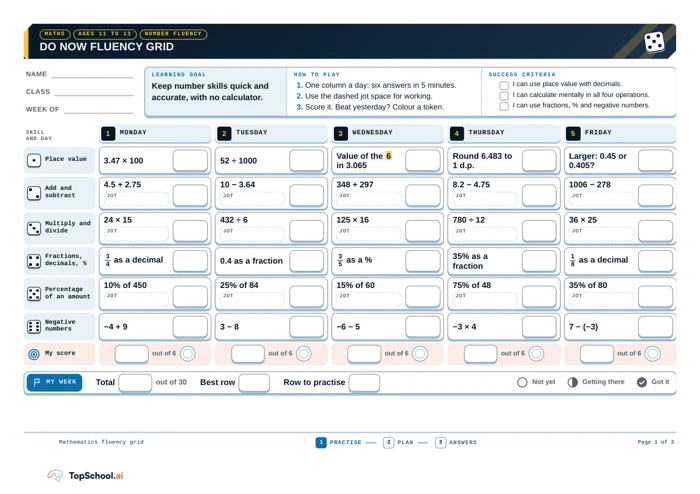
Practise number fluency in short daily rounds, completing one question from each of six skill rows in the day’s column. The five-day board covers place value, operations, fractions, percentages and negative numbers; a second board lets a teacher prepare a new set.
Read the material
Practise number fluency in short daily rounds, completing one question from each of six skill rows in the day’s column. The five-day board covers place value, operations, fractions, percentages and negative numbers; a second board lets a teacher prepare a new set.
Shared activity record. Use the preview for diagrams and layout.
Page 1
NAME
CLASS
WEEK OF
LEARNING GOAL
Keep number skills quick and
accurate, with no calculator.
HOW TO PLAY
1. One column a day: six answers in 5 minutes.
2. Use the dashed jot space for working.
3. Score it. Beat yesterday? Colour a token.
SUCCESS CRITERIA
I can use place value with decimals.
I can calculate mentally in all four operations.
I can use fractions, % and negative numbers.
SKILL
AND DAY
1
MONDAY
2
TUESDAY
3
WEDNESDAY
4
THURSDAY
5
FRIDAY
Place value
Add and
subtract
Multiply and
divide
Fractions,
decimals, %
Percentage
of an amount
Negative
numbers
My score
out of 6
out of 6
out of 6
out of 6
out of 6
MY WEEK
Total
out of 30
Best row
Row to practise
Not yet
Getting there
Got it
Mathematics fluency grid
1
PRACTISE
2
PLAN
3
ANSWERS
MATHS
AGES 11 TO 13
NUMBER FLUENCY
DO NOW FLUENCY GRID
3.47 × 100
52 ÷ 1000
Value of the 6
in 3.065
Round 6.483 to
1 d.p.
Larger: 0.45 or
0.405?
4.5 + 2.75
JOT
10 − 3.64
JOT
348 + 297
JOT
8.2 − 4.75
JOT
1006 − 278
JOT
24 × 15
JOT
432 ÷ 6
JOT
125 × 16
JOT
780 ÷ 12
JOT
36 × 25
JOT
3
4 as a decimal
0.4 as a fraction
3
5 as a %
35% as a
fraction
1
8 as a decimal
10% of 450
JOT
25% of 84
JOT
15% of 60
JOT
75% of 48
JOT
35% of 80
JOT
−4 + 9
3 − 8
−6 − 5
−3 × 4
7 − (−3)
Page 1 of 2
Page 2
NAME
CLASS
WEEK OF
LEARNING GOAL
HOW TO PLAY
1. One column a day: six answers in 5 minutes.
2. Use the dashed jot space for working.
3. Score it. Beat yesterday? Colour a token.
TEACHER: FILL THE BOARD
Write one question in each square, keeping one
skill per row. Copy the board for your class.
SKILL
AND DAY
1
MONDAY
2
TUESDAY
3
WEDNESDAY
4
THURSDAY
5
FRIDAY
Place value
Add and
subtract
Multiply and
divide
Fractions,
decimals, %
Percentage
of an amount
Negative
numbers
My score
out of 6
out of 6
out of 6
out of 6
out of 6
MY WEEK
Total
out of 30
Best row
Row to practise
Not yet
Getting there
Got it
Mathematics fluency grid
1
PRACTISE
2
PLAN
3
ANSWERS
MATHS
AGES 11 TO 13
BLANK BOARD
DO NOW FLUENCY GRID: YOUR OWN BOARD
JOT
JOT
JOT
JOT
JOT
JOT
JOT
JOT
JOT
JOT
JOT
JOT
JOT
JOT
JOT
Page 2 of 2
Page 1
Do now fluency grid: practise across the week
Teacher companion
Mathematics | Pupils aged 11 to 13 and teachers
Use with the exact 2-page original file. Keep pupil or staff activity pages separate from this teacher companion.
When to use it
Use as brief retrieval practice after pupils have learned the methods. Choose a suitable
question column for each day, allow the stated working time and provide an answer source
before pupils score their work.
Purpose
Practise a range of number calculations accurately and notice which skill needs more practice.
Start here
Read the five-day routine and use the jot space to show working where helpful.
A teaching sequence
1. Complete one day’s column of six questions in about five minutes, without a calculator as
directed. Use the dashed jot area for working. Check answers using the teacher’s answer
source and record a score out of six. Colour a token if the score beats the previous day.
2. At the end of the week, total the daily scores out of 30 and identify a best row and a row to
practise.
3. The teacher can use page 2 to write one question in each grid cell, keeping the skill
consistent across a row, then copy the board for the class.
4. Review errors and choose a practice step. A lower score is information about what to revisit,
not a judgement of ability. Ask, “Which row needs practice based on these results?” Choose a
next exercise without ranking pupils.
Checking guidance
Rows are listed Monday to Friday. Place value: 347; 0.052; 0.06 (six hundredths); 6.5; 0.45.
Add/subtract: 7.25; 6.36; 645; 3.45; 728.
Multiply/divide: 360; 72; 2000; 65; 900. Fractions/decimals/percentages: 0.75; 2/5; 60%; 7/20;
0.125.
Percentage of an amount: 45; 21; 9; 36; 28. Negative numbers: 5; -5; -11; -12; 10.
The printed grid has six questions per day and 30 in the week. Page 2 is a teacher-filled blank
board: its future answers depend on the questions written and must be checked separately.
Offer an untimed route where appropriate.
Support
Adjust the time, calculator rule or number of questions to suit the class. Provide accessible
layouts and time to show working. Pupils can complete fewer questions or practise with
support without comparing scores publicly.
Take it further
Ask pupils to write a new question for one skill row and provide a checked solution. They can
compare two strategies for a calculation and explain which is most efficient and why.
Things to keep in mind
Timed fluency may not suit every learner. Use the checked answers for the fixed grid; the
teacher-filled blank board needs a new answer set after its questions are written.
Do now fluency grid: practise across the week
Teacher companion | Page 1
A teaching sequence
Practise a range of number calculations accurately and notice which skill needs more practice.
Complete and check a daily column
Attempt one six-question day without a calculator, using the jot area for working. Check with the teacher's answer source, record the score and use the personal token only if helpful.
Which working explains an answer you changed after checking?
Review the weekly pattern
At the end of the week, total the daily scores out of 30 and identify a best row and a row to practise.
Which row needs practice based on your own results?
Prepare a consistent blank board
The teacher can use page 2 to write one question in each grid cell, keeping the skill consistent across a row, then copy the board for the class.
Does each row practise one skill with a newly checked answer set?
Choose the next practice
Review errors and choose a next practice task without ranking pupils. Treat a lower score as information about what to revisit.
Which error points to a useful next exercise?
Before you teach
Look for the thinking behind an answer, choose the support your class needs and leave room for an independent response.
What to look for
Rows are listed Monday to Friday. Place value: 347; 0.052; 0.06 (six hundredths); 6.5; 0.45. Add/subtract: 7.25; 6.36; 645; 3.45; 728. Multiply/divide: 360; 72; 2000; 65; 900. Fractions/decimals/percentages: 0.75; 2/5; 60%; 7/20; 0.125. Percentage of an amount: 45; 21; 9; 36; 28. Negative numbers: 5; -5; -11; -12; 10. The printed grid has six questions per day and 30 in the week. Page 2 is a teacher-filled blank board: its future answers depend on the questions written and must be checked separately. Offer an untimed route where appropriate.
Give a little support
Adjust the time, calculator rule or number of questions to suit the class. Provide accessible layouts and time to show working. Pupils can complete fewer questions or practise with support without comparing scores publicly.
Take the idea further
Ask pupils to write a new question for one skill row and provide a checked solution. They can compare two strategies for a calculation and explain which is most efficient and why.
Things to keep in mind
Timed fluency may not suit every learner. Use the checked answers for the fixed grid; the teacher-filled blank board needs a new answer set after its questions are written.
Keep the idea. Make it yours.
Bring your topic, learning goal and class context to PLAI™, then review what you create.
Ideas for using this resource
Sample teaching perspectives on what to try, what to adapt and what to watch for.
Meet The Creators
Meet the creators whose teaching interests connect with this template. Find an approach to try with your class.
Nicole Fontaine
I build secondary mathematics from notation through small steps and whiteboard working, making pupils’ methods legible and allowing time to explain the meaning behind a calculation.
Meet the creator
Callum Ferris
I target Year 6 retrieval at the class’s current gaps and prepare transition communication for families considering different secondary settings, keeping the next step clear and relevant.
Meet the creator
Chalk Dust & Checklists
The weekly grid has six no-calculator questions per day across place value, operations, fractions/decimals/percentages, percentages of amounts and negative numbers. Pupils score out of six and identify a best row and one to practise.
Kindly Red Pen
For ages 11 to 13, the five-minute routine builds repeated practice across the week, with a space for working and a cumulative score out of 30. The second page lets a teacher create a class board by skill.
Thoughtful Pause
One column per day keeps the workload bounded, and the jot spaces preserve working for review. “Not yet”, “Getting there” and “Got it” offer a pupil a simple way to note confidence in each skill.
Coffee Before Copies
Speed and a score out of six do not show full mathematical understanding. Review working and errors as well as totals, and avoid using “beat yesterday” as pressure for pupils whose progress is not linear.