
English reading
The Keeper’s Lantern
Read for the story. Return for the clues. Help pupils connect an idea about Mira with the words that support it.
Gull Point Lighthouse. A storm. A light goes out.
Read the material
Read a lighthouse story about Mira and Grandad, then answer questions that practise retrieval, vocabulary, inference, sequencing and summarising. A detective tip encourages pupils to support a thought with a quotation and because. Check answers together.
Activity. Use the preview for diagrams and layout.
Page 1
NAME
CLASS
DATE
LEARNING GOAL
I can find and use evidence from a story
to explain what characters think and
feel.
SUCCESS CRITERIA
I can find facts in the text quickly.
I can work out what words mean from the sentence
around them.
I can back up my ideas with a quote and the word
because.
?
Word help
barometer
a tool that measures air
pressure to help forecast the
weather
winced
pulled a quick face because
something hurt
paraffin
an oil that was burned in
lamps before electric lights
lens
a large curved glass that
bends light into a strong
beam
Reading comprehension · Story by the class teacher
ENGLISH READING
AGES 8 TO 10
FICTION
The Keeper's Lantern
Read the story twice: once for fun, once like a detective hunting for
clues.
E
very evening for forty years, Grandad Amos
had climbed the one hundred and twelve
steps of Gull Point Lighthouse. Each step creaked
its own note, and Mira, who was nine, knew every
one of them by heart.
1
"Storm's coming," Grandad said one October
afternoon, tapping the barometer by the door.
The needle had swung so far to the left that it
seemed to be hiding. Outside, the sea had
turned the colour of an old spoon.
2
By seven o'clock the wind was howling like a
kettle that nobody would take off the stove.
Then, with a fizz and a pop, every light in the
cottage went out. Mira gasped. Through the
window, the tower stood black against the sky.
The great lamp at the top was dark.
3
"The power line's down," Grandad muttered. He
reached for his walking stick, winced, and sat
back down. His knee had been bad all week. "The
Mary Jane is due back tonight. Without the light,
they won't see the rocks."
4
Mira thought of the old paraffin lantern in the
store cupboard, the one Grandad kept "just in
case". Her heart thumped against her ribs. "I can
do it," she said, before she could change her
mind.
5
She counted the steps as she climbed: the
squeak, the groan, the one that sounded like a
cough. At the top, her fingers shook as she
struck the match. The flame caught. She set the
lantern in front of the great glass lens, and a
beam swung out across the water, wide and
golden.
6
Far below, a small light blinked twice. Mira
grinned. It was the Mary Jane, answering.
7
Page 1 of 2
Page 2
1
How many steps lead to the top of Gull Point Lighthouse?
R
RETRIEVE
1 mark
2
Give one reason why Grandad could not climb the tower himself.
R
RETRIEVE
1 mark
3
Paragraph 4 Find and copy one word that shows Grandad was in pain.
V
VOCABULARY
1 mark
4
Paragraph 2 “The sea had turned the colour of an old spoon.” What colour was the
sea, and what does this tell you about the weather?
V
VOCABULARY
2 marks
5
“‘I can do it,’ she said, before she could change her mind.” How was Mira feeling at this
moment? Use a quote from paragraph 5 to prove it.
I
INFER
2 marks
6
Why do you think the small light blinked twice?
I
INFER
1 mark
7
Number these events from 1 to 5 in the order they happen. The first one is done
for you.
Mira strikes a match at the top of the tower.
1
Grandad notices the barometer needle has swung to the left.
A small light blinks back from the sea.
The lights in the cottage go out.
Mira remembers the lantern in the store cupboard.
S
SEQUENCE
2 marks
8
Sum up the whole story in one sentence of no more than 20 words.
S
SUMMARISE
2 marks
Detective tip: for questions 5 and 6, use the frame I
think ... because the text says "...". A quote plus because
turns a guess into an answer.
How did you do? Colour the shape that matches
you.
Not yet
Getting there
Got it
Reading comprehension · Total 12 marks
THE KEEPER'S LANTERN
QUESTIONS
Be a reading detective
Each question names the reading skill it practises.
Page 2 of 2
A teaching sequence
Find stated details, use context to consider word meaning, support an inference with a quotation and summarise the story briefly.
Gull Point Lighthouse. A storm. A light goes out.
Read and notice
Read once for enjoyment, then return to find clues. Review barometer, winced, paraffin and lens.
What changes when the lights go out?
“Her heart thumped against her ribs.”A clue from paragraph 5
Find the evidence
Locate stated details, consider vocabulary in context and support an inference about Mira with a quotation.
One possible inference: Mira feels nervous because her heart is thumping.
Connect the story
Order the five events and summarise the story in one sentence of no more than 20 words.
Keep the change that matters. Remove extra detail.
Before you teach
Look for the thinking behind an answer, choose the support your class needs and leave room for an independent response.
What to look for
Look for an answer that separates what the story states from what the pupil infers. Ask, “Which words make you think that?” If a pupil gives an unsupported guess, return to the detective tip and help them connect a quotation to their explanation.
Give a little support
Complete one retrieval question together, then underline the evidence before writing. Provide the sentence frame “I think ___ because the text says ___” for an inference and let pupils discuss an answer before recording it.
Take the idea further
Ask pupils to explain how one detail foreshadows what happens later. They can write a different final sentence and support how it changes the story's mood using evidence from the text.
Things to keep in mind
The story is fictional; its lighthouse setting and events are not factual reading content. Mira climbs and lights a lantern in a storm, which should not be presented as a safe action for pupils to copy. The download contains the two available activity pages.
Keep the idea. Make it yours.
Bring your topic, learning goal and class context to PLAI™, then review what you create.
Another starting point
Explore a different teaching task from this selection.
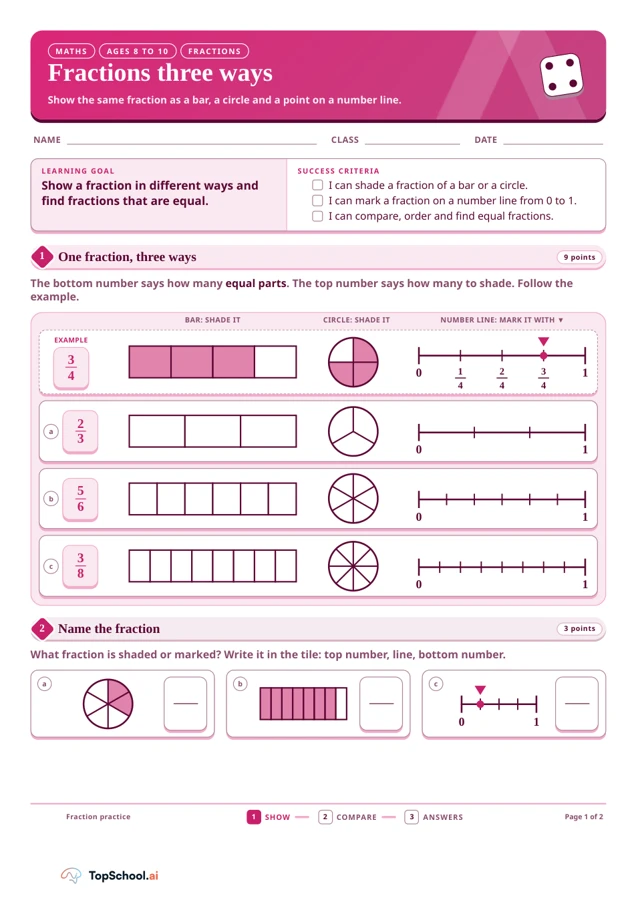
Fractions three ways
Show the same fraction three ways. Use equal wholes to compare values and explain your thinking.
Explore resource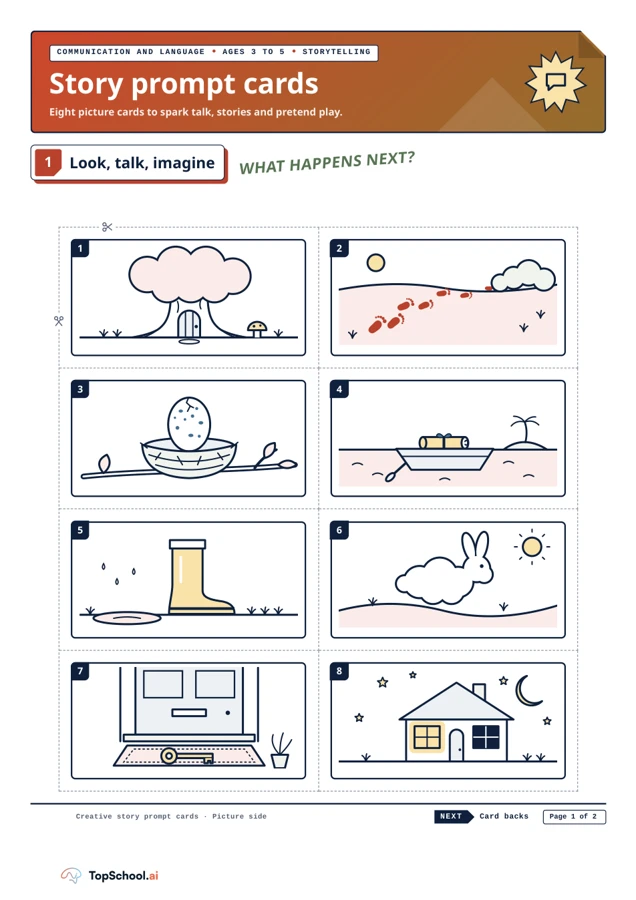
Story prompt cards
Choose a picture, describe what you see and imagine what happens next.
Explore resourceIdeas to try with your class
Sample teaching perspectives on what to try, what to adapt and what to watch for.
Meet The Creators
Meet the creators whose teaching interests connect with this template. Find an approach to try with your class.

Maya Tan
I plan adaptation before the lesson, choosing accessible texts, vocabulary support and preparation time so pupils with different starting points can join the same Year 4 conversation.
Meet the creator
Callum Ferris
I target Year 6 retrieval at the class’s current gaps and prepare transition communication for families considering different secondary settings, keeping the next step clear and relevant.
Meet the creator
Nicholas Blaker
I use a clear curriculum map to connect what pupils have learned with what comes next, keeping Year 6 preparation proportionate across different secondary-school pathways.
Meet the creator
Emily Carter
A local river, canal or museum can give pupils a place to ask questions and connect an abstract idea with something they can observe or read about.
Meet the creator
The Curious Pencil
This two-page story worksheet asks pupils to find stated facts, use nearby sentences to work out vocabulary, support an inference with a quotation and explain it with “because.” The word-help bar defines barometer, winced and paraffin.
Storytime Sidekick
The sequence moves from retrieving details to interpreting what a character thinks or feels, with a quotation required as support. The vocabulary bar can reduce lookup friction while keeping the reasoning task in the story.
Margin Note
Mark the sentence that supplies a fact before making an inference about a character's feeling. Ask pupils to quote the supporting words and explain the link; check that the quotation supports the idea they have chosen.
Page-Turner Planner
The worksheet assesses response to its supplied story only. A quoted detail supports an interpretation but may not prove it uniquely; accept a different inference when it is well supported by the text.