
Science
Sorting and classification mat
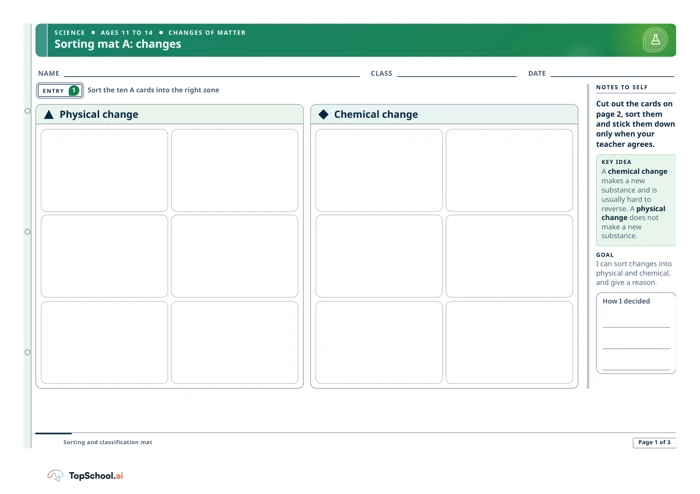
Sort example cards into two science classifications, explain the reasoning and check each placement before fixing it to the mat. The three pages cover physical and chemical changes, then elements, compounds and mixtures for discussion.
Read the material
Sort example cards into two science classifications, explain the reasoning and check each placement before fixing it to the mat. The three pages cover physical and chemical changes, then elements, compounds and mixtures for discussion.
Complete resource. Use the preview for diagrams and layout.
Page 1
SCIENCE
AGES 11 TO 14
CHANGES OF MAT TER
Sorting mat A: changes
NAME
CLASS
DATE
E N T R Y
1
Sort the ten A cards into the right zone
Physical change
Chemical change
NOTES TO SELF
Cut out the cards on
page 2, sort them
and stick them down
only when your
teacher agrees.
KEY IDEA
A chemical change
makes a new
substance and is
usually hard to
reverse. A physical
change does not
make a new
substance.
GOAL
I can sort changes into
physical and chemical,
and give a reason.
How I decided
Sorting and classification mat
Page 1 of 3
Page 2
SCIENCE
AGES 11 TO 14
CARD SET
Cards to cut out
SET A
physical or chemical?
SET B
element, compound or mixture?
Cut along the dashed lines. Card B10 is blank: write your own example. Print this page single-sided, so cutting it out does not cut into mat A.
A1
ice melting
A2
salt dissolving in water
A3
water boiling
A4
cutting paper
A5
breaking glass
A6
wood burning
A7
iron rusting
A8
baking a cake
A9
milk going sour
A10
frying an egg
B1
oxygen
B2
iron
B3
helium
B4
water
B5
carbon dioxide
B6
sodium chloride
(table salt)
B7
air
B8
seawater
B9
orange squash
B10
Make your own
Sorting and classification mat
Page 2 of 3
Page 3
SCIENCE
AGES 11 TO 14
TYPES OF SUBSTANCE
Sorting mat B: substances
NAME
CLASS
DATE
E N T R Y
2
Sort cards B1 to B9 into the right zone. Stick your own card, B10, in the margin.
Element
An element has only one kind of atom.
Compound
A compound has different kinds of atom
joined together.
Mixture
A mixture has substances that are not
joined together.
MY OWN CARD
Stick card B10 here
My card B10 is
an element
a compound
a mixture
How I decided
I read the definitions.
I wrote my reasons.
My teacher agreed.
Sorting and classification mat
Page 3 of 3
A teaching sequence
Classify changes and types of substance using the definitions on the mats, then give a reason for each classification.
Prepare and sort the change cards
Cut out the ten A cards on the middle sheet and sort examples such as melting ice, dissolving salt, burning wood and rusting iron into physical or chemical change.
Does this example make a new substance under the printed definition?
Explain before sticking on Mat A
Give a reason for each placement and ask the teacher to check before sticking cards onto Mat A.
What reason will you show the teacher for this placement?
Classify the substance cards
Use the B cards to sort examples such as oxygen, water, air and seawater into element, compound or mixture on Mat B.
Which definition distinguishes an element, compound or mixture here?
Create and justify card B10
Write an example on the blank B10 card, place it in the margin and select the substance type. Explain the choice using the printed definitions.
How does your chosen example fit its substance type?
Before you teach
Look for the thinking behind an answer, choose the support your class needs and leave room for an independent response.
What to look for
Ask pupils to explain whether a new substance is formed for an A-card choice, and whether a B-card is one element, chemically joined elements or a mixture. Check reasoning before cards are glued down. Ask which definition supports the chosen category.
Give a little support
Work through one example from each set and keep the definitions visible. Offer two possible zones at a time, use cards with fewer examples and let pupils explain by pointing or speaking before writing.
Take the idea further
Ask pupils to find another example of each category and justify it. They can compare a familiar mixture with a compound and explain why the substances are not classified in the same way.
Things to keep in mind
The definitions are simplified classroom explanations. Some examples, especially mixtures such as orange squash, depend on the product composition; check the actual example and accept reasoned classifications. Follow school safety procedures if pupils extend the discussion to practical demonstrations.
Keep the idea. Make it yours.
Bring your topic, learning goal and class context to PLAI™, then review what you create.
Ideas to try with your class
Sample teaching perspectives on what to try, what to adapt and what to watch for.
Meet The Creators
Meet a creator whose teaching interests connect with this template.

Little Lightbulbs
The three-page science mat for ages 11 to 14 asks pupils to sort ten cards into physical or chemical changes, wait for teacher approval before sticking them down and explain their choices using the supplied definitions.
One More Question
The key idea distinguishes a new substance from a change that does not make one, and the self-notes ask pupils to record how they decided. The teacher check allows classification to be discussed before answers are fixed.
Coffee Before Copies
Sort one example aloud, name whether a new substance forms and then ask the pupil to justify the next card. Leave the cards movable until the explanation is checked.
Storytime Sidekick
The reversibility wording is a general clue, not the sole definition of a chemical change. Check each example against the lesson's science and avoid asking pupils to perform reactions as part of this sorting task.