
Maths
Fractions three ways: show, compare and share
One fraction, three representations. Help pupils see the same value in a bar, a circle and a number line, then compare and share.
Same amount. Three ways.
3/4: three of four equal parts.
Read the material
Represent fractions with bars, circles and points on a number line, then use a fraction wall to find equivalent fractions, compare values and calculate fractions of amounts. A final prompt asks pupils to explain why the size of a denominator alone does not decide which fraction is larger.
Activity. Use the preview for diagrams and layout.
Page 1
NAME
CLASS
DATE
LEARNING GOAL
Show a fraction in different ways and
find fractions that are equal.
SUCCESS CRITERIA
I can shade a fraction of a bar or a circle.
I can mark a fraction on a number line from 0 to 1.
I can compare, order and find equal fractions.
One fraction, three ways
9 points
The bottom number says how many equal parts. The top number says how many to shade. Follow the
example.
BAR: SHADE IT
CIRCLE: SHADE IT
NUMBER LINE: MARK IT WITH ▼
EXAMPLE
0
1
4
2
4
3
4
1
a
0
1
b
0
1
c
0
1
Name the fraction
3 points
What fraction is shaded or marked? Write it in the tile: top number, line, bottom number.
a
b
c
0
1
Fraction practice
1
SHOW
2
COMPARE
3
ANSWERS
MATHS
AGES 8 TO 10
FRACTIONS
Fractions three ways
Show the same fraction as a bar, a circle and a point on a number line.
1
3
4
2
3
5
6
3
8
2
Page 1 of 2
Page 2
The fraction wall
Each row is one whole, cut into equal parts. Use it for 4 to 7.
1
1 whole
1
2
1
2
halves
1
3
1
3
1
3
thirds
1
4
1
4
1
4
1
4
quarters
1
6
1
6
1
6
1
6
1
6
1
6
sixths
1
8
1
8
1
8
1
8
1
8
1
8
1
8
1
8
eighths
Equal fractions
Find the missing number. 4 points
a
1
2 =
4
b
1
2 =
8
c
1
3 =
6
d
3
4 =
8
Bigger or smaller?
6 points
Write <, > or = in each tile.
a
1
3
1
4
b
2
3
4
6
c
3
8
1
2
d
5
6
3
4
e
2
8
1
4
f
2
3
3
4
Line them up
4 points
Write these in order, smallest first.
SMALLEST
LARGEST
Fraction of an amount
6 points
EXAMPLE 1
4 of 12 = 3
Share 12 into 4 equal groups. One group is 3.
LEVEL 1
1
2 of 16 =
1
4 of 20 =
LEVEL 2
1
3 of 21 =
1
8 of 24 =
LEVEL 3
3
4 of 12 =
2
3 of 18 =
BONUS ROUND
Kit says 1
3 is bigger than 1
2
because 3 is bigger than 2. Is
Kit right? Explain why.
Fraction practice
1
SHOW
2
COMPARE
3
ANSWERS
MATHS
AGES 8 TO 10
FRACTIONS
Compare, order and share
3
4
5
6
1
2
1
8
3
4
1
3
7
Page 2 of 2
Page 1
Fractions three ways: show, compare and share
Teacher companion
Mathematics | Pupils aged 8 to 10
Use with the exact 2-page original file. Keep pupil or staff activity pages separate from this teacher companion.
When to use it
Use after pupils have practised equal parts and understand that a fraction names parts of a
whole. The visual models support guided instruction and independent practice; check that
pupils can see how each model represents the same whole.
Purpose
Represent fractions visually, recognise equivalent fractions, compare values and find a
fraction of an amount.
Start here
Read the bar, circle and number-line example, then complete each representation using equal
parts.
A teaching sequence
1. Shade the requested fraction in equal-part bars and circles, then mark the same value on a
zero-to-one number line. Name each numerator and denominator.
2. Use the fraction wall to complete equivalents, compare pairs with symbols and order a set
from smallest to largest.
3. For a fraction of an amount, share the total into equal denominator groups and take the
numerator’s groups. Follow the example before practice.
4. Evaluate Kit’s claim that one third is greater than one half because three is greater than
two. Ask, “How can the same whole help compare them?” Show a model.
Checking guidance
Task 1: shade and mark 2/3, 5/6 and 3/8 on equal-part models. Task 2 a-c: 2/6 (or 1/3), 7/8,
1/4.
Task 4 missing numerators a-d: 2, 4, 2, 6. Task 5 comparisons a-f: >, =, <, >, =, <. Task 6
order: 1/8, 1/3, 1/2, 3/4.
Task 7 a-f: 8, 5, 7, 3, 9, 12. Kit is incorrect: for equal wholes, 1/3 is less than 1/2. Show the
fraction wall or equal-size shapes to justify the explanation.
Credit equivalent fractions where the prompt permits them. For a drawn response, check
equal partitions and a point at the correct value, not the neatness of shading.
Support
Use counters or paper strips to make equal parts before moving to symbols. Keep the fraction
wall visible and model that the whole must stay the same size when comparing. Give pupils
time to draw or explain a sharing strategy before writing a numerical answer.
Take it further
Ask pupils to create two different visual models for the same fraction and explain why the
values agree. They can write a comparison that needs equivalent fractions and design a
misconception question for a partner to solve.
Things to keep in mind
The resource focuses on fractions with denominators shown in its models and questions.
Visual comparisons are meaningful only when the wholes are equal. Use additional examples
if pupils need practice with unlike denominators or fractions greater than one.
Fractions three ways: show, compare and share
Teacher companion | Page 1
A teaching sequence
Represent fractions visually, recognise equivalent fractions, compare values and find a fraction of an amount.
Same amount. Three ways.
3/4: three of four equal parts.
Show the same value
Shade a bar and circle, then mark the value between zero and one. Name the numerator and denominator.
Three out of four equal parts.
Keep the whole the same.
A bigger denominator makes smaller parts when the whole stays equal.
Compare equal wholes
Use the fraction wall to find equivalents, compare pairs and order fractions. Keep the whole the same size.
One half is larger than one third.
Share 12 into 4 equal groups.
1/4 of 12 = 3
Take one equal group.
Share, then explain
Share an amount into equal denominator groups. Take the numerator’s groups, then use a model to challenge Kit’s claim.
One quarter of 12 is 3.
Before you teach
Look for the thinking behind an answer, choose the support your class needs and leave room for an independent response.
Check the reasoning and answers
| Task | What to check |
|---|---|
| 1. Show it | 2/3, 5/6 and 3/8. Check equal partitions and a point at the correct value, rather than neatness of shading. |
| 2. Name it | a to c: 2/6 (or 1/3), 7/8, 1/4. Credit equivalent fractions where the prompt permits them. |
| 4. Equivalents | Missing numerators, a to d: 2, 4, 2, 6. |
| 5. Compare | a to f: >, =, <, >, =, <. |
| 6. Order | 1/8, 1/3, 1/2, 3/4. |
| 7. Amounts | a to f: 8, 5, 7, 3, 9, 12. |
Kit is incorrect: for equal wholes, 1/3 is less than 1/2. Show the fraction wall or equal-size shapes to justify the explanation. Credit equivalent fractions where the prompt permits them. For a drawn response, check equal partitions and a point at the correct value, not the neatness of shading.
Give a little support
Use counters or paper strips to make equal parts before moving to symbols. Keep the fraction wall visible and model that the whole must stay the same size when comparing. Give pupils time to draw or explain a sharing strategy before writing a numerical answer.
Take the idea further
Ask pupils to create two different visual models for the same fraction and explain why the values agree. They can write a comparison that needs equivalent fractions and design a misconception question for a partner to solve.
Things to keep in mind
The resource focuses on fractions with denominators shown in its models and questions. Visual comparisons are meaningful only when the wholes are equal. Use additional examples if pupils need practice with unlike denominators or fractions greater than one.
Keep the idea. Make it yours.
Bring your topic, learning goal and class context to PLAI™, then review what you create.
Another starting point
Explore a different teaching task from this selection.
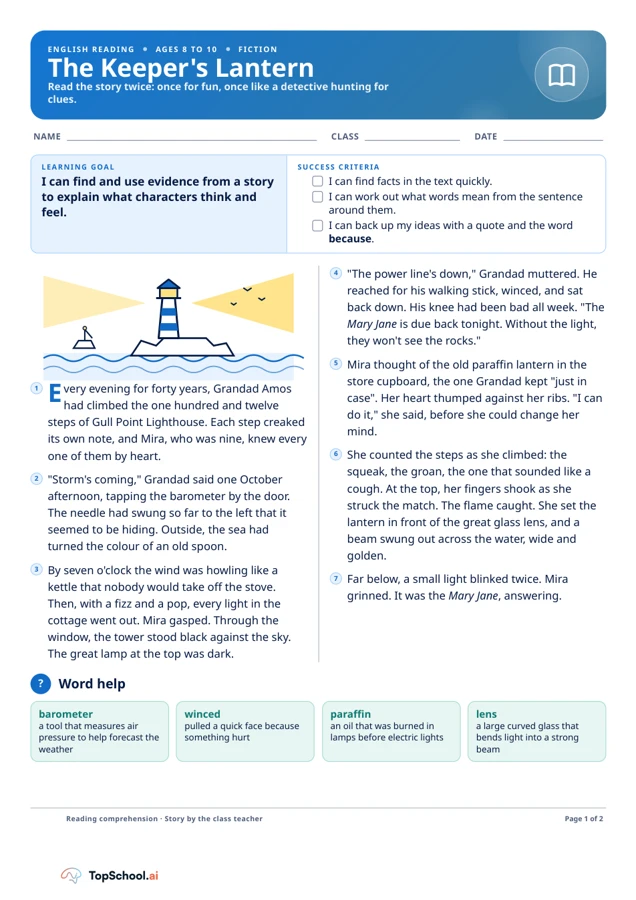
The Keeper’s Lantern
Read the lighthouse story, find a clue and use a quotation with “because” to explain your answer.
Explore resource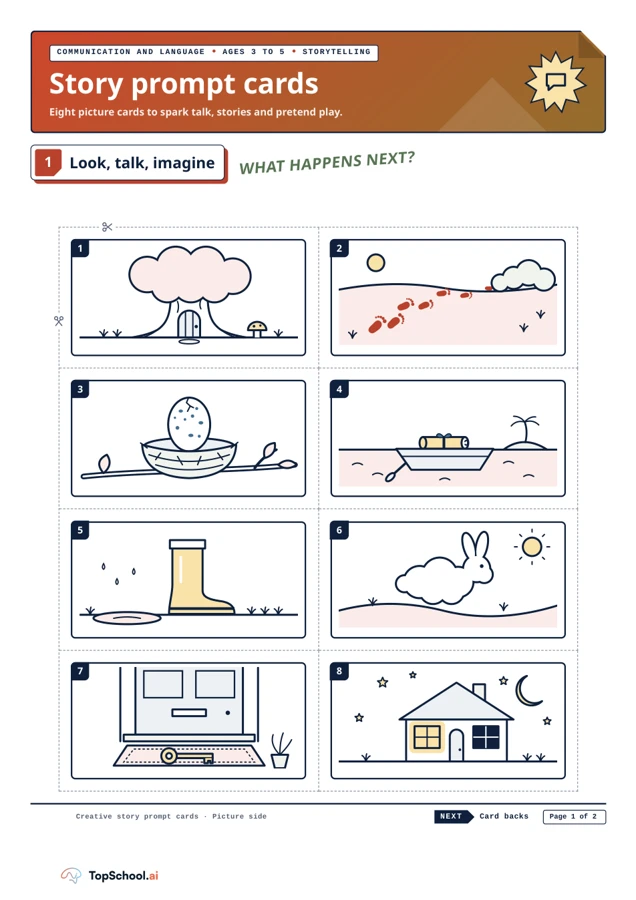
Story prompt cards
Choose a picture, describe what you see and imagine what happens next.
Explore resourceIdeas to try with your class
Sample teaching perspectives on what to try, what to adapt and what to watch for.
Meet The Creators
Meet the creators whose teaching interests connect with this template. Find an approach to try with your class.
Wendy Trebilcock
I support a Year 5 class and look for practical ways to run small-group work when the whole group shares one room.
Meet the creator
Priya Nandakumar
I want all pupils to work with a meaningful mathematical idea and have a chance to explain, test or revise their approach.
Meet the creator
Chalk & Chai
The two-page worksheet moves from representing a fraction as a bar, circle and number-line point to fraction-wall equivalence, comparisons, ordering and finding fractions of amounts. The worked quarter-of-12 example shows equal sharing.
Coffee Before Copies
For ages 8 to 10, the fraction wall supports questions about halves, thirds, quarters, sixths and eighths before pupils compare values. The levels for finding amounts add a progression from halves and quarters to thirds and eighths.
Kindly Red Pen
Use the same fraction across all three representations before moving to the wall. For “one quarter of 12”, physically or visually grouping twelve into four equal parts makes the meaning clearer than applying a rule without a model.
One More Question
A shaded bar, circle and number line need equal parts to represent the same value. Check the drawn divisions before accepting a comparison, and use the wall as a model rather than a complete explanation of every equivalence.