
Geography
Water cycle: an interactive model
Trace water through sea, cloud, precipitation and river in an interactive landscape. Sun-heat and wind controls let pupils compare changes in this illustrative model, and one question focuses on cloud formation over a mountain. The separate companion explains droplet growth, combined river-and-snow storage and omitted processes.
Follow evaporation, condensation and precipitation in the model. Open it to change the sun and wind.
Read the complete materialRead the material
Trace water through sea, cloud, precipitation and river in an interactive landscape. Sun-heat and wind controls let pupils compare changes in this illustrative model, and one question focuses on cloud formation over a mountain. The separate companion explains droplet growth, combined river-and-snow storage and omitted processes.
Interactive activity. Use the preview for diagrams and layout.
Resource text
Geography · Year 6
The water cycle
Illustrative closed model: arbitrary rates and store shares, not Earth data or a forecast. Groundwater and transpiration are omitted.
Evaporation
Condensation
Precipitation
Collection
Sun heat
Wind
Illustrative stores (rounded %)
Sea
Cloud
River + snow
Why can cloud droplets form as moist air rises over the mountain?
Page 1
Teacher companion
Water cycle: an interactive model
Processes and rainfall
Evaporation makes invisible vapour; condensation forms droplets. Rain requires droplets to grow enough
that their fall speed exceeds support from rising air. A cloud is not a full container. Rising moist air can cool
over mountains; condensation alone does not guarantee rainfall.
Stores and controls
The displayed third store includes river water and snow and is labelled River+snow. Store percentages
describe a closed illustrative model, not Earth’s measured distribution. Heat/wind sliders and time/rain rates
are arbitrary. Rain transfers use illustrative thresholds, not a calculation of actual droplet growth or fall
speed. Groundwater and transpiration are omitted.
Review
Reset restores warm/breezy defaults. Test cold/calm and hot/strong combinations and explain model
omissions. The cloud-formation quiz accepts rising air cools, with a droplet-growth qualification before rain.
Use this model for discussion; no forecast or calibrated water-balance claim is made.
Teacher companion | Page 1 of 1
A teaching sequence
Pupils should explain a route through evaporation, condensation, precipitation and collection, then use the mountain example to connect cooling with droplet formation. They should recognise that condensation alone does not guarantee rain and identify a process or store omitted from the model.
Follow evaporation, condensation and precipitation in the model. Open it to change the sun and wind.
Read the complete materialTrace each water process
Follow water from the sea towards the cloud and back through precipitation and river flow. Ask what happens between each named stage rather than accepting the stage names alone.
What happens to water between evaporation and condensation?
Change heat, then wind
Predict what changing sun heat might alter, then compare with wind fixed. Reset before changing wind and describe only the model behaviour actually observed.
What changed with wind fixed, and what changed after you reset and varied wind?
Explain droplets and rain
Answer the mountain question and explain why rising moist air can cool and form droplets. Ask what else must happen before droplets fall as rain, using the companion’s growth qualification.
What must happen to droplets before they can fall as rain?
Compare stores and omissions
Read the illustrative stores, including River + snow. Compare cold/calm and hot/strong settings, then discuss how omitted groundwater and transpiration would broaden a real water-cycle account.
Where would groundwater and transpiration fit in a fuller water-cycle account?
Before you teach
Look for the thinking behind an answer, choose the support your class needs and leave room for an independent response.
What to look for
A useful response connects evaporation into invisible vapour, condensation into droplets and precipitation returning water towards collection. For the quiz, “Rising air cools” explains cloud formation; droplets must also grow enough to fall as rain. If a pupil describes a cloud as a full container, return to droplet growth and the model’s illustrative thresholds.
Give a little support
Use a route sketch and the stem “Water moves from… to… when…”. Work through one connection before tracing the whole route. Keep vapour and visible droplets distinct, and use the combined River + snow label when discussing where the illustrated water is stored.
Take the idea further
Draw a second landscape that includes groundwater or transpiration and add those connections to the model’s route. Explain what the screen omits and why its store percentages cannot describe Earth’s measured water distribution. Keep the added diagram as a reasoned extension rather than a weather forecast.
Things to keep in mind
Rates, time, rounded store percentages and rain thresholds are illustrative, not Earth data or a forecast. Groundwater and transpiration are omitted.
Keep the idea. Make it yours.
Bring your topic, learning goal and class context to PLAI™, then review what you create.
Another starting point
Explore a different teaching task from this selection.
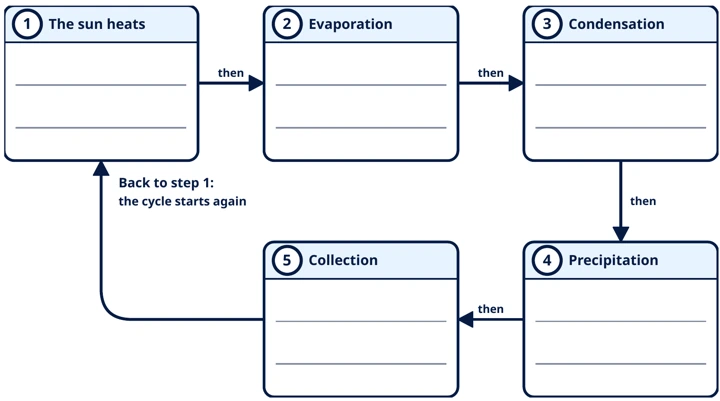
Process flowchart organiser
Read the learning goal and success criteria. Choose whether to begin with the water-cycle boxes or the frog-life-cycle sequence, then review the relevant word bank or stage names.
Explore resource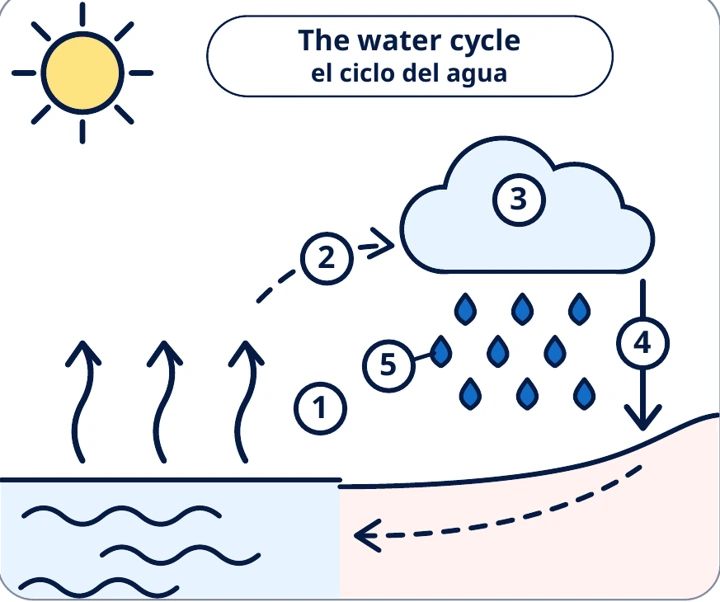
The water cycle in English, Spanish and your language
Point to each numbered part of the water-cycle picture and read its English and Spanish label.
Explore resourceIdeas to try with your class
Sample teaching perspectives on what to try, what to adapt and what to watch for.
Meet The Creators
Meet a creator whose teaching interests connect with this template.

Chalk & Chai
This Year 6 interactive landscape shows evaporation, condensation, precipitation and collection, with sun-heat and wind controls, rounded illustrative stores and a mountain question about cloud droplets. Groundwater and transpiration are explicitly omitted.
Gentle Reminder
The mountain prompt links rising air cooling to droplet formation, while the companion distinguishes condensation from the droplet growth needed before rain falls. Comparing one control at a time supports a focused explanation of model behaviour.
Notes Between Bells
Trace one route from sea through cloud to river or snow, use the stem “Water moves from … to … when …” and keep vapour distinct from visible droplets. Reset before changing from sun heat to wind.
After the Bell
The rates, store shares, time and rain thresholds are illustrative, not Earth data or a forecast. Identify omitted groundwater and transpiration when discussing the model and avoid treating its percentages as measured global water distribution.