
Languages and literacy
Spelling the shun sound
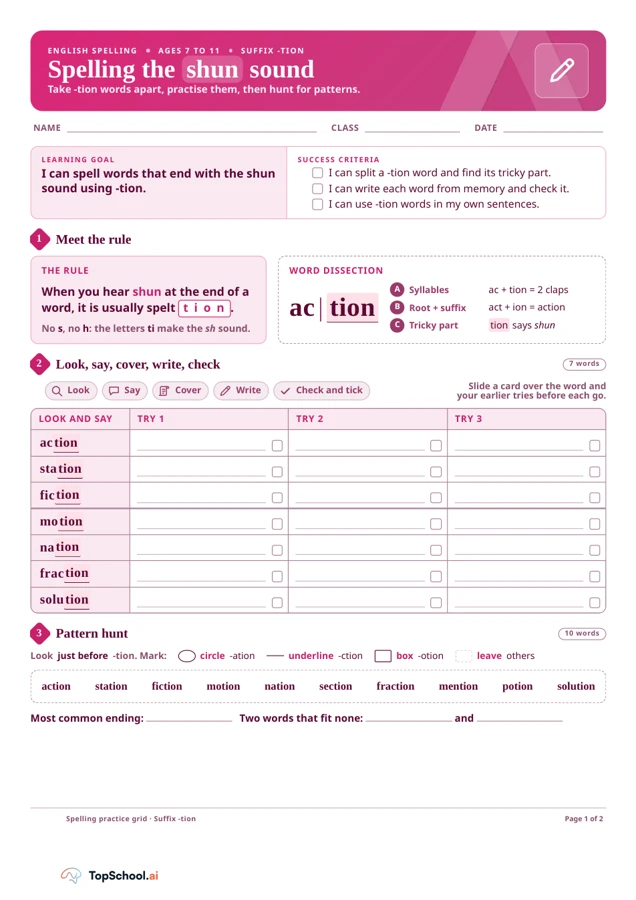
Practise words ending in the /shun/ sound by noticing the common -tion spelling, retrieving words from memory and looking for patterns. Pupils then use selected words in sentences and correct deliberately misspelt examples before review.
Read the material
Practise words ending in the /shun/ sound by noticing the common -tion spelling, retrieving words from memory and looking for patterns. Pupils then use selected words in sentences and correct deliberately misspelt examples before review.
Activity. Use the preview for diagrams and layout.
Page 1
NAME
CLASS
DATE
LEARNING GOAL
I can spell words that end with the shun
sound using -tion.
SUCCESS CRITERIA
I can split a -tion word and find its tricky part.
I can write each word from memory and check it.
I can use -tion words in my own sentences.
Meet the rule
THE RULE
When you hear shun at the end of a
word, it is usually spelt t i o n .
No s, no h: the letters ti make the sh sound.
WORD DISSECTION
ac| tion
A
Syllables
ac + tion = 2 claps
B
Root + suffix
act + ion = action
C
Tricky part
tion says shun
Look, say, cover, write, check
7 words
Look
Say
Cover
Write
Check and tick
Slide a card over the word and
your earlier tries before each go.
LOOK AND SAY
TRY 1
TRY 2
TRY 3
action
station
fiction
motion
nation
fraction
solution
Pattern hunt
10 words
Look just before -tion. Mark:
circle -ation
underline -ction
box -otion
leave others
action
station
fiction
motion
nation
section
fraction
mention
potion
solution
Most common ending:
Two words that fit none:
 and
Spelling practice grid · Suffix -tion
ENGLISH SPELLING
AGES 7 TO 11
SUFFIX -TION
Spelling the shun sound
Take -tion words apart, practise them, then hunt for patterns.
1
2
3
Page 1 of 2
Page 2
Use it in a sentence
4 marks
Write one sentence for each word. Start with a capital letter and end with a full stop.
station
We waited at the ...
fraction
A half is a ...
potion
The wizard made a ...
solution
Our solution was ...
Spot the mistake
4 marks
Each sentence has one word spelt wrongly. Circle it, then write it correctly.
a
The train was late, so we waited at the stashun for an hour.
b
My favourite ficsion book is about a dragon who loves maths.
c
We found the solushion to the puzzle at the very last minute.
d
The whole nashon cheered when the team won the cup.
GO FURTHER: BUILD LONGER WORDS
re + action =
sub + traction =
nation + al =
pro + motion =
Find a -tion word with four syllables:
How do I feel about spelling -tion words?
Not yet
Getting there
Got it
Spelling practice grid · 8 marks plus practice
SPELLING THE SHUN SOUND
USE IT AND CHECK IT
Put your -tion words to work
4
5
MEMORY TRICK
Invent one for your hardest word.
Example: the t in -tion is top secret: it hides the sh sound.
Page 2 of 2
A teaching sequence
Recognise the -tion ending, break a word into parts, spell target words from memory and use them in a sentence.
Practise seven words from memory
Use Look, Say, Cover, Write, Check for the seven listed words. Hide the target before each try and compare the attempt with the correct spelling.
Which spelling needs correction after you reveal the target?
Mark the printed ending groups
In the pattern hunt, mark the ending groups shown in the instructions and find any words that do not fit those three patterns.
Which words fall outside the three named pattern groups?
Use four target words in sentences
Write one sentence for each of the four target words using the sentence starters as needed.
Does the chosen word fit the sentence's meaning?
Correct, build and choose a memory cue
Find the misspelt word in each sentence and write the standard spelling beside it. Then complete the word-building prompts by adding the parts shown, then invent a memory trick for a spelling that needs more practice.
How does the corrected or built word compare with the taught spelling?
Before you teach
Look for the thinking behind an answer, choose the support your class needs and leave room for an independent response.
What to look for
Ask pupils to explain which letters represent the ending sound and to check a word against the target spelling after recalling it. Look for a complete sentence with a capital and full stop, and a correction that preserves the meaning.
Give a little support
Practise one word together, say it slowly and highlight the final letters. Offer fewer words at a time, a syllable clap or a trace-over before recall. Let pupils say a sentence first and record it with support.
Take the idea further
Ask pupils to find a new word ending in -tion and identify its root or syllables. They can compare -ation, -ction and -otion examples and explain what helped them remember the spelling.
Things to keep in mind
The sheet says -tion is the usual spelling for this final sound, not a rule for every word. Check word examples and morphological explanations against the class spelling programme. The word list may not cover every pronunciation or exception pupils encounter.
Keep the idea. Make it yours.
Bring your topic, learning goal and class context to PLAI™, then review what you create.
Ideas to try with your class
Sample teaching perspectives on what to try, what to adapt and what to watch for.
Meet The Creators
Meet the creators whose teaching interests connect with this template. Find an approach to try with your class.

Wendy Trebilcock
I support a Year 5 class and look for practical ways to run small-group work when the whole group shares one room.
Meet the creator
Samuel Ogilvie
Reading for pleasure matters to me, and I would rather help a child finish a book they selected than fill every reading moment with a worksheet.
Meet the creator
Steady Marker
This two-page spelling grid teaches the -tion ending as the usual spelling for the “shun” sound at a word ending. Pupils split words into syllables and root plus suffix, write target words from memory, check them and use them in sentences.
Little Lightbulbs
The action sequence “look, say, cover, write, check” makes retrieval and self-checking explicit. The word dissection shows “action” as act plus ion, drawing attention to the suffix rather than only its sound.
Pocketful of Stories
Say the word, clap its syllables and cover the model before writing. Compare the result with the printed form and mark the suffix so the learner can identify what to practise.
Paperclip Perspective
The sheet presents -tion as a usual pattern, not a rule for every word ending in that sound. Keep the target list aligned with taught vocabulary and check each spelling rather than overgeneralising.