
Languages and literacy
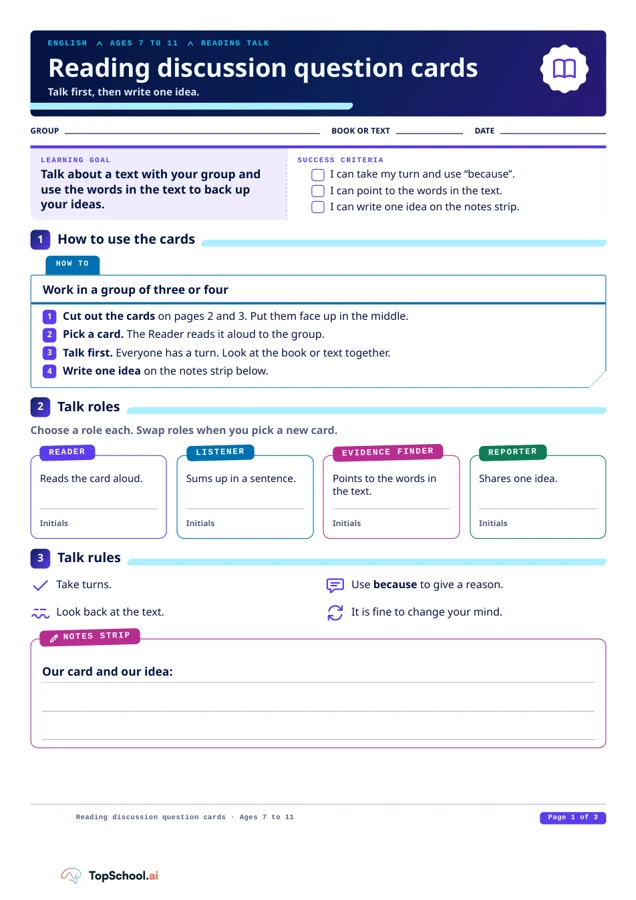
Reading discussion question cards
Use group roles and prompt cards to discuss a book or text, point to evidence and record one shared idea. The cards cover prediction, inference and vocabulary. Pupils take turns, use because to give a reason and can change their minds as they talk.
Read the material
Use group roles and prompt cards to discuss a book or text, point to evidence and record one shared idea. The cards cover prediction, inference and vocabulary. Pupils take turns, use because to give a reason and can change their minds as they talk.
Complete resource. Use the preview for diagrams and layout.
Page 1
GROUP
BOOK OR TEXT
DATE
LEARNING GOAL
Talk about a text with your group and
use the words in the text to back up
your ideas.
SUCCESS CRITERIA
I can take my turn and use “because”.
I can point to the words in the text.
I can write one idea on the notes strip.
1
How to use the cards
2
Talk roles
Choose a role each. Swap roles when you pick a new card.
3
Talk rules
Take turns.
Use because to give a reason.
Look back at the text.
It is fine to change your mind.
Reading discussion question cards · Ages 7 to 11
Page 1 of 3
ENGLISH
AGES 7 TO 11
READING TALK
Reading discussion question cards
Talk first, then write one idea.
Work in a group of three or four
HOW TO
Cut out the cards on pages 2 and 3. Put them face up in the middle.
1
Pick a card. The Reader reads it aloud to the group.
2
Talk first. Everyone has a turn. Look at the book or text together.
3
Write one idea on the notes strip below.
4
Reads the card aloud.
Initials
READER
Sums up in a sentence.
Initials
LISTENER
Points to the words in
the text.
Initials
EVIDENCE FINDER
Shares one idea.
Initials
REPORTER
NOTES STRIP
Our card and our idea:
Page 2
Cut along the dashed lines. The letter and shape show the set: P circle, I square, W scalloped.
P1
Predict
Look at the cover and the title.
What do you think will happen?
What makes you think so?
P2
Predict
Read the first page.
What kind of text is it?
Which clues told you?
P3
Predict
What do you think the character will do
next?
Give a reason from the text.
P4
Predict
Stop here.
Think of two things that could happen next.
Which is more likely, and why?
P5
Predict
How do you think it will end?
What would surprise you?
I1
Infer
How is the character feeling?
Which words or actions show it?
I2
Infer
Why did the character do that?
What clues does the author give?
I3
Infer
What does the setting tell you?
Find a clue.
Reading discussion question cards · Ages 7 to 11
Page 2 of 3
ENGLISH
AGES 7 TO 11
READING TALK
Cards: Predict and Infer
Cut out, pick one, talk first.
Page 3
Cut along the dashed lines. The letter and shape show the set: P circle, I square, W scalloped.
I4
Infer
What does the author not say, but you can
tell?
I5
Infer
How has the character changed since the
start?
What shows it?
I6
Infer
What is the character like?
Find two things they say or do that show it.
Words
Find a word you do not know.
Read the sentence before and after.
What could it mean?
Words
Which word does the author use to describe
something?
Why is it a good choice?
Words
Find a word that could be swapped for a
more exact one.
Words
Find a word that shows how a character
moves or speaks.
What picture does it give you?
Words
Choose a word you like.
Why do you like it?
Use it in a sentence of your own.
Reading discussion question cards · Ages 7 to 11
Page 3 of 3
ENGLISH
AGES 7 TO 11
READING TALK
Cards: Infer and Words
Cut out, pick one, talk first.
W1
W2
W3
W4
W5
A teaching sequence
Take turns discussing a text, use evidence to support an idea and record one response from the group’s conversation with a quotation or passage detail.
Prepare the cards and text
Cut out the cards and place them face up, or read a prompt directly from the page before cutting.
Can everyone see the chosen prompt and an appropriate shared text?
Read, take turns and find evidence
Let the Reader read one question aloud. Give everyone time to respond, with the Evidence Finder locating relevant words in the text.
Which words can the Evidence Finder locate for the group's response?
Explain a prediction or inference
Use a prediction or inference card and ask pupils to explain their thinking with because.
What clue makes this idea plausible, and could another reading fit?
Record an idea and swap roles
Record one shared idea on the notes strip, then swap roles before choosing another card. Ask each speaker to cite a line or detail.
Which line or detail supports the note before the group chooses another card?
Before you teach
Look for the thinking behind an answer, choose the support your class needs and leave room for an independent response.
What to look for
Look for pupils taking a turn and connecting an idea to words in the text. Ask, “Which part helped you think that?” If a response is only a guess, invite the group to reread a sentence and revise or keep the idea with a reason.
Give a little support
Start with one prediction prompt and allow pupils to speak before writing. Use the role cards to distribute participation, and let a pupil pass or change their view after hearing new evidence.
Take the idea further
Ask the group to compare two possible predictions and explain which is better supported by the text. The Reporter can write a brief summary of the reasons the group considered, including a point on which pupils disagreed.
Things to keep in mind
The prompts are open-ended and have no single answer key. A discussion card does not show that every pupil has understood the whole text. Use a book or text appropriate to the group and handle turn-taking in line with classroom needs.
Keep the idea. Make it yours.
Bring your topic, learning goal and class context to PLAI™, then review what you create.
Another starting point
Explore a different teaching task from this selection.
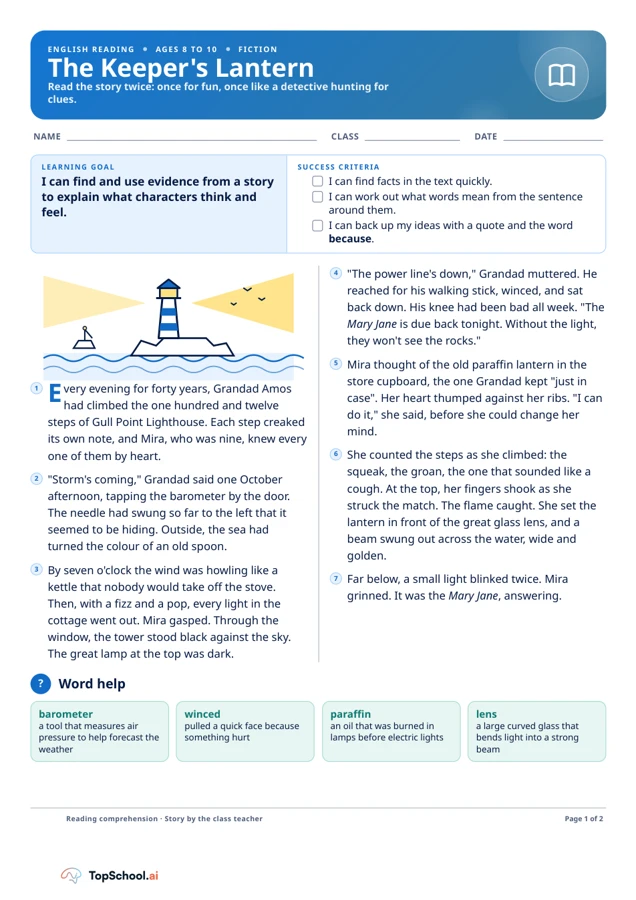
The Keeper’s Lantern
Read the lighthouse story, find a clue and use a quotation with “because” to explain your answer.
Explore resourceIdeas to try with your class
Sample teaching perspectives on what to try, what to adapt and what to watch for.
Meet The Creators
Meet the creators whose teaching interests connect with this template. Find an approach to try with your class.

Hannah Wright
I put reading for pleasure at the centre of a shared conversation, offering passages, questions, partner exchanges and listening so pupils have different ways into the same book.
Meet the creator
Owen Pritchard
I teach Year 3 and think carefully about how Religious Education can include pupils with different relationships to parish preparation.
Meet the creator
Samuel Ogilvie
Reading for pleasure matters to me, and I would rather help a child finish a book they selected than fill every reading moment with a worksheet.
Meet the creator
Aisha Rahman
I look at how a pupil applies a sound or pattern and decide whether to revisit it, model another word or move on.
Meet the creator
Board Eraser
The three-page discussion set asks each group to assign roles, take turns, look back at the text, use “because” and record one idea on a notes strip. Pupils may change their minds as they discuss a question.
Kindly Red Pen
The cards structure a text-based conversation with both a speaking routine and a written record. Requiring a quotation or passage detail gives the group a shared point of reference for claims.
Open Book Pause
Model how to find a relevant passage and offer sentence starters for agreeing, adding a reason or revising an idea. Rotate roles when choosing a new card so each pupil can practise more than one part.
Notes Between Bells
The cards guide a discussion but do not ensure every pupil contributes equally. Agree respectful turn-taking, avoid forcing personal disclosure about a text and check that the selected book is appropriate for the group.