
Languages and literacy
Talk it through: discussion and debate cards
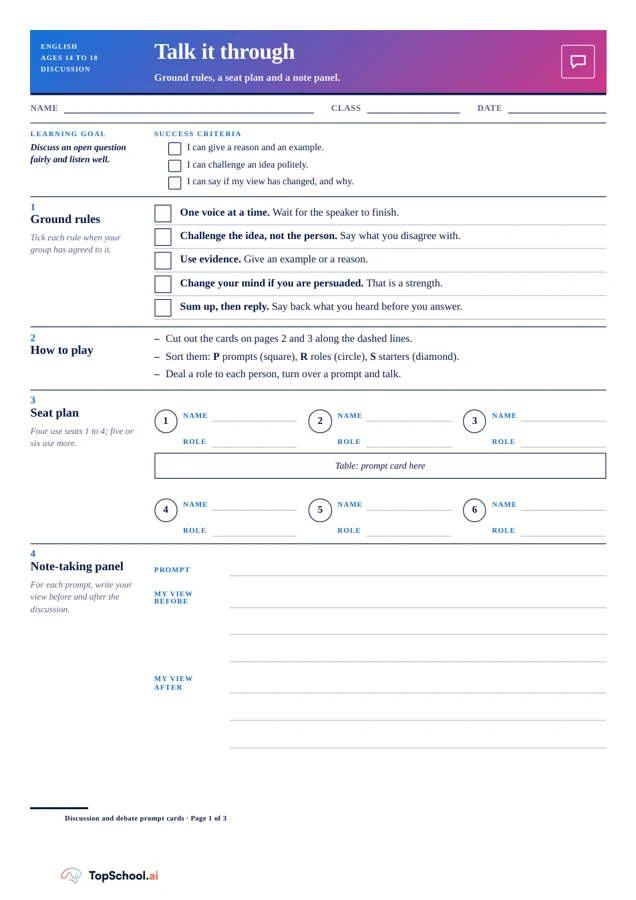
Set up a structured discussion with shared ground rules, rotating roles and open questions. The three-page A4 pack includes prompts about homework, rules, school start times, uniforms, languages and screens, alongside sentence starters and a before-and-after reflection panel.
Read the material
Set up a structured discussion with shared ground rules, rotating roles and open questions. The three-page A4 pack includes prompts about homework, rules, school start times, uniforms, languages and screens, alongside sentence starters and a before-and-after reflection panel.
Complete resource. Use the preview for diagrams and layout.
Page 1
NAME
CLASS
DATE
LEARNING GOAL
Discuss an open question
fairly and listen well.
SUCCESS CRITERIA
I can give a reason and an example.
I can challenge an idea politely.
I can say if my view has changed, and why.
1
Ground rules
Tick each rule when your
group has agreed to it.
One voice at a time. Wait for the speaker to finish.
Challenge the idea, not the person. Say what you disagree with.
Use evidence. Give an example or a reason.
Change your mind if you are persuaded. That is a strength.
Sum up, then reply. Say back what you heard before you answer.
2
How to play
3
Seat plan
Four use seats 1 to 4; five or
six use more.
1
NAME
ROLE
2
NAME
ROLE
3
NAME
ROLE
Table: prompt card here
4
NAME
ROLE
5
NAME
ROLE
6
NAME
ROLE
4
Note-taking panel
For each prompt, write your
view before and after the
discussion.
PROMPT
MY VIEW
BEFORE
MY VIEW
AFTER
Discussion and debate prompt cards · Page 1 of 3
ENGLISH
AGES 14 TO 18
DISCUSSION
Talk it through
Ground rules, a seat plan and a note panel.
Cut out the cards on pages 2 and 3 along the dashed lines.
–
Sort them: P prompts (square), R roles (circle), S starters (diamond).
–
Deal a role to each person, turn over a prompt and talk.
–
Page 2
Cut along the dashed lines. Badges: P prompt (square), R role (circle).
P
PROMPT 1: HOMEWORK
Should students choose some of their own
homework tasks?
P
PROMPT 2: RULES
Is it ever right to break a rule?
P
PROMPT 3: SCHOOL DAY
Should schools start later in the day?
P
PROMPT 4: UNIFORM
Do school uniforms help or hinder learning?
P
PROMPT 5: LANGUAGES
Should every student learn a second language?
P
PROMPT 6: SCREENS
How much of our learning should be done on
screens?
R
ROLE: CHAIR
Invite each person to speak and keep the talk on the
prompt.
R
ROLE: TIMEKEEPER
Watch the clock and give a warning one minute before
the end.
R
ROLE: SCRIBE
Write down the main points on the note panel.
R
ROLE: SPEAKER FOR
Give reasons and evidence in favour of the prompt.
Discussion and debate prompt cards · Page 2 of 3
ENGLISH
AGES 14 TO 18
DISCUSSION
Cards to cut: sheet 1
Page 3
Cut along the dashed lines. Badges: R role (circle), S starter (diamond).
R
ROLE: SPEAKER AGAINST
Give reasons and evidence against the prompt.
R
ROLE: SUMMARISER
Say what the group has agreed and where it disagrees.
R
ROLE: CHALLENGER
Ask one fair question that tests a reason or an example.
STARTER
“I agree with … because …”
STARTER
“I see it differently because …”
STARTER
“Can you give an example?”
STARTER
“What would change your mind?”
STARTER
“Building on what … said …”
STARTER
“Let me check I understand: you think …”
STARTER: MY OWN
Write a respectful starter of your own.
Discussion and debate prompt cards · Page 3 of 3
ENGLISH
AGES 14 TO 18
DISCUSSION
Cards to cut: sheet 2
S
S
S
S
S
S
S
A teaching sequence
Contribute to a discussion by giving reasons and examples, challenging ideas respectfully and explaining whether or why a view changed.
Agree rules and place the prompt
Agree the rules and place a prompt where everyone can see it.
Can everyone see the question and the agreed talk rules?
Assign contribution and challenge roles
Deal roles so a chair invites contributions, speakers offer reasons, and the challenger tests an idea fairly.
How will the chair invite people and the challenger test an idea fairly?
Record a view, listen and reply
Ask each pupil to note a view before the discussion, then listen, summarise and reply.
Can you summarise the reason you heard before responding?
Explain the view after discussion
Record a view afterwards and explain whether it changed, stayed the same or became more qualified. Let pupils explain without pressure to agree.
What strengthened, changed or qualified the view without requiring agreement?
Before you teach
Look for the thinking behind an answer, choose the support your class needs and leave room for an independent response.
What to look for
Look for reasons, examples, respectful challenge and evidence that pupils listened before replying. Ask: “What part of what you heard made you reconsider or strengthen your view?” A change of view is one possible outcome; pupils should not be pressured to agree.
Give a little support
Use a smaller group, a visible speaking order and one prompt at a time. Model a sentence starter and let pupils write before speaking; provide a pass option and keep discussion focused on ideas rather than personal disclosure.
Take the idea further
Invite pupils to write a new prompt and role, then test whether it allows more than one defensible view. They can compare their opening and closing notes and identify which evidence mattered most.
Things to keep in mind
The cards create a discussion structure but do not guarantee equal participation or agreement. Adapt prompts to the group and school context; no adult answer guide is included. A changed view is not required for a successful discussion.
Keep the idea. Make it yours.
Bring your topic, learning goal and class context to PLAI™, then review what you create.
Ideas to try with your class
Sample teaching perspectives on what to try, what to adapt and what to watch for.
Meet The Creators
Meet a creator whose teaching interests connect with this template.

Board Eraser
The three-page set pairs ground rules, a seat plan and a before/after view panel with cut-out prompts, roles and starters. It asks pupils to use evidence, challenge an idea rather than a person and repeat what they heard before replying.
Paperclip Perspective
For ages 14 to 18, the prompts cover homework choice, rules, school start times and uniform among other topics. The roles and rounds give a group an order for discussion and a reason to reflect on whether its view changed.
Storytime Sidekick
The seat plan can be scaled for four to six participants, while role cards distribute the work of prompting and listening. A pupil can record a view before discussion and compare it afterwards rather than needing to speak in every turn.
Pocketful of Stories
The prompt topics may need adaptation to the class and context, and the cards do not establish a single correct position. Agree ground rules first and keep evidence requirements clear when a topic touches pupils’ personal experience.