
Languages and literacy
Classroom English: talk and learning cards
Practise six useful English words for joining a classroom task. Each card pairs the word with a plain definition and a sentence pupils can say or complete.
Read the material
Practise six useful English words for joining a classroom task. Each card pairs the word with a plain definition and a sentence pupils can say or complete.
Pupil cards and task. Use the preview for diagrams and layout.
Page 1
Classroom English: talk and learning cards
Pupil cards and task
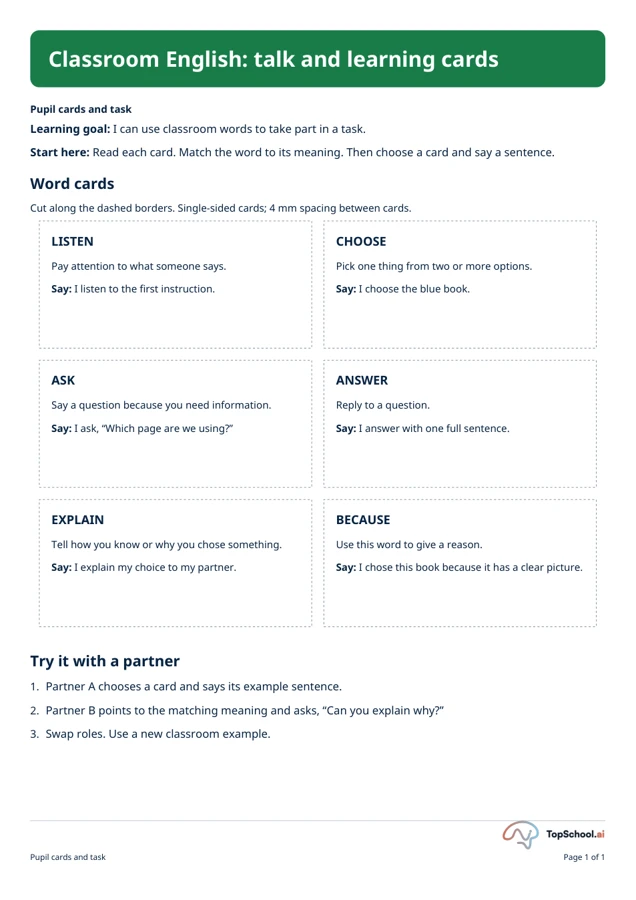
Learning goal: I can use classroom words to take part in a task.
Start here: Read each card. Match the word to its meaning. Then choose a card and say a sentence.
Word cards
Cut along the dashed borders. Single-sided cards; 4 mm spacing between cards.
LISTEN
Pay attention to what someone says.
Say: I listen to the first instruction.
CHOOSE
Pick one thing from two or more options.
Say: I choose the blue book.
ASK
Say a question because you need information.
Say: I ask, “Which page are we using?”
ANSWER
Reply to a question.
Say: I answer with one full sentence.
EXPLAIN
Tell how you know or why you chose something.
Say: I explain my choice to my partner.
BECAUSE
Use this word to give a reason.
Say: I chose this book because it has a clear picture.
Try it with a partner
1. Partner A chooses a card and says its example sentence.
2. Partner B points to the matching meaning and asks, “Can you explain why?”
3. Swap roles. Use a new classroom example.
Pupil cards and task
Page 1 of 1
Page 1
Classroom English: talk and learning cards
Teacher key and guidance supporting this exact edition
Teacher check
Look for a word that fits the situation and a sentence that communicates a complete idea. Offer a gesture, an
object or two answer choices when needed.
Teacher companion
Page 1 of 1
A teaching sequence
Recognise six classroom participation words and use one in a short spoken sentence.
Match classroom words to actions
Read listen, choose, ask, answer, explain and because, then match each with its meaning. Choose a classroom situation and identify which card word could help.
Which card helps with the classroom situation you chose?
Say a complete idea
Use the sentence frame on the card to say a complete idea. A partner listens and asks one follow-up question.
Can you use because to explain your choice?
Swap and try a fresh sentence
Swap roles. Pupils choose a different card and use it in a new sentence about the same task.
Does the new sentence keep the selected word's meaning?
Before you teach
Look for the thinking behind an answer, choose the support your class needs and leave room for an independent response.
What to look for
Expected: ask requests information, as in “Which page are we using?”; answer replies to a question; because introduces a reason. One model is “I choose the blue book because it has a clear picture.” Follow up: ask pupils to choose one card, make a new classroom sentence and tell a partner why the word fits.
Give a little support
Model one card with an action or classroom object. Offer a choice between two words, allow rehearsal with a partner and keep the sentence frame visible.
Take the idea further
Ask pupils to join two cards in one response, for example, “I chose this book because it has a clear picture.” Invite them to add a respectful follow-up question.
Things to keep in mind
The cards practise English classroom words. Use a gesture, real object or current classroom task to make each meaning clear before asking for a spoken or supported response.
Keep the idea. Make it yours.
Bring your topic, learning goal and class context to PLAI™, then review what you create.
Ideas to try with your class
Sample teaching perspectives on what to try, what to adapt and what to watch for.
Meet The Creators
Meet the creators whose teaching interests connect with this template. Find an approach to try with your class.

Grace Lim
I support English as an Additional Language across Primary, often from inside the classroom rather than by taking pupils away from their peers.
Meet the creator
Beata Kowalczyk
I pre-teach key vocabulary with visuals or another language where possible, giving pupils time to use the words in context and participate in the shared lesson.
Meet the creator
Steady Marker
Six classroom-participation words have definitions and short sentence examples for matching and oral practice. Pupils use each word in a sentence.
Little Lightbulbs
The examples put the verbs into classroom actions, such as asking which page to use. That connects word meaning to participation in a task.
Thoughtful Pause
Model a card and let pupils match or point before speaking. Ask them to choose one word they can use in the current lesson and accept a clear sentence of their own.
Pocketful of Stories
The cards cover six English verbs and do not assess general classroom participation or language proficiency. Check that examples fit the instructions actually used in the class.