
Maths
Quantity matching cards
Match number words and numerals from 1 to 10 with counters in ten frames. The first pages model filling frames for 1 to 5 and 6 to 10; the third provides number cards for matching. An adult is asked to cut the cards before use.
Match a number with its picture quantity. The dot and ten-frame cards are shown without added answer lines.
Read the complete materialRead the material
Match number words and numerals from 1 to 10 with counters in ten frames. The first pages model filling frames for 1 to 5 and 6 to 10; the third provides number cards for matching. An adult is asked to cut the cards before use.
Shared activity record. Use the preview for diagrams and layout.
Page 1
1
Fill the ten frames
1 to 5
1
one
2
two
3
three
4
four
5
five
HOW TO PLAY
Point to the number. Say it.
Put that many counters in the frame, one in a space. Top row first.
Count them together. Does it match the number?
Quantity matching cards
1
FIVE
2
TEN
3
CARDS
4
GUIDE
MATHS
AGES 3 TO 5
NUMBERS 1 TO 5
Counting mat: 1 to 5
Say the number. Put that many counters in the ten frame. Count them together.
Page 1 of 3
Page 2
2
Fill the ten frames
6 to 10
6
six
7
seven
8
eight
9
nine
10
ten
FIVE AND MORE
Top row: 5. Then count on: 6, 7.
For 7, put 7 counters in the frame.
Quantity matching cards
1
FIVE
2
TEN
3
CARDS
4
GUIDE
MATHS
AGES 3 TO 5
NUMBERS 6 TO 10
Counting mat: 6 to 10
Say the number. Put that many counters in the ten frame, top row first. Count them together.
Page 2 of 3
Page 3
Quantity matching cards
1
FIVE
2
TEN
3
CARDS
4
GUIDE
MATHS
AGES 3 TO 5
NUMBERS 1 TO 10
Match the cards
An adult cuts on the dashed lines. Find the picture card that matches each number.
1
2
3
4
5
6
7
8
9
10
Page 3 of 3
Page 1
Quantity matching cards
Teacher companion
Mathematics | Pupils aged 3 to 5
Use with the exact 3-page original file. Keep pupil or staff activity pages separate from this teacher companion.
When to use it
Use this when pupils are beginning to connect number names, numerals and quantities. Start
with counters and the smaller numbers before moving to the second page. The adult can
model the top-row-first arrangement and count the counters together with the pupil.
Purpose
Represent each numeral from 1 to 10 with a matching quantity, count the counters and
explain how the total matches the numeral.
Start here
Choose the numbers 1 to 5 first. Point to one numeral, say its number name and place that
many counters in its ten frame, beginning with the top row.
A teaching sequence
1. Use page 1 to practise numbers 1 to 5, saying each number and filling the corresponding
frame with counters.
2. Move to page 2 for numbers 6 to 10. Follow the printed suggestion to fill the top row first
and count on for five and more.
3. Cut out the number and quantity cards on page 3, then match each card to the
corresponding numeral.
4. Count the counters together and ask whether the quantity matches the number shown.
Compare each set with the number card.
Checking guidance
Each numeral matches exactly that many counters or pictured objects. On the ten frames, 1-5
occupy the top row; 6-10 complete the top row then add 1-5 spaces below.
Check one counter per space and one number word per object. Rearrange a small set and ask
the child to count it again; the quantity stays the same even when the layout changes.
An adult prepares the cut cards and chooses counters through the setting’s normal risk check.
Offer pointing, looking or matching an enlarged symbol when handling counters is unsuitable.
Support
Begin with one or two counters and a numeral the pupil knows. Let the pupil place counters
while an adult counts slowly, then repeat with a slightly larger number. Keep extra counters
nearby and use the frame to organise them.
Take it further
Ask pupils to show the same quantity in another arrangement and explain why the total stays
the same. Compare two adjacent numbers and describe how many counters need to be added
or removed.
Things to keep in mind
Ten frames and counters are a representation, not a full assessment of number
understanding. Provide suitable counters and supervise any cutting. Check explanation as
well as matching, and try another arrangement to see how pupils understand the quantities.
Quantity matching cards
Teacher companion | Page 1
A teaching sequence
Represent each numeral from 1 to 10 with a matching quantity, count the counters and explain how the total matches the numeral.
Fill frames from one to five
Use page 1 to practise numbers 1 to 5, saying each number and filling the corresponding frame with counters.
Does the number of counters match the numeral?
See five and more
Move to page 2 for numbers 6 to 10. Follow the printed suggestion to fill the top row first and count on for five and more.
How many counters are in the full top row, and how many more do you need?
Match a number with its picture quantity. The dot and ten-frame cards are shown without added answer lines.
Read the complete materialMatch number and quantity
Cut out the number and quantity cards on page 3, then match each card to the corresponding numeral.
Which pictured set matches this number card?
Count to check the match
Count the counters together and ask whether the quantity matches the number shown. Compare each set with the number card.
Have you counted each counter once, without skipping or counting twice?
Before you teach
Look for the thinking behind an answer, choose the support your class needs and leave room for an independent response.
What to look for
Each numeral matches exactly that many counters or pictured objects. On the ten frames, 1-5 occupy the top row; 6-10 complete the top row then add 1-5 spaces below. Check one counter per space and one number word per object. Rearrange a small set and ask the child to count it again; the quantity stays the same even when the layout changes. An adult prepares the cut cards and chooses counters through the setting’s normal risk check. Offer pointing, looking or matching an enlarged symbol when handling counters is unsuitable.
Give a little support
Begin with one or two counters and a numeral the pupil knows. Let the pupil place counters while an adult counts slowly, then repeat with a slightly larger number. Keep extra counters nearby and use the frame to organise them.
Take the idea further
Ask pupils to show the same quantity in another arrangement and explain why the total stays the same. Compare two adjacent numbers and describe how many counters need to be added or removed.
Things to keep in mind
Ten frames and counters are a representation, not a full assessment of number understanding. Provide suitable counters and supervise any cutting. Check explanation as well as matching, and try another arrangement to see how pupils understand the quantities.
Keep the idea. Make it yours.
Bring your topic, learning goal and class context to PLAI™, then review what you create.
Another starting point
Explore a different teaching task from this selection.
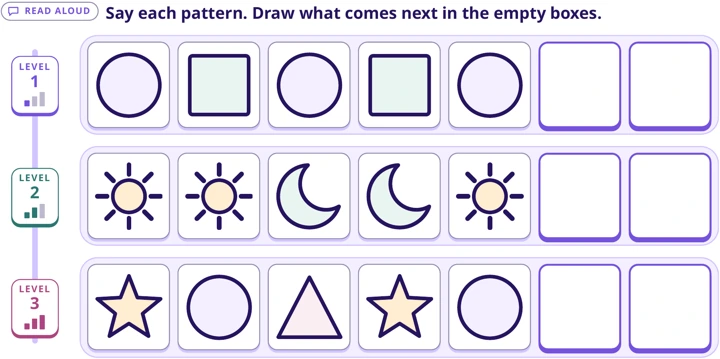
What comes next? Early-years number and pattern
Say each pattern aloud while pointing to its items, then ask the child what may come next.
Explore resourceIdeas for using this resource
Sample teaching perspectives on what to try, what to adapt and what to watch for.
Meet The Creators
Meet a creator whose teaching interests connect with this template.
Kindly Red Pen
The three-page set covers numerals 1 to 10 with counters and ten frames; the first guide demonstrates 1 to 5. It asks the child to say a number, place one counter in each space and count to check that the quantity matches.
Notes Between Bells
The ten-frame representation makes one-to-one counting visible, while numeral and number word connect quantity with symbol and language. The stated top-row-first direction gives adults and children a consistent starting point.
Extra Page
Start with the 1-to-5 mat, placing one counter at a time as the child counts. Invite the child to recount and compare with the numeral, and move to the remaining cards when the smaller set is secure.
Kind Check-In
The cards practise quantities to ten and do not show general number understanding by themselves. Because the material names ages 3 to 5, supply counters of a suitable size under adult supervision; check any extension beyond the printed range.