
Music and performing arts
Instrument cards: meet the orchestra families
Sort 16 labelled orchestra cards into four families and explain how each family makes sound. Three pupil pages provide the sorting sheet, schematic instrument cards and fact checks. The companion gives placements and answers, including why a metal flute belongs to woodwind; no audio is supplied.
Meet the instrument, then compare how it is played with another orchestra family.
Read the complete materialRead the material
Sort 16 labelled orchestra cards into four families and explain how each family makes sound. Three pupil pages provide the sorting sheet, schematic instrument cards and fact checks. The companion gives placements and answers, including why a metal flute belongs to woodwind; no audio is supplied.
Pupil worksheet. Use the preview for diagrams and layout.
Page 1
NAME
CLASS
DATE
LEARNING GOAL
Name orchestra instruments and sort
them into families.
1
Meet and sort the families
ACT 1
16 marks
A family is about how the sound is made, not what the instrument is made of. Cut out your 16 cards (pages
2 and 3) and sort them. Write each name on its family ticket.
Strings
Strings are bowed or
plucked.
Woodwind
Blown across a hole or
through a reed.
Brass
Buzz your lips into a
mouthpiece.
Percussion
Struck, shaken or scraped.
2
Fact check
ACT 2
5 marks
a
Sam says: "The flute is made of metal, so it
is brass." Is Sam right? Explain.
b
Circle the right answer.
A trombone changes
notes with a
valve
slide
reed
An oboe player blows
through a
single reed
double reed
A pedal changes the note of
the
timpani
cymbals
ENCORE
Put the violin, cello and double bass cards in order of size. Tell a partner which one you think
plays the lowest notes, and why.
MUSIC
AGES 7 TO 11
THE ORCHESTRA
Instrument cards
Meet, sort and play 16 orchestra instruments.
ACT 1
SUCCESS CRITERIA
I can name instruments from a picture.
I can sort instruments into four families.
I can say how each family is played.
CARDS
4
CARDS
4
CARDS
4
CARDS
4
Pupil activity | Page 1 of 3
Page 2
Cut along the dashed lines. The stub on each card shows its family:
Strings or
Woodwind.
MUSIC
INSTRUMENT CARDS
CARDS 1 TO 8
Strings and woodwind
Violin
HOW IT IS PLAYED
Bowed or plucked. Rest it
under your chin.
LOOK FOR
f-holes, a curly scroll and
a bow.
Cello
HOW IT IS PLAYED
Bowed or plucked. Sit
and hold it between your
knees.
LOOK FOR
Bigger than a violin. A
spike (endpin) rests on
the floor.
Double bass
HOW IT IS PLAYED
Bowed or plucked. Stand,
or sit on a tall stool.
LOOK FOR
The biggest string
instrument, with sloping
shoulders.
Harp
HOW IT IS PLAYED
Plucked with the fingers
of both hands.
LOOK FOR
Lots of strings in a big
triangle-shaped frame.
Flute
HOW IT IS PLAYED
Blow across a hole. Hold
it out sideways to the
right.
LOOK FOR
Usually made of metal,
but still a woodwind!
Clarinet
HOW IT IS PLAYED
Blow through a
mouthpiece with one
reed.
LOOK FOR
A straight black tube with
a bell at the end.
Oboe
HOW IT IS PLAYED
Blow through a double
reed: two thin reeds tied
together.
LOOK FOR
Slimmer than a clarinet,
with no mouthpiece.
Bassoon
HOW IT IS PLAYED
Blow through a double
reed on a curved metal
tube (crook).
LOOK FOR
A long wooden tube
folded in two.
STRINGS
1
STRINGS
2
STRINGS
3
STRINGS
4
WOODWIND
5
WOODWIND
6
WOODWIND
7
WOODWIND
8
small / chin
endpin / seated
largest / low notes
Pupil activity | Page 2 of 3
Page 3
Cut along the dashed lines. The stub on each card shows its family:
Brass or
Percussion.
MUSIC
INSTRUMENT CARDS
CARDS 9 TO 16
Brass and percussion
Trumpet
HOW IT IS PLAYED
Buzz your lips into a
mouthpiece. Press three
valves.
LOOK FOR
Three valves on top and
a bell at the front.
French horn
HOW IT IS PLAYED
Buzz your lips into a
mouthpiece. One hand
rests in the bell.
LOOK FOR
A round, coiled tube with
a wide flared bell.
Trombone
HOW IT IS PLAYED
Buzz your lips. Push and
pull the slide to change
notes.
LOOK FOR
A long U-shaped slide.
Tuba
HOW IT IS PLAYED
Buzz your lips into a big
mouthpiece. Press the
valves.
LOOK FOR
The biggest, lowest
brass. Its bell points up.
Timpani
HOW IT IS PLAYED
Struck with soft sticks. A
pedal tunes the drum.
LOOK FOR
Big kettle drums on
stands.
Xylophone
HOW IT IS PLAYED
Struck with beaters on
wooden bars.
LOOK FOR
Shorter bars play higher
notes.
Snare drum
HOW IT IS PLAYED
Struck with sticks. Wires
under it make it rattle.
LOOK FOR
A shallow drum on a
stand.
Cymbals
HOW IT IS PLAYED
Crashed together, or
struck with a stick.
LOOK FOR
Two round metal plates
with handles.
BRASS
9
BRASS
10
BRASS
11
BRASS
12
PERCUSSION
13
PERCUSSION
14
PERCUSSION
15
PERCUSSION
16
Pupil activity | Page 3 of 3
Page 1
Teacher companion
Instrument cards: meet the orchestra families
Family sort, 16 marks
Strings: violin, cello, double bass, harp. Woodwind: flute, clarinet, oboe, bassoon. Brass: trumpet, French
horn, trombone, tuba. Percussion: timpani, xylophone, snare drum, cymbals. One mark per correct family
placement.
Fact check, 5 marks
Sam is wrong: the flute is woodwind because sound is produced by blowing across its embouchure hole,
regardless of metal construction (2). Trombone: slide (1). Oboe: double reed (1). Pedal: timpani (1). Total
activity score 21.
Visual comparison and extension
The new first three string diagrams use different sizes; violin is the small chin-held instrument, cello the
larger seated instrument with an endpin, and double bass the largest. Typical size order is violin, cello,
double bass; the double bass usually plays the lowest notes. Diagrams are schematic and labelled, not
photographs or a blind recognition assessment.
Sequence
This new edition has three pupil pages and this separate key.
 No audio is supplied.
Teacher companion | Page 1 of 1
A teaching sequence
Pupils should name the pictured instruments, sort them into strings, woodwind, brass and percussion, and explain the sound-making basis of a placement. They should use card details to distinguish a flute’s construction material from its family.
Meet the instrument, then compare how it is played with another orchestra family.
Read the complete materialInspect names and playing clues
Inspect the instrument names, playing descriptions and visual clues. Compare the violin, cello and double bass using their labelled size and playing-position features.
How do the labelled size and position clues distinguish violin, cello and double bass?
Sort by sound-making method
Sort the 16 cards and record four names on each family ticket. Ask pupils to justify a placement by sound-making method, while recognising that the cards already show family labels.
Why is the metal flute grouped as woodwind?
Check the printed instrument facts
Complete the fact checks using the card evidence: flute, trombone slide, oboe double reed and timpani pedal. Revisit any explanation based only on what an instrument is made from.
Which card identifies the slide, double reed or tuning pedal?
Meet the instrument, then compare how it is played with another orchestra family.
Read the complete materialReview the schematic comparison
Review the family groups with the companion. Discuss the printed size-order challenge and ask pupils to connect their answer to the schematic clues rather than treating the pictures as photographs.
What supports the size order without treating drawings as photographs?
Before you teach
Look for the thinking behind an answer, choose the support your class needs and leave room for an independent response.
What to look for
A useful response places the flute in woodwind because it is played by blowing across a hole, even though it is usually metal. The trombone uses a slide, the oboe a double reed and the timpani a pedal. If a pupil groups by material, return to the family’s sound-making description and re-sort one card.
Give a little support
Compare two cards at a time and underline the playing verbs: bowed, plucked, blown, buzzed or struck. Keep the four family descriptions beside the cards. Let pupils point or place uncut cards if cutting is a barrier, then ask for one short reason for their choice.
Take the idea further
Build a comparison within one family, such as flute, clarinet and oboe. Explain what they share and how their playing methods differ, using the printed descriptions. Create a new question whose answer can be checked on those cards, then exchange it with a partner.
Things to keep in mind
Diagrams are schematic and labelled. No sound files or unlabelled picture-recognition assessment are supplied.
Keep the idea. Make it yours.
Bring your topic, learning goal and class context to PLAI™, then review what you create.
Ideas to try with your class
Sample teaching perspectives on what to try, what to adapt and what to watch for.
Meet The Creators
Meet the creators whose teaching interests connect with this template. Find an approach to try with your class.

Hoang Thi Trang
Working with different year groups lets me return to musical ideas in varied ways, while keeping the purpose of each lesson clear.
Meet the creator
Lisa Coker
Because classes meet for Music at a regular point in the week, I want repertoire and listening choices that give pupils something worth exploring and returning to.
Meet the creator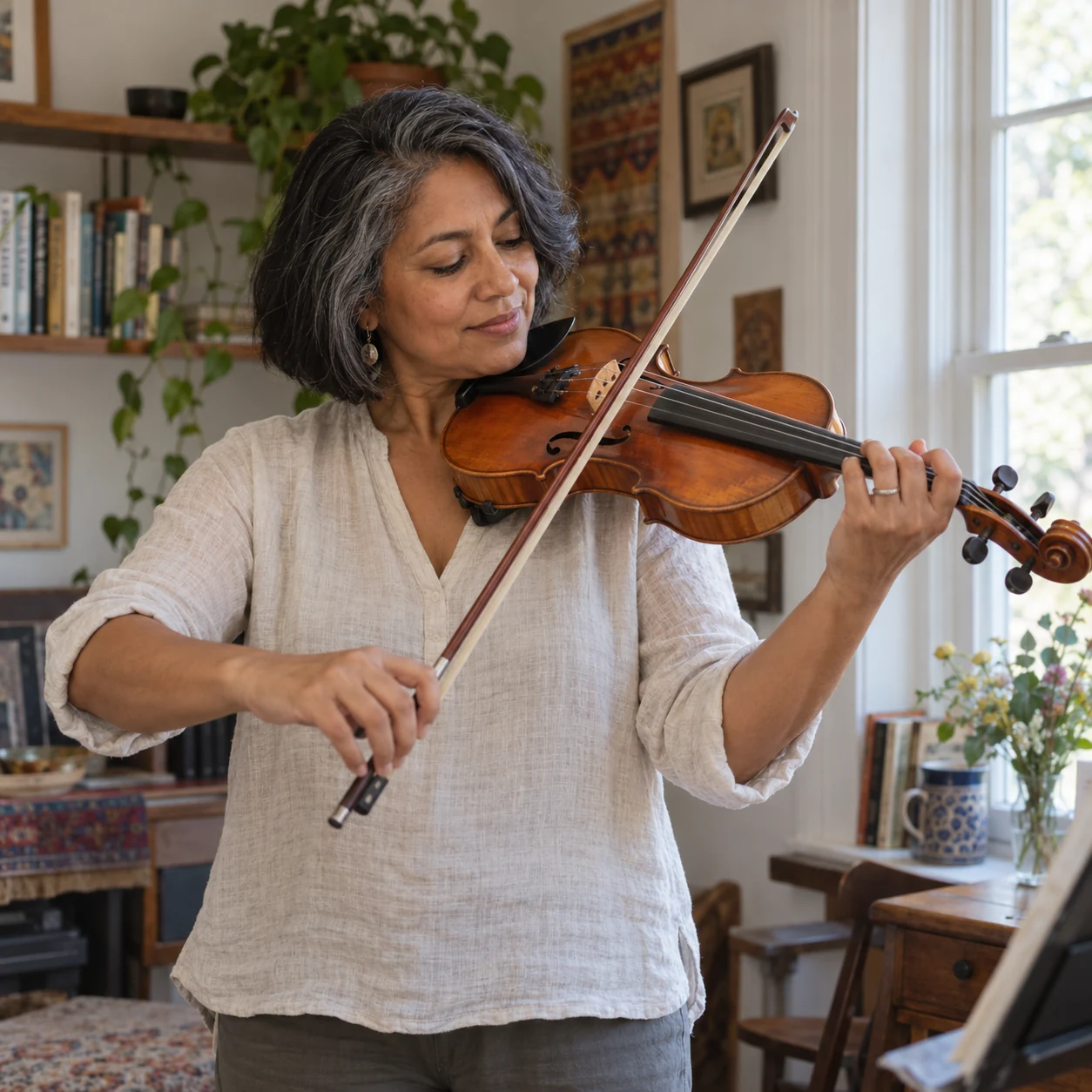
Helen Curzon-Rae
I want music-making to be a regular part of school life, with time to listen, practise and develop an ensemble sound.
Meet the creator
Gentle Reminder
The 16 cards are sorted by how sound is made: bowed or plucked strings, blown woodwind, buzzing brass and struck, shaken or scraped percussion. The flute question directly tests the rule that family is not determined by what an instrument is made from.
Page-Turner Planner
For ages 7 to 11, pupils name, sort and explain before answering a fact check about trombone, oboe and timpani. The size order for violin, cello and double bass adds a listening-related discussion about which may play the lowest notes.
Paperclip Perspective
The family tickets and card details give a visual route into sorting, while “how it is played” supplies a clue to discuss. Ask pupils to justify one placement aloud rather than relying on the card’s material alone.
Bright Margins
The family categories depend on sound production, not instrument material; preserve the flute example when using the set. Check any instrument fact against a music source before extending the cards beyond the pictured instruments.