
Geography
Debate a school rain-garden location
For Years 8 to 9 Geography pupils, use fictional school site notes and stated constraints to compare two rain-garden locations and justify a group decision.
Read the material
For Years 8 to 9 Geography pupils, use fictional school site notes and stated constraints to compare two rain-garden locations and justify a group decision.
Pupil cards and task. Use the preview for diagrams and layout.
Page 1
Debate a school rain-garden location
Pupil cards and task
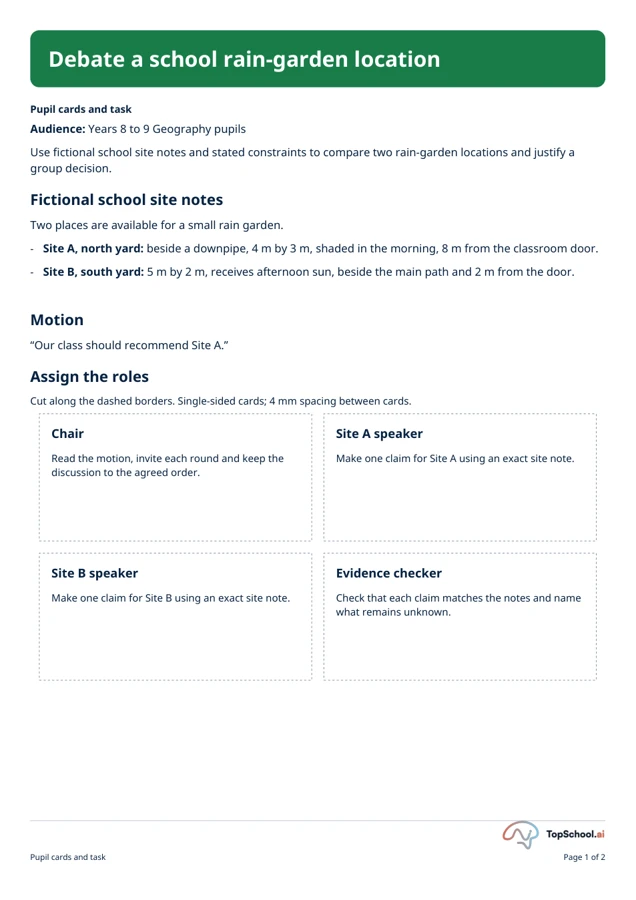
Audience: Years 8 to 9 Geography pupils
Use fictional school site notes and stated constraints to compare two rain-garden locations and justify a
group decision.
Fictional school site notes
Two places are available for a small rain garden.
-
Site A, north yard: beside a downpipe, 4 m by 3 m, shaded in the morning, 8 m from the classroom door.
-
Site B, south yard: 5 m by 2 m, receives afternoon sun, beside the main path and 2 m from the door.
Motion
“Our class should recommend Site A.”
Assign the roles
Cut along the dashed borders. Single-sided cards; 4 mm spacing between cards.
Chair
Read the motion, invite each round and keep the
discussion to the agreed order.
Site A speaker
Make one claim for Site A using an exact site note.
Site B speaker
Make one claim for Site B using an exact site note.
Evidence checker
Check that each claim matches the notes and name
what remains unknown.
Pupil cards and task
Page 1 of 2
Page 2
Debate a school rain-garden location
Challenger
Ask one respectful question about access, shade,
space or missing evidence.
Summariser
Record one accepted point, one unresolved
question and the group's final decision.
With fewer than six pupils, combine the evidence-checker and challenger roles.
Debate rounds
1. Plan: each speaker chooses a site detail and one reason.
2. Open: Site A and Site B speakers each give a claim with evidence.
3. Challenge and reply: ask one question, then let the other speaker respond.
4. Summarise: record the strongest point for each site, the unknowns and the group's choice.
Site A area: 4 × 3 = ____ m². Site B area: 5 × 2 = ____ m². Which site is closer to the door? ________
Ground rules: one voice at a time; challenge the idea, not the person; use a site detail; summarise before
replying.
Pupil cards and task
Page 2 of 2
Page 1
Debate a school rain-garden location
Teacher key and guidance supporting this exact edition
Teacher check
Site A area is 12 m²; Site B area is 10 m². Site B is 6 m closer to the door. The notes do not establish which site
will drain better, so the debate has no single evidence-proven winner.
Teacher companion
Page 1 of 1
A teaching sequence
Use fictional school site notes and stated constraints to compare two rain-garden locations and justify a group decision.
Plan from the site notes
In planning, each side selects one site detail and one question for further investigation.
Which exact site detail supports your speaker's reason?
Make both opening claims
In opening statements, the Site A and Site B speakers each give one claim with a note as evidence.
Has each speaker named a fact rather than assumed a drainage outcome?
Challenge and reply respectfully
The challenger asks one respectful question; each speaker responds with a site detail.
What information about access or shade is still missing?
Summarise a qualified decision
The summariser records one accepted point, one unresolved question and the group decision.
Which point was accepted, and which question remains unresolved?
Before you teach
Look for the thinking behind an answer, choose the support your class needs and leave room for an independent response.
What to look for
Site A is 12 m² and Site B is 10 m²; Site B is 6 m closer to the door, while Site A is beside a downpipe. No drainage test or site map is supplied, so neither drainage outcome is established.
Give a little support
Provide a site-notes table, role cards and the frame “We choose __ because the site notes show __.”
Take the idea further
Add a third location or ask what additional field evidence a real decision would need.
Things to keep in mind
The scenario is fictional and does not describe the school grounds or establish a real drainage outcome.
Keep the idea. Make it yours.
Bring your topic, learning goal and class context to PLAI™, then review what you create.
Ideas to try with your class
Sample teaching perspectives on what to try, what to adapt and what to watch for.
Meet The Creators
Meet a creator whose teaching interests connect with this template.

Thoughtful Pause
The fictional site notes distinguish north-yard Site A’s downpipe, shade and distance from the door from south-yard Site B’s afternoon sun and position beside the main path. Roles require exact notes, missing evidence and a decision.
Bright Margins
The debate assigns chair, site speakers, evidence checker, challenger and summariser, with a combination when fewer than six pupils take part. The group must record one accepted point, an unresolved question and its final choice.
Tea Break Notes
The evidence checker can ask speakers to connect each claim directly to a site dimension or feature before the challenger raises access, shade, space or missing information. This makes the evidence routine visible for geography discussion.
Step by Step
The sites are invented and the notes omit key design and access details. A class recommendation is a discussion decision, not approval to build; confirm drainage, safety, land ownership and other local requirements separately.