
Wellbeing and personal development
My goal plan: small steps and weekly check-in
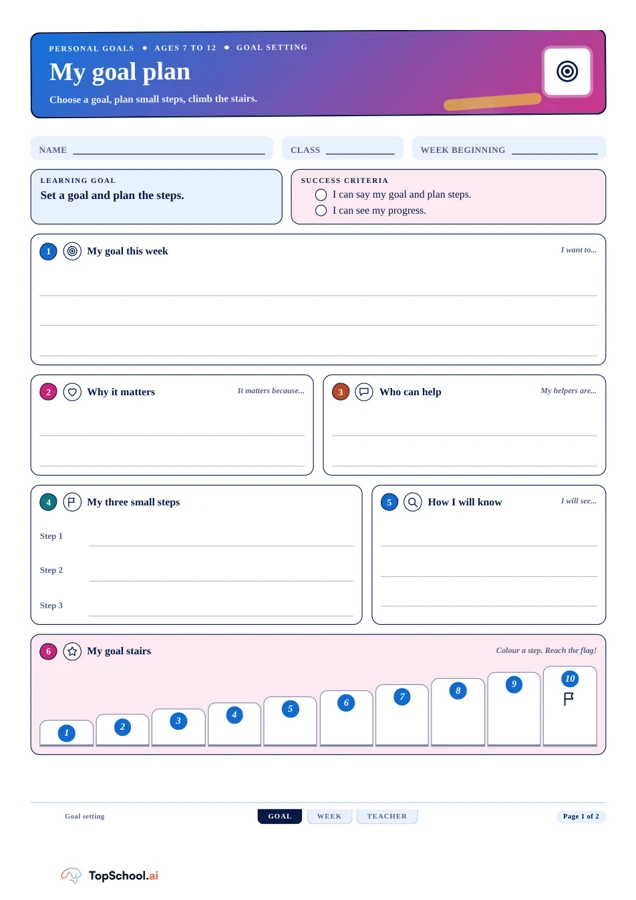
Choose a personal goal, write why it matters, identify someone who can help and break the goal into three small steps. A weekly tracker supports two goals across five days and invites pupils to celebrate progress and notice what helped.
Read the material
Choose a personal goal, write why it matters, identify someone who can help and break the goal into three small steps. A weekly tracker supports two goals across five days and invites pupils to celebrate progress and notice what helped.
Complete resource. Use the preview for diagrams and layout.
Page 1
NAME
CLASS
WEEK BEGINNING
LEARNING GOAL
Set a goal and plan the steps.
SUCCESS CRITERIA
I can say my goal and plan steps.
I can see my progress.
Goal setting
GOAL
WEEK
TEACHER
Page 1 of 2
PERSONAL GOALS
AGES 7 TO 12
GOAL SETTING
My goal plan
Choose a goal, plan small steps, climb the stairs.
1
My goal this week
I want to...
2
Why it matters
It matters because...
3
Who can help
My helpers are...
4
My three small steps
Step 1
Step 2
Step 3
5
How I will know
I will see...
6
My goal stairs
Colour a step. Reach the flag!
1
2
3
4
5
6
7
8
9
10
Page 2
Write your goal. Each day, circle one face. All answers are okay. Then colour a step.
Goal setting
GOAL
WEEK
TEACHER
Page 2 of 2
PERSONAL GOALS
AGES 7 TO 12
MY WEEK
My week, my goals
GOAL 1
Mon
Yes!
A bit
Not yet
Tue
Yes!
A bit
Not yet
Wed
Yes!
A bit
Not yet
Thu
Yes!
A bit
Not yet
Fri
Yes!
A bit
Not yet
Goal 1 steps
1
2
3
4
5
6
7
8
9
10
GOAL 2
Mon
Yes!
A bit
Not yet
Tue
Yes!
A bit
Not yet
Wed
Yes!
A bit
Not yet
Thu
Yes!
A bit
Not yet
Fri
Yes!
A bit
Not yet
Goal 2 steps
1
2
3
4
5
6
7
8
9
10
1
Celebrate my progress
Start with: I am proud that I…
2
What helped me
Start with: It helped when…
A teaching sequence
Set a meaningful goal, plan manageable steps and reflect on what helped during the week.
Plan three manageable actions
Choose a personal goal, say why it matters and name a person who could help. Break it into three small steps and an observable sign of progress.
What observable sign would show progress towards this goal?
Use the stairs as a reminder
Colour a stair for a step or milestone reached; the ten-step path is a reminder, not a score or promised timescale.
Which milestone has been reached, without treating the path as a score?
Record a chosen weekly check
On the weekly sheet, track up to two goals each weekday using Yes, A bit or Not yet. Colour a step for progress.
Does Yes, A bit or Not yet reflect what happened today?
Celebrate and adjust
Write something to celebrate and a factor that helped. Decide with the pupil whether to continue, change or pause.
Would you like to continue, change or pause this goal?
Before you teach
Look for the thinking behind an answer, choose the support your class needs and leave room for an independent response.
What to look for
Check that the goal is within the pupil’s influence, broken into small steps and connected to an observable sign of progress. Ask what support would help and whether the pupil wants to continue with the goal. Treat “not yet” as information for planning, not failure.
Give a little support
Offer examples and help reword a broad goal into one small action. A pupil can draw or talk through the steps and may track only one goal. Avoid setting a target on a pupil’s behalf or requiring disclosure about why the goal matters.
Take the idea further
After the week, ask the pupil to compare the steps planned with the actions tried. They can identify one helpful strategy, revise a step and choose whether to carry the goal into another week.
Things to keep in mind
Progress is not always linear and can depend on support or circumstances outside a pupil’s control. The stairs graphic is a visual tracker, not a measure of a child’s ability. Adapt the time window and response choices to the goal.
Keep the idea. Make it yours.
Bring your topic, learning goal and class context to PLAI™, then review what you create.
Ideas to try with your class
Sample teaching perspectives on what to try, what to adapt and what to watch for.
Meet The Creators
Meet the creators whose teaching interests connect with this template. Find an approach to try with your class.

Anita Sharma
A short plan can help the adults agree what to do, but it should remain connected to the pupil’s experience and be reviewed rather than filed away.
Meet the creator
Hannah Goldberg
I plan secondary learning adjustments as familiar tools in everyday classroom practice before examinations, discussing what helps and checking that teachers can apply the agreed approach consistently.
Meet the creator
Thomas Beattie
A task should help pupils think or give the teacher something actionable to respond to; it should not simply generate more work to read and record.
Meet the creator
Rachel Kaminski
I coordinate access arrangements and targeted support through evidence of normal classroom practice, asking what barriers pupils meet, what has been tried and what teachers have observed.
Meet the creator
Helena Marsh
Time is limited, so I want to remove tasks that do not help and give staff space to concentrate on the work that matters.
Meet the creator
Hannah Zwelithini-Grant
Regular review gives families and teachers a chance to discuss what is working, what needs adjustment and whether a new support should be tried.
Meet the creator
Julie Anstey
I prefer a concise plan that names a small number of strategies, gives staff something practical to try and leaves room to review how it went.
Meet the creator
Callum Ferris
I target Year 6 retrieval at the class’s current gaps and prepare transition communication for families considering different secondary settings, keeping the next step clear and relevant.
Meet the creator
Fiona McArdle
I use Year 8 English teaching to examine how whole-school routines work in class, looking for patterns in context and communicating next steps calmly and specifically to families.
Meet the creator
Hannah Zielinski
I make inclusion plans understandable to families and organise access evidence around the decision it supports, with clear language, reliable records and appropriate boundaries for personal information.
Meet the creator
Step by Step
The two-page plan asks for a weekly goal, why it matters, helpers, three steps and a sign of progress; a staircase visual tracks steps. The second page records two goals across weekdays and asks what helped.
Quietly Curious
For ages 7 to 12, the sheet connects an intention to practical actions and a weekly review. Its daily “Yes”, “A bit” and “Not yet” responses allow progress to be described without a single all-or-nothing check.
Open Book Pause
The helper prompt and three small steps encourage a pupil to plan support as well as effort. Adults can make the goal more manageable by agreeing one observable sign of progress with the pupil.
Helpful Highlighter
The “goal stairs” and daily face check should not make a missed step feel like failure. Use the reflection to adjust the pupil's three small steps or named helpers, not to rank pupils or treat a coloured stair as proof that the weekly goal was reached.