
Worksheet
Exit tickets: reflect on today’s learning
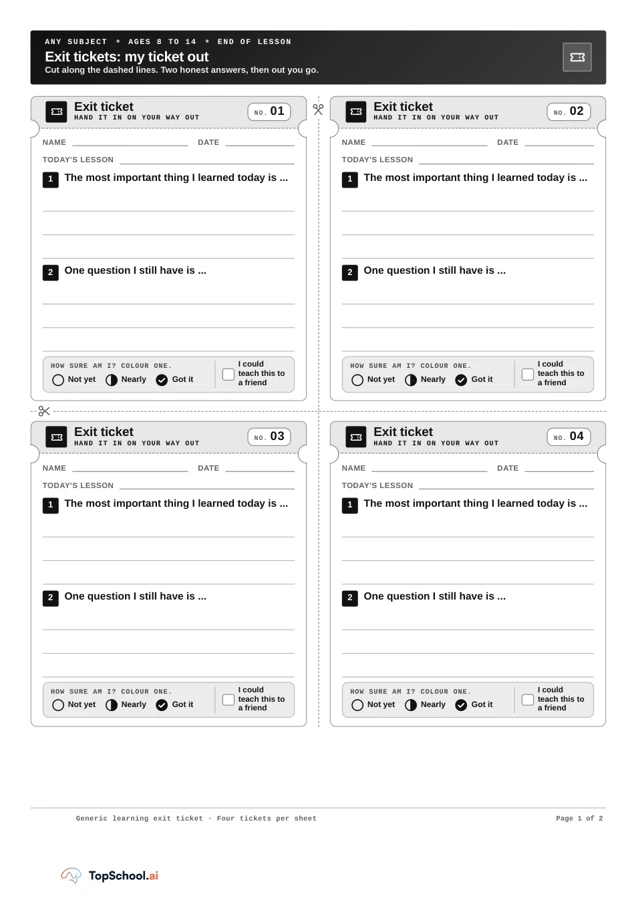
Use a short written exit ticket to capture one important idea, one question and a confidence check. A second format uses three things learned, two connections and one question, giving pupils a brief way to reflect before leaving a lesson.
Read the material
Use a short written exit ticket to capture one important idea, one question and a confidence check. A second format uses three things learned, two connections and one question, giving pupils a brief way to reflect before leaving a lesson.
Activity. Use the preview for diagrams and layout.
Page 1
Generic learning exit ticket · Four tickets per sheet
ANY SUBJECT
AGES 8 TO 14
END OF LESSON
Exit tickets: my ticket out
Cut along the dashed lines. Two honest answers, then out you go.
Exit ticket
HAND IT IN ON YOUR WAY OUT
NO. 01
NAME
DATE
TODAY'S LESSON
1
The most important thing I learned today is ...
2
One question I still have is ...
HOW SURE AM I? COLOUR ONE.
Not yet
Nearly
Got it
I could
teach this to
a friend
Exit ticket
HAND IT IN ON YOUR WAY OUT
NO. 02
NAME
DATE
TODAY'S LESSON
1
The most important thing I learned today is ...
2
One question I still have is ...
HOW SURE AM I? COLOUR ONE.
Not yet
Nearly
Got it
I could
teach this to
a friend
Exit ticket
HAND IT IN ON YOUR WAY OUT
NO. 03
NAME
DATE
TODAY'S LESSON
1
The most important thing I learned today is ...
2
One question I still have is ...
HOW SURE AM I? COLOUR ONE.
Not yet
Nearly
Got it
I could
teach this to
a friend
Exit ticket
HAND IT IN ON YOUR WAY OUT
NO. 04
NAME
DATE
TODAY'S LESSON
1
The most important thing I learned today is ...
2
One question I still have is ...
HOW SURE AM I? COLOUR ONE.
Not yet
Nearly
Got it
I could
teach this to
a friend
Page 1 of 2
Page 2
Generic learning exit ticket · 3-2-1 variant
ANY SUBJECT
AGES 8 TO 14
3-2-1 VARIANT
3-2-1 tickets: count it out
Three things, two links, one question. Short and true is perfect.
3-2-1 ticket
THREE, TWO, ONE, AND OUT
NO. 05
NAME
DATE
TODAY'S LESSON
3
things I learned
2
interesting facts or connections
1
question I still have
HOW SURE AM I? COLOUR ONE.
Not yet
Nearly
Got it
I could
teach this to
a friend
1
2
3
1
2
3-2-1 ticket
THREE, TWO, ONE, AND OUT
NO. 06
NAME
DATE
TODAY'S LESSON
3
things I learned
2
interesting facts or connections
1
question I still have
HOW SURE AM I? COLOUR ONE.
Not yet
Nearly
Got it
I could
teach this to
a friend
1
2
3
1
2
3-2-1 ticket
THREE, TWO, ONE, AND OUT
NO. 07
NAME
DATE
TODAY'S LESSON
3
things I learned
2
interesting facts or connections
1
question I still have
HOW SURE AM I? COLOUR ONE.
Not yet
Nearly
Got it
I could
teach this to
a friend
1
2
3
1
2
3-2-1 ticket
THREE, TWO, ONE, AND OUT
NO. 08
NAME
DATE
TODAY'S LESSON
3
things I learned
2
interesting facts or connections
1
question I still have
HOW SURE AM I? COLOUR ONE.
Not yet
Nearly
Got it
I could
teach this to
a friend
1
2
3
1
2
Page 2 of 2
A teaching sequence
Summarise learning, identify an open question and reflect on confidence at the end of a lesson.
Choose and complete a standard ticket
Give each pupil a cut ticket or display the prompts to copy. Record one important learning point, one open question and a chosen confidence response on the standard ticket.
What important learning and open question can you honestly record?
Use the 3-2-1 alternative
On the 3-2-1 version, record three things learned, two interesting facts or connections and one remaining question. Use short notes if needed.
Which two facts or connections belong to this lesson?
Follow the agreed collection
Hand the completed ticket to the teacher on the way out, following the agreed name and collection instructions.
What name and collection instructions has the teacher given?
Plan a response to the tickets
Sort the tickets by confidence, recurring questions or ideas that need revisiting. Use a recurring question to plan the next lesson’s follow-up and share a response with the class.
Which recurring question needs a follow-up rather than a confidence label alone?
Before you teach
Look for the thinking behind an answer, choose the support your class needs and leave room for an independent response.
What to look for
Look for a specific idea from the lesson, a genuine question or connection and a confidence choice. Treat the response as a quick snapshot, not proof of mastery. Use patterns in the tickets to plan a follow-up question, explanation or additional practice.
Give a little support
Allow a pupil to draw, dictate or write a short phrase. Explain the confidence choices without implying that “got it” is a grade. If pupils need time to formulate a question, offer a sentence starter such as “I am still wondering…”.
Take the idea further
Ask pupils to connect today’s idea with an earlier lesson or to write a question that would help a classmate explain the topic. At the next lesson, revisit selected questions and ask whether the new explanation changed their confidence.
Things to keep in mind
An exit ticket captures what a pupil chooses to write at one moment and may not show their full understanding. It does not guarantee anonymity unless the teacher removes identifying fields and explains the collection process.
Keep the idea. Make it yours.
Bring your topic, learning goal and class context to PLAI™, then review what you create.
Ideas to try with your class
Sample teaching perspectives on what to try, what to adapt and what to watch for.
Meet The Creators
Meet the creators whose teaching interests connect with this template. Find an approach to try with your class.

Nicole Fontaine
I teach Science as a specialist across the primary phase, with a focus on keeping the purpose of each activity clear.
Meet the creatorMaya Tan
I plan adaptation before the lesson, choosing accessible texts, vocabulary support and preparation time so pupils with different starting points can join the same Year 4 conversation.
Meet the creatorDang Thi Thao
I look for ways to make instructions explicit, check understanding without putting anyone on the spot and connect a new idea to examples the group can recognise.
Meet the creator
Cerys Evans
Staying connected to classroom learning helps me understand what pupils know through the work itself, alongside the information a report or assessment may provide.
Meet the creator
Grace Whitfield
I introduce Religious Education through questions, warm explanations and discussion, making space for pupils to explore beliefs and practices without assuming their family’s experience of faith.
Meet the creatorGrace Adeyemi
I make choir invitations open and rehearsals purposeful, helping children listen, keep a shared pulse and contribute together while giving Art the time it needs for practical choices.
Meet the creator
Marcus Bell
I use small steps and careful representations so pupils can see how a method works rather than guess which procedure to copy.
Meet the creator
Hollie Braithwaite
Revision is more useful when it responds to a specific gap pupils have shown, rather than covering a broad topic simply because it appears in a generic pack.
Meet the creator
Leanne Ackroyd
I work with Year 7 tutors on concise settling-in summaries that identify useful follow-up conversations, leaving room to learn directly from pupils after their first weeks in secondary school.
Meet the creator
Pocketful of Stories
The two-page sheet provides four cut-out tickets with a lesson summary, an open question and a confidence choice, then four 3-2-1 tickets asking for three learnings, two connections and one question.
Planning List
For ages 8 to 14 and any subject, the exit ticket captures what a pupil can state at the end of one lesson. The second format makes room for links between ideas as well as an unresolved question.
Book and Biscuit
The confidence choices range from “Not yet” to “I could teach this to a friend”, allowing a pupil to signal how secure the learning feels. A teacher can use the question to decide what needs revisiting.
Steady Marker
A self-rating is not a test score or evidence that a pupil can independently teach the topic. Interpret it alongside the written response and lesson evidence, and keep the two ticket formats distinct when collecting results.