
Science
Science words in use: compare, evidence and conclusion
Read six science words with their meanings, then use them to describe a small practice data set and explain a conclusion.
Read the material
Read six science words with their meanings, then use them to describe a small practice data set and explain a conclusion.
Pupil document. Use the preview for diagrams and layout.
Page 1
Teaching template
1
Science words in use: compare, evidence
and conclusion
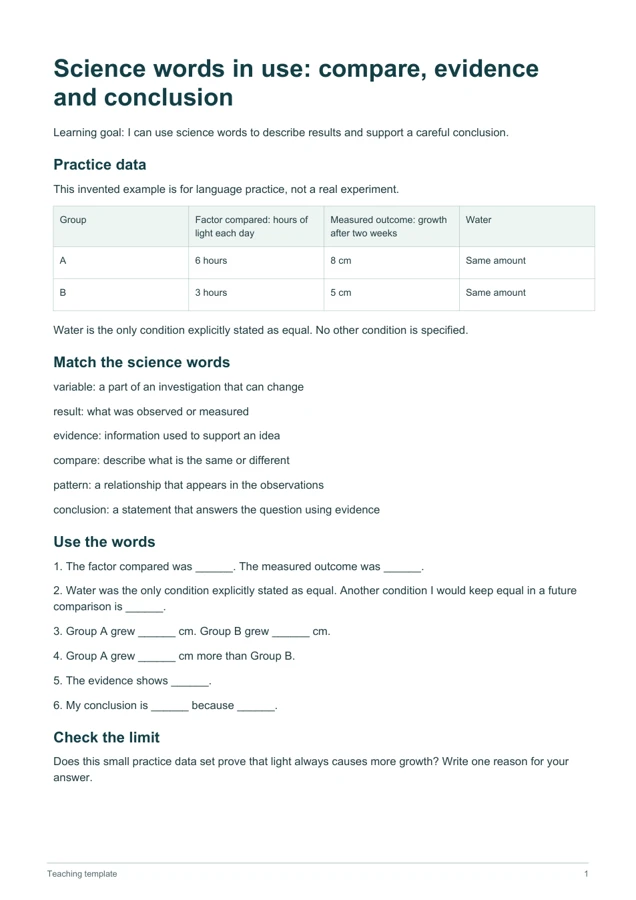
Learning goal: I can use science words to describe results and support a careful conclusion.
Practice data
This invented example is for language practice, not a real experiment.
Group
Factor compared: hours of
light each day
Measured outcome: growth
after two weeks
Water
A
6 hours
8 cm
Same amount
B
3 hours
5 cm
Same amount
Water is the only condition explicitly stated as equal. No other condition is specified.
Match the science words
variable: a part of an investigation that can change
result: what was observed or measured
evidence: information used to support an idea
compare: describe what is the same or different
pattern: a relationship that appears in the observations
conclusion: a statement that answers the question using evidence
Use the words
1. The factor compared was ______. The measured outcome was ______.
2. Water was the only condition explicitly stated as equal. Another condition I would keep equal in a future
comparison is ______.
3. Group A grew ______ cm. Group B grew ______ cm.
4. Group A grew ______ cm more than Group B.
5. The evidence shows ______.
6. My conclusion is ______ because ______.
Check the limit
Does this small practice data set prove that light always causes more growth? Write one reason for your
answer.
Page 1
Teaching template
1
Science words in use: compare, evidence
and conclusion: teacher notes
Teacher check
Expected: factor compared, hours of light; measured outcome, growth after two weeks; only stated equal
condition, water. Group A grew 3 cm more. Pupils should say the fictional values show a difference in this
example, not prove that light caused it. An additional condition such as plant type is a possible future
control, not a condition stated as equal in this table.
A teaching sequence
Explain six common science words and use evidence and because to connect a result with a cautious conclusion.
Read the six investigation terms
Read variable, result, evidence, compare, pattern and conclusion with their displayed definitions.
What does evidence mean in this invented practice task?
Identify factor, outcome and stated control
Identify hours of light as the factor compared and growth after two weeks as the measured outcome. Water is the only condition explicitly stated as equal; no other condition is specified.
Which condition is actually stated as equal, rather than assumed?
Complete frames through table evidence
Underline the part of the practice data that supports a statement and complete the sentence frames using the table.
What value supports the comparison between Group A and Group B?
Write a careful conclusion with a limit
Write a short conclusion. Include one limit: two groups alone do not show that the pattern will always happen.
Why do these two groups not prove that light always causes more growth?
Before you teach
Look for the thinking behind an answer, choose the support your class needs and leave room for an independent response.
What to look for
Expected: hours of light is the factor compared; growth after two weeks is the measured outcome; water is the only condition explicitly stated as equal. Group A grew 8 cm and Group B 5 cm, so A grew 3 cm more. The fictional values show a difference in this example, not that light caused it. Follow up: ask which additional condition, such as plant type, pupils would keep equal in a future comparison; the table does not state that it was equal here.
Give a little support
Pre-teach variable, result and evidence with gestures or labelled examples. Let pupils rehearse the sentence aloud before writing and keep the values visible.
Take the idea further
Ask pupils to suggest one additional condition to keep the same and one way to repeat the practice investigation. Explain why more observations would strengthen a conclusion.
Things to keep in mind
The values are invented for language practice, not experimental evidence. Hours of light is the factor compared and growth after two weeks is the measured outcome. Water is the only condition explicitly stated as equal; no other condition is specified. The values show a difference in this example only and do not prove that light caused the growth.
Keep the idea. Make it yours.
Bring your topic, learning goal and class context to PLAI™, then review what you create.
Another starting point
Explore a different teaching task from this selection.
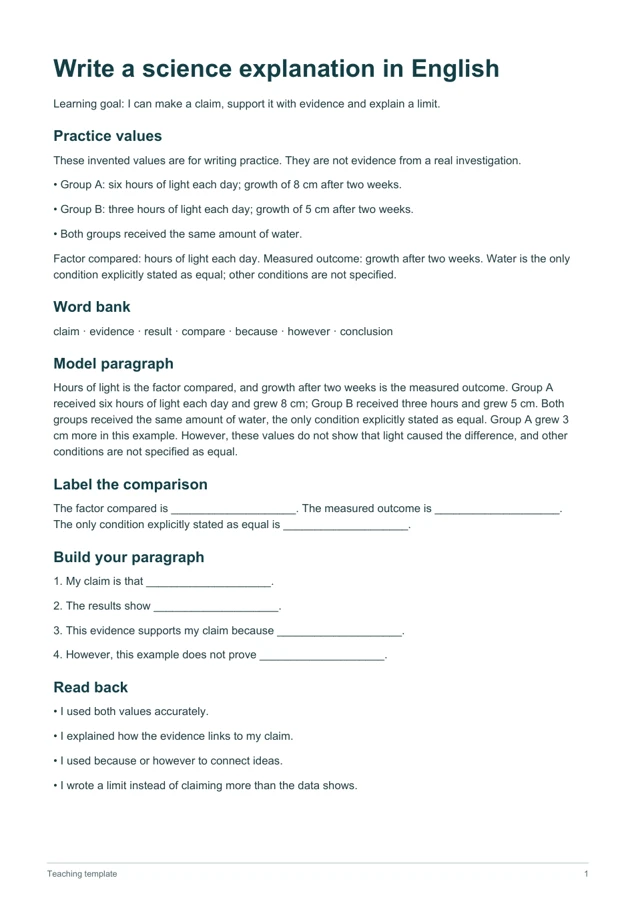
Write a science explanation in English
Read the practice values: Group A grew 8 cm and Group B grew 5 cm. Group A received six hours of light each day and Group B received three. Both groups received the same amount of water. These are invented practice values.
Explore resourceIdeas to try with your class
Sample teaching perspectives on what to try, what to adapt and what to watch for.
Meet The Creators
Meet the creators whose teaching interests connect with this template. Find an approach to try with your class.

Daniel Osei
A word list can help, but it is more useful when pupils see how the language works in a text, a question or a discussion they are already trying to follow.
Meet the creator
Meera Pillai
I help subject teachers identify the language embedded in their tasks and plan ways for EAL pupils to participate, listen and explain their thinking within the lesson.
Meet the creator
Beatriz Ocampo-Lim
I look for plans that show how a pupil can access the same important learning in a way that is appropriate to their current language development.
Meet the creator
Sarah Whitcombe
Mangroves, reefs and tropical ecology give us plenty to investigate, so I look for ways to connect the syllabus with what pupils can observe around them.
Meet the creator
Oliver Bancroft
I value collaboration that supports the pupil in the moment and helps the teacher recognise language demands in future planning.
Meet the creator
Zainab Sheikh
The house role gives student captains responsibility for events, and I want them to be able to take a plan forward rather than wait for an adult to explain every detail.
Meet the creator
Reece Fairclough
I support newly arrived Year 8 EAL pupils through lesson-specific task breakdowns and check-ins, clarifying the first action and checking understanding before giving them room to continue.
Meet the creator
Extra Page
This one-page English science language template supplies invented growth values: Group A receives six hours of light and grows 8 cm; Group B receives three hours and grows 5 cm. Pupils match terms and write a cautious conclusion using evidence and “because.”
Storytime Sidekick
The note that both groups received the same amount of water, while no other condition is specified, gives pupils a concrete limit to include in a conclusion. The data are explicitly for language practice, not a real experiment.
After the Bell
Underline the values, time period and stated water condition before writing. Use a sentence frame that reports the difference and then names what remains unknown.
Open Book Pause
These invented values cannot support a real claim about light and plant growth. Do not infer that water is the only controlled factor; the source says other conditions are unspecified.