
Languages and literacy · Science
Write a science explanation in English
Use a short fictional data set, a word bank and sentence frames to identify the factor compared, name the measured growth outcome and write a cautious explanation. Water is the only condition explicitly stated as equal.
Read the material
Use a short fictional data set, a word bank and sentence frames to identify the factor compared, name the measured growth outcome and write a cautious explanation. Water is the only condition explicitly stated as equal.
Pupil document. Use the preview for diagrams and layout.
Page 1
Teaching template
1
Write a science explanation in English
Learning goal: I can make a claim, support it with evidence and explain a limit.
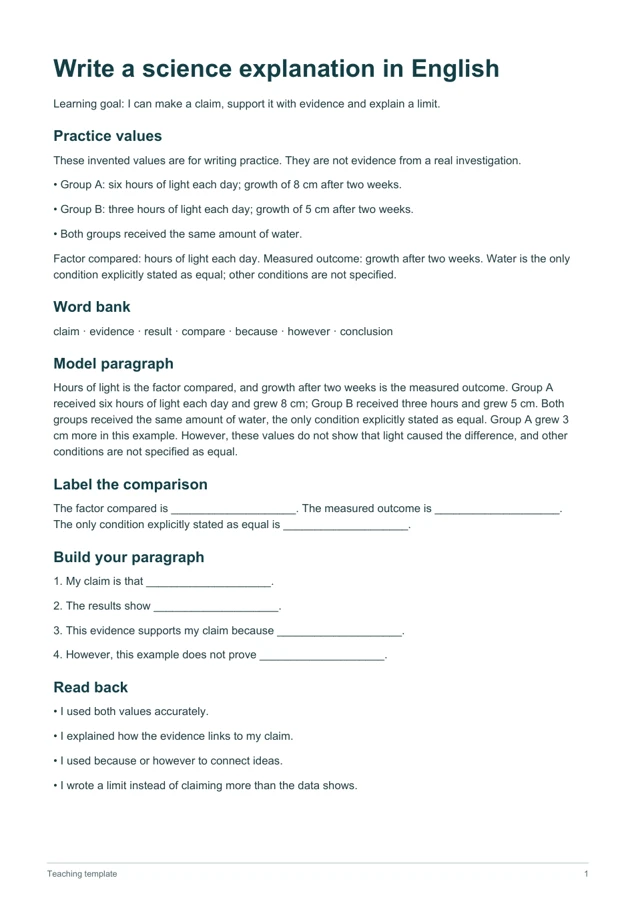
Practice values
These invented values are for writing practice. They are not evidence from a real investigation.
• Group A: six hours of light each day; growth of 8 cm after two weeks.
• Group B: three hours of light each day; growth of 5 cm after two weeks.
• Both groups received the same amount of water.
Factor compared: hours of light each day. Measured outcome: growth after two weeks. Water is the only
condition explicitly stated as equal; other conditions are not specified.
Word bank
claim · evidence · result · compare · because · however · conclusion
Model paragraph
Hours of light is the factor compared, and growth after two weeks is the measured outcome. Group A
received six hours of light each day and grew 8 cm; Group B received three hours and grew 5 cm. Both
groups received the same amount of water, the only condition explicitly stated as equal. Group A grew 3
cm more in this example. However, these values do not show that light caused the difference, and other
conditions are not specified as equal.
Label the comparison
The factor compared is ____________________. The measured outcome is ____________________.
The only condition explicitly stated as equal is ____________________.
Build your paragraph
1. My claim is that ____________________.
2. The results show ____________________.
3. This evidence supports my claim because ____________________.
4. However, this example does not prove ____________________.
Read back
• I used both values accurately.
• I explained how the evidence links to my claim.
• I used because or however to connect ideas.
• I wrote a limit instead of claiming more than the data shows.
Page 1
Teaching template
1
Write a science explanation in English:
teacher notes
Teacher support
Let pupils rehearse each sentence orally. Fade the frames one at a time when pupils can connect a claim
to a named result. Keep the fictional-data label visible.
A teaching sequence
Write a connected English paragraph that makes a claim, quotes a result and explains what the evidence does and does not show.
Identify the factor, outcome and only stated control
Identify hours of light as the factor compared and growth after two weeks as the measured outcome. Both groups received the same amount of water; water is the only condition explicitly stated as equal, and other conditions are not specified.
Which condition is explicitly equal, and which conditions are unreported?
Copy and compare the two fictional results
Copy the two results accurately and compare them using more than or less than.
Have you matched six hours with eight centimetres and three hours with five centimetres?
Build evidence-linked sentences
Complete the sentence frames with evidence and a because explanation.
How does the because explanation connect the claim with the supplied values?
Add a limit and read back
Add a limit to the conclusion, then read the paragraph aloud and check each link.
Does however prevent claiming that these values establish a cause?
Before you teach
Look for the thinking behind an answer, choose the support your class needs and leave room for an independent response.
What to look for
Expected: hours of light is the factor compared; growth after two weeks is the measured outcome; water is the only condition explicitly stated as equal. Group A grew 8 cm and Group B 5 cm, so A grew 3 cm more in this example. These fictional values do not show that light caused the difference, and no other condition is stated as equal. Follow up: ask which additional condition, such as plant type, pupils would keep equal in a future comparison.
Give a little support
Highlight the values before writing, rehearse “The results show…” orally and provide the word bank. Accept a first draft with frames before asking pupils to remove one frame.
Take the idea further
Add a counterpoint beginning “However…” and suggest another observation or a repeated test that would help check the pattern.
Things to keep in mind
The values are fictional writing practice. Hours of light is the factor compared and growth after two weeks is the measured outcome. Water is the only condition explicitly stated as equal; no other condition is specified. These two examples cannot show that light caused growth.
Keep the idea. Make it yours.
Bring your topic, learning goal and class context to PLAI™, then review what you create.
Another starting point
Explore a different teaching task from this selection.
Science words in use: compare, evidence and conclusion
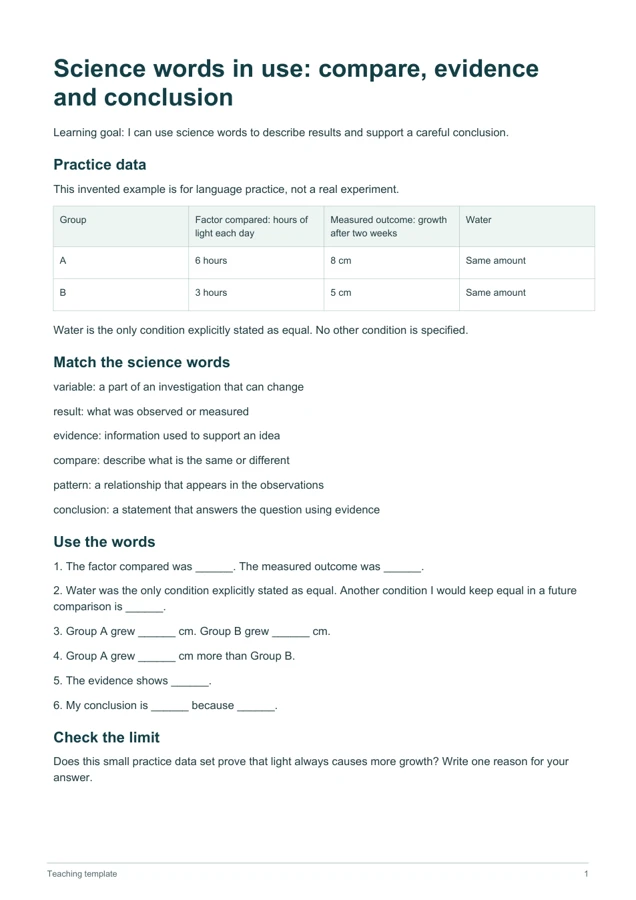
Read the practice data first. Group A received six hours of light each day and grew 8 cm in two weeks. Group B received three hours and grew 5 cm. Both groups received the same amount of water. Treat this as practice data, not a report of a real experiment.
Explore resourceIdeas to try with your class
Sample teaching perspectives on what to try, what to adapt and what to watch for.
Meet The Creators
Meet the creators whose teaching interests connect with this template. Find an approach to try with your class.

Daniel Osei
A word list can help, but it is more useful when pupils see how the language works in a text, a question or a discussion they are already trying to follow.
Meet the creator
Meera Pillai
I help subject teachers identify the language embedded in their tasks and plan ways for EAL pupils to participate, listen and explain their thinking within the lesson.
Meet the creator
Beatriz Ocampo-Lim
I look for plans that show how a pupil can access the same important learning in a way that is appropriate to their current language development.
Meet the creator
Oliver Bancroft
I value collaboration that supports the pupil in the moment and helps the teacher recognise language demands in future planning.
Meet the creator
Page-Turner Planner
This one-page Year 9 science writing template gives invented plant-growth values for two light conditions and explicitly says they are for writing practice, not real investigation evidence. Pupils make a claim, cite a result and explain a limit.
Tea at Breaktime
The supplied figures create a narrow comparison for practising an evidence sentence and an explanation. The disclaimer lets the teacher focus on writing without representing the numbers as measured science.
Notes Between Bells
Underline the two values and their units, then model a sentence that reports the difference without claiming more than the data show. Ask pupils to identify one limitation separately.
Paperclip Perspective
The figures are invented and cannot support a factual claim about light and growth. Use actual experimental data and a suitable method when teaching the science conclusion itself.