
Maths
Find the error: algebra and equations
Identify a distribution error, correct the equation and explain why the revised solution satisfies both sides.
Read the material
Identify a distribution error, correct the equation and explain why the revised solution satisfies both sides.
Pupil document. Use the preview for diagrams and layout.
Page 1
Teaching template
1
Find the error: algebra and equations
Audience: Secondary pupils practising expansion and linear equations
Identify a distribution error, correct the equation and explain why the revised solution satisfies both sides.
Student work to inspect
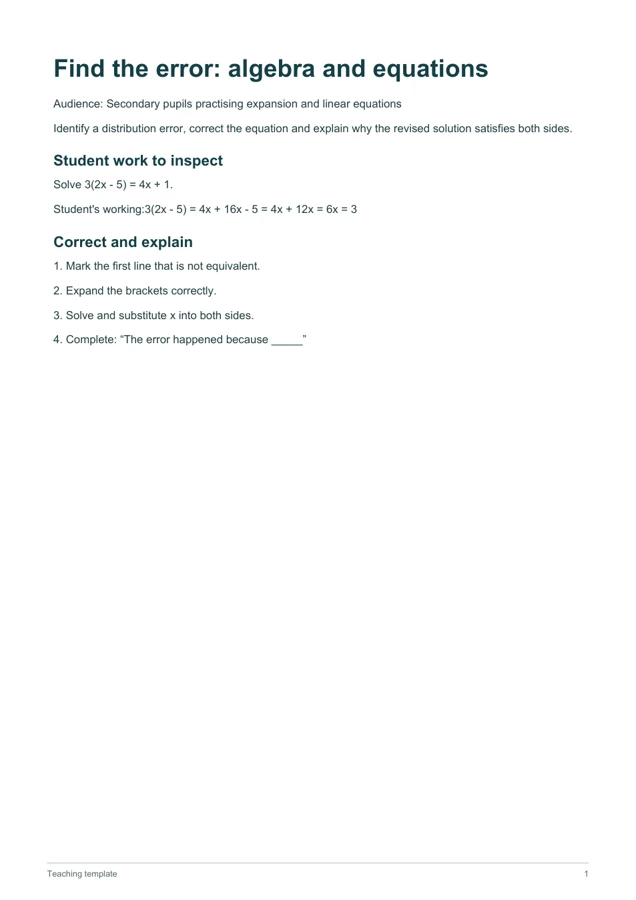
Solve 3(2x - 5) = 4x + 1.
Student's working:3(2x - 5) = 4x + 16x - 5 = 4x + 12x = 6x = 3
Correct and explain
1. Mark the first line that is not equivalent.
2. Expand the brackets correctly.
3. Solve and substitute x into both sides.
4. Complete: “The error happened because _____”
Page 1
Teaching template
1
Find the error: algebra and equations:
teacher notes
Teacher answer
3(2x - 5) = 6x - 15. Then 6x - 15 = 4x + 1, so 2x = 16 and x = 8. Check: left = 33 and right = 33.
A teaching sequence
Identify a distribution error, correct the equation and explain why the revised solution satisfies both sides.
Correct expansion and solve
Expand the brackets correctly. Solve the corrected equation using the same operation on both sides.
Have you distributed the multiplier to every term in the bracket?
Substitute in the original
Substitute the answer into the original equation.
Does your value make both sides of 3(2x − 5) = 4x + 1 equal?
Explain the written error
Name the misconception in one sentence.
Which term was left unchanged in the incorrect expansion?
Before you teach
Look for the thinking behind an answer, choose the support your class needs and leave room for an independent response.
What to look for
The first error is 3(2x - 5) = 6x - 5; the 3 must multiply both terms. Correct solution is x = 8. Ask, “What must be multiplied by 3?”
Give a little support
Model 3(a + b) = 3a + 3b before the task.
Take the idea further
Create a different incorrect solution for a partner and keep the correct answer covered.
Things to keep in mind
Confirm the class has met brackets and equations; the teacher should select further items to match the course.
Keep the idea. Make it yours.
Bring your topic, learning goal and class context to PLAI™, then review what you create.
Another starting point
Explore a different teaching task from this selection.
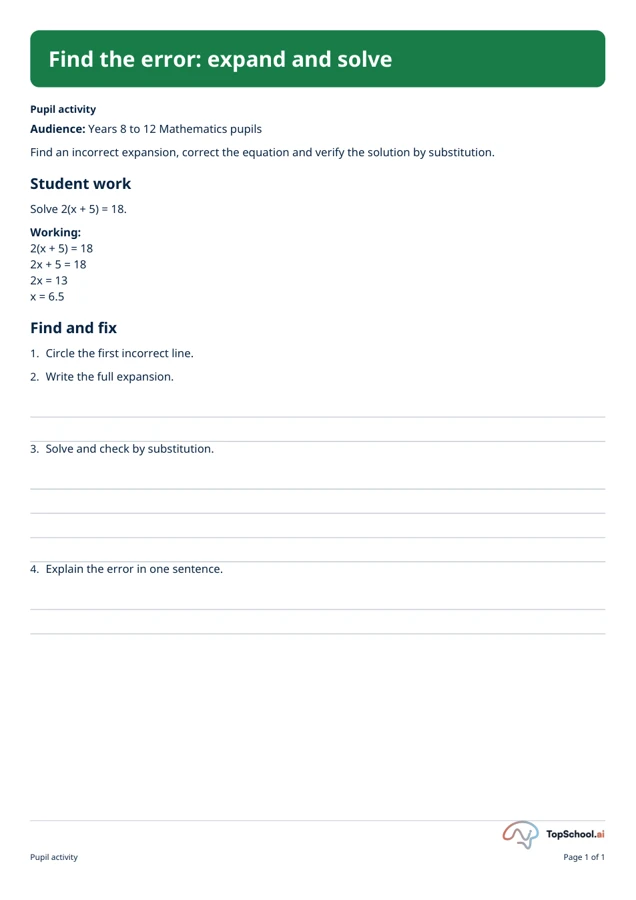
Find the error: expand and solve
Circle the first line that is not equivalent to the original equation.
Explore resource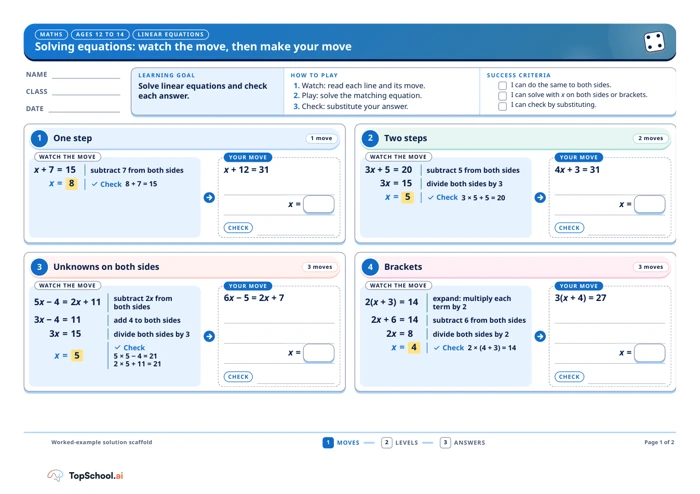
Solving equations: watch the move, then make your move
Review the worked examples and check the algebra, layout and answer guidance before use. Explain that the same operation must be applied to both sides, and that substitution can test whether a proposed value works.
Explore resourceIdeas to try with your class
Sample teaching perspectives on what to try, what to adapt and what to watch for.
Meet The Creators
Meet the creators whose teaching interests connect with this template. Find an approach to try with your class.

Nicole Fontaine
I build secondary mathematics from notation through small steps and whiteboard working, making pupils’ methods legible and allowing time to explain the meaning behind a calculation.
Meet the creator
Lukas Brandt
I plan Mathematics for pupils bringing different curricular methods, using small steps and whiteboard time to make notation and working explicit before speed becomes a priority.
Meet the creator
Wei Ling Chua
I begin Mathematics with worked examples and deliberate practice, checking understanding before removing prompts so pupils can carry a method through and explain why it applies.
Meet the creator
Priyanka Deshmukh
I value prompts that ask pupils to explain what a symbol represents and why a step follows, so that notation carries the reasoning rather than hiding it.
Meet the creator
Hollie Braithwaite
Revision is more useful when it responds to a specific gap pupils have shown, rather than covering a broad topic simply because it appears in a generic pack.
Meet the creator
Vikram Sethi
I use diagnostic Mathematics questions to locate a specific misconception before choosing a worked example, keeping assessment precise enough to guide the next teaching step and review.
Meet the creator
Page-Turner Planner
The one-page prompt asks pupils to find the first non-equivalent line in 3(2x − 5) = 4x + 1, correct the distribution, solve and substitute into both sides. That distinguishes the initial error from the later answer.
Bright Margins
The exercise targets distribution and preservation of equality, with a short explanation of why the error happened. The substitution step checks the corrected solution in the original equation rather than relying on the final value alone.
Five More Minutes
Ask pupils to expand 3 across both terms before combining like terms. Keeping the original equation visible during the correction helps make the missing multiplication of −5 the specific issue to explain.
Kind Check-In
The fictional student work is a single example and cannot diagnose a learner’s misconception. Use the written explanation as a hypothesis about the error, then check understanding with another equation.