Maths
Find the error: algebra and equations
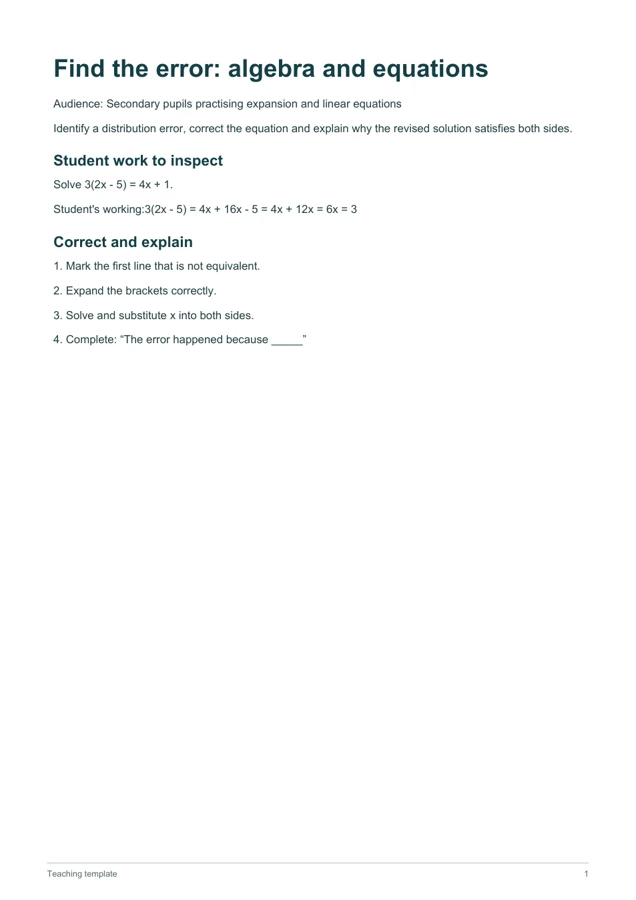
Identify a distribution error, correct the equation and explain why the revised solution satisfies both sides.
Head of Mathematics
I begin Mathematics with worked examples and deliberate practice, checking understanding before removing prompts so pupils can carry a method through and explain why it applies.
Explore the collectionI teach Mathematics across secondary and lead the department. I use worked examples first, followed by deliberate practice and then greater independence. That order gives pupils a clear model before they are expected to carry a method through on their own.
Pupils benefit when the steps in a solution are visible and the explanation connects each step to the problem. I look for practice that lets them use the same idea more than once, then decide when a prompt can be removed. A teacher can check understanding and add another example before pupils practise a method independently.
I value resources that make differentiation practical without burying the mathematical idea under too many versions. A well-chosen example can introduce the method; focused practice can strengthen it. I am cautious about discovery tasks when pupils have not yet built the knowledge they need, but I still want them to explain their reasoning and recognise when a method applies.
Model a method before asking for independent practice.
Use deliberate practice to build fluency.
Remove prompts as pupils become ready to work independently.
Explore these templates and decide what fits your own setting.
Maths
Identify a distribution error, correct the equation and explain why the revised solution satisfies both sides.
Maths
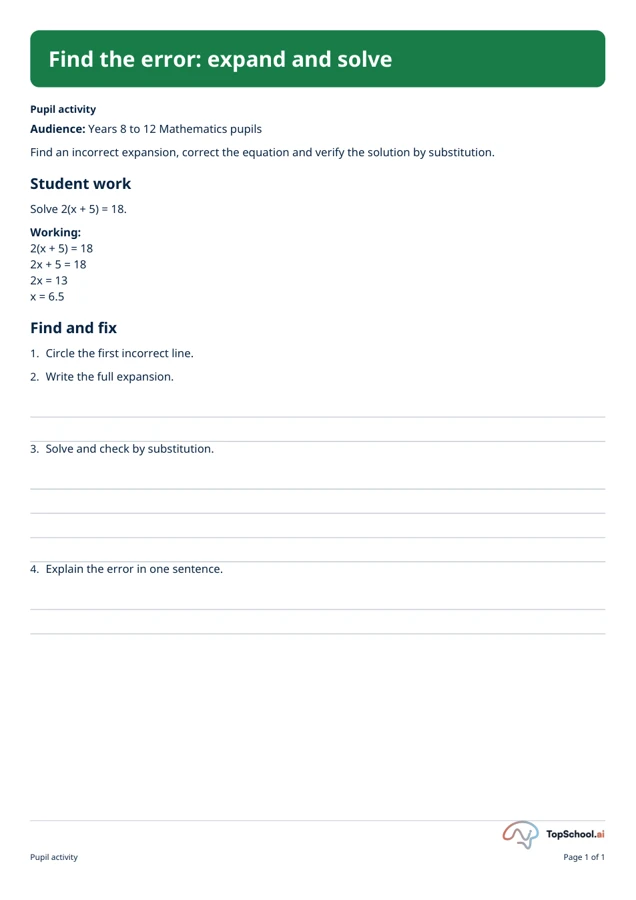
Find an incorrect expansion, correct the equation and verify the solution by substitution.
Maths
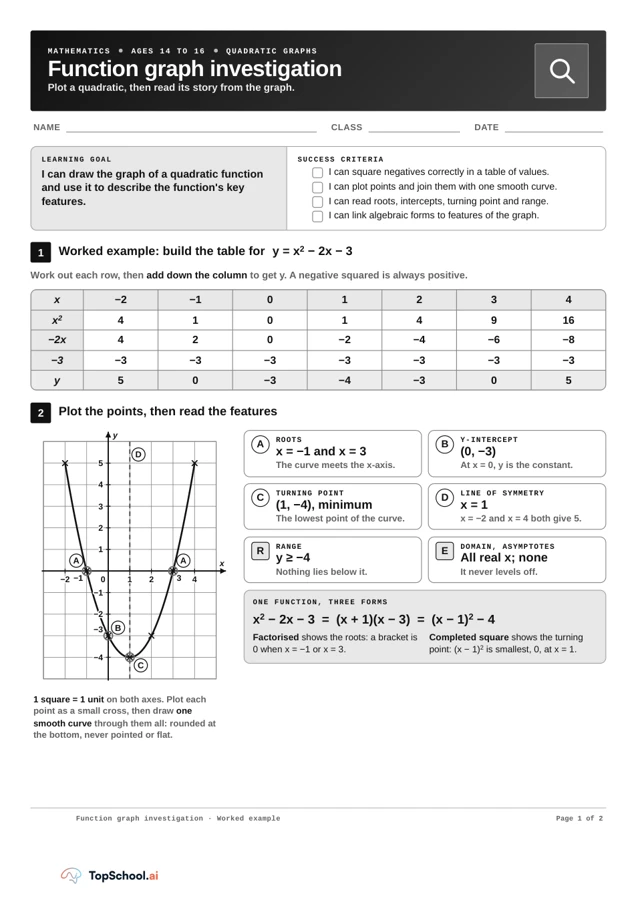
Calculate and graph a quadratic function and connect its algebraic forms to key graph features.
Maths
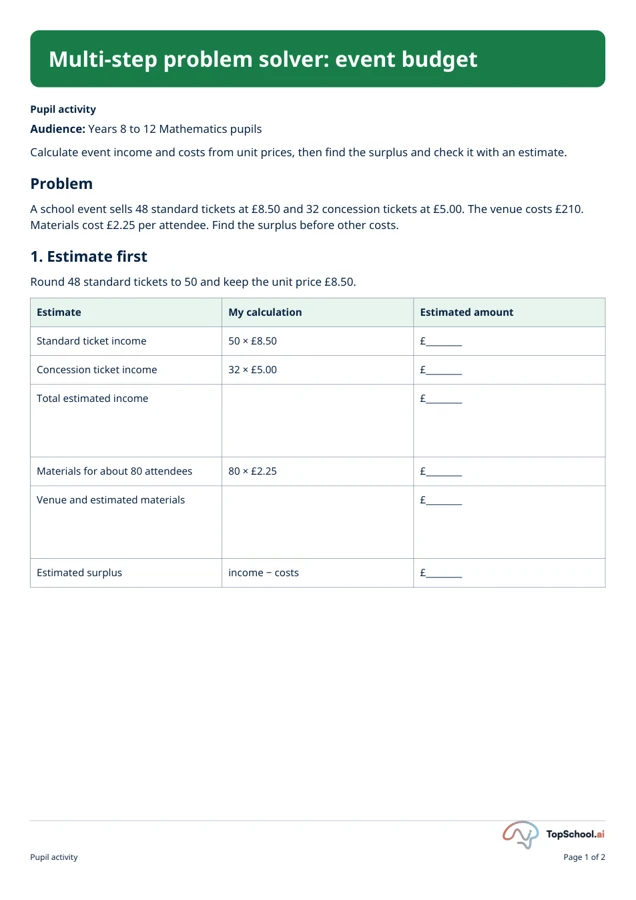
Calculate event income and costs from unit prices, then find the surplus and check it with an estimate.