Maths
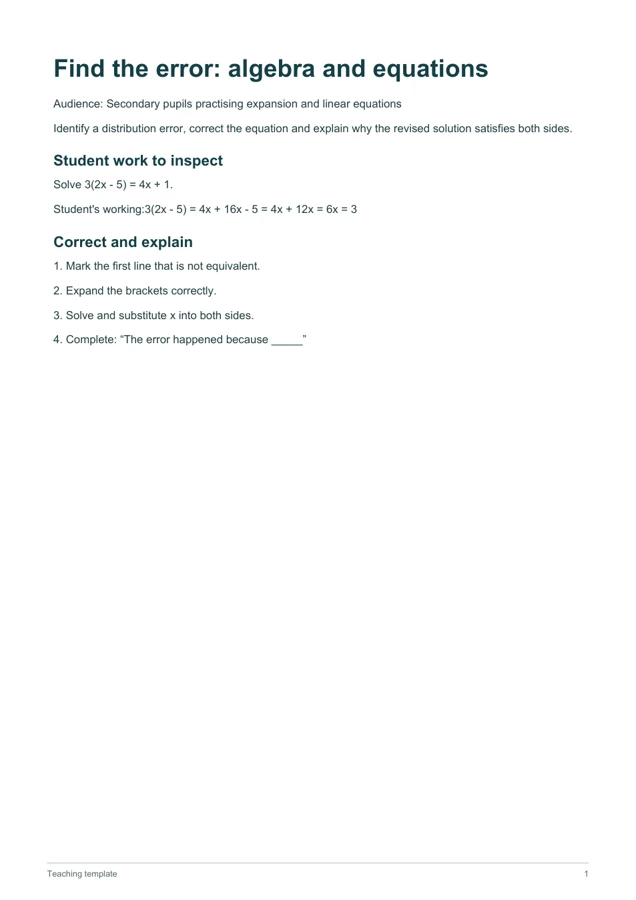
Find the error: algebra and equations
Identify a distribution error, correct the equation and explain why the revised solution satisfies both sides.

Head of Mathematics
I use diagnostic Mathematics questions to locate a specific misconception before choosing a worked example, keeping assessment precise enough to guide the next teaching step and review.
Explore the collectionA wrong answer in Mathematics can point to a particular misconception. I lead the subject and use diagnostic questions to identify that point before choosing a worked example, rather than responding with more practice on a broad topic.
Across Key Stage 3, our department uses a mastery scheme. At Key Stage 4, foundation or higher entry decisions need to remain open to evidence as pupils develop. I want examples and assessments to be precise enough to show what a student understands, what is still uncertain and which route deserves further discussion.
The timing of a tier decision matters as much as the label. A choice made too early may not reflect later evidence, so I keep the reasoning under review towards the entry deadline. Clear examples help pupils see the mathematical idea they are practising; careful assessment helps teachers choose the next step.
Use diagnostic questions to identify the misconception behind an answer.
Build worked examples around the specific mathematical point at issue.
Keep foundation or higher decisions open to evidence until entry.
Explore these templates and decide what fits your own setting.
Maths
Identify a distribution error, correct the equation and explain why the revised solution satisfies both sides.
Maths
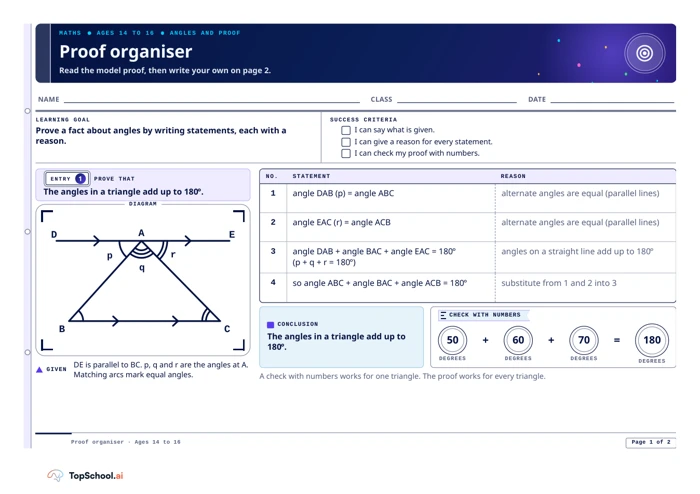
Build a geometric proof by recording statements, reasons and a conclusion in a logical order.
Maths
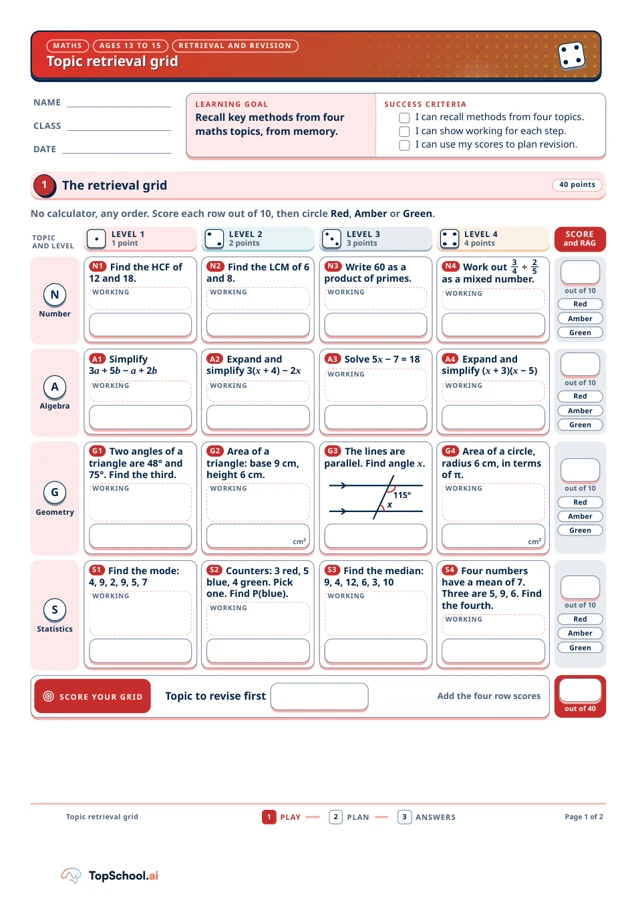
Recall and show working for selected methods across four mathematics topics, then use errors and confidence ratings to choose a next revision step.