Maths
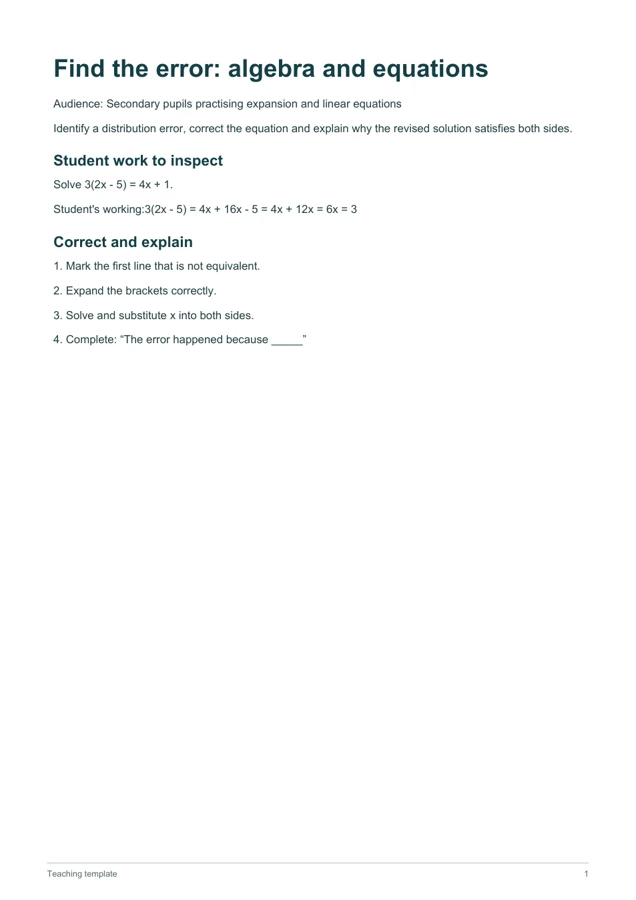
Find the error: algebra and equations
Identify a distribution error, correct the equation and explain why the revised solution satisfies both sides.

Mathematics teacher
I value prompts that ask pupils to explain what a symbol represents and why a step follows, so that notation carries the reasoning rather than hiding it.
Explore the collectionI teach Mathematics from Year 7 through IGCSE. I pay close attention to how pupils record their thinking. A pupil may reason well and still find it difficult to express that reasoning in notation another person can follow. Helping them write it down clearly is part of teaching mathematics, not a final presentation task.
Pupils can arrive with different methods for the same operation. I want to understand how they are thinking before introducing a new approach. Whiteboard work gives us a way to make a step visible, compare it with another and decide where a more explicit example would help.
I look for resources that build confidence without rushing towards speed. A sequence can move from one clear example to supported practice and then greater independence. I value prompts that ask pupils to explain what a symbol represents and why a step follows, so that notation carries the reasoning rather than hiding it.
Make notation and written reasoning explicit.
Compare methods from different prior experiences.
Use small steps and visible examples before independent work.
Explore these templates and decide what fits your own setting.
Maths
Identify a distribution error, correct the equation and explain why the revised solution satisfies both sides.
Maths
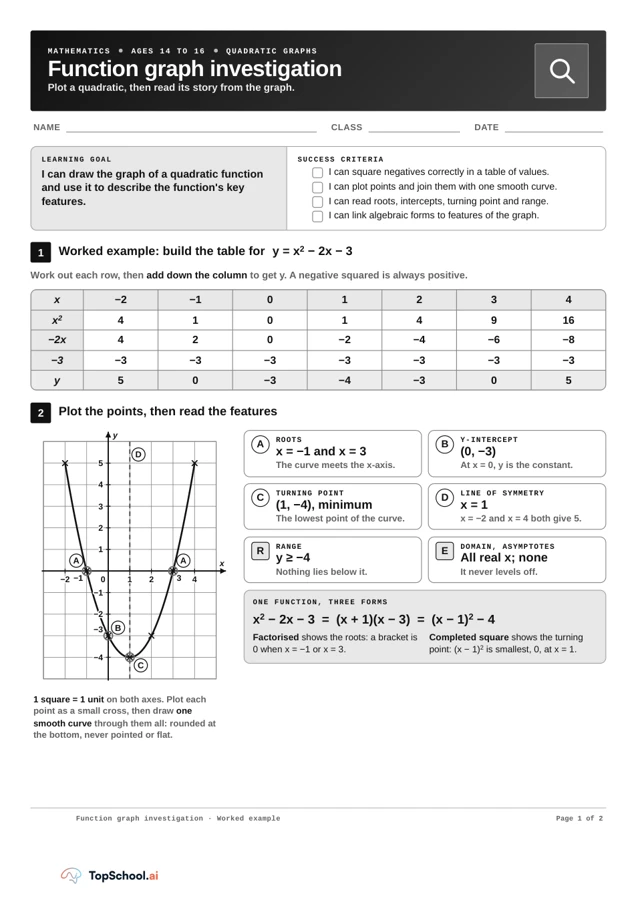
Calculate and graph a quadratic function and connect its algebraic forms to key graph features.
Maths
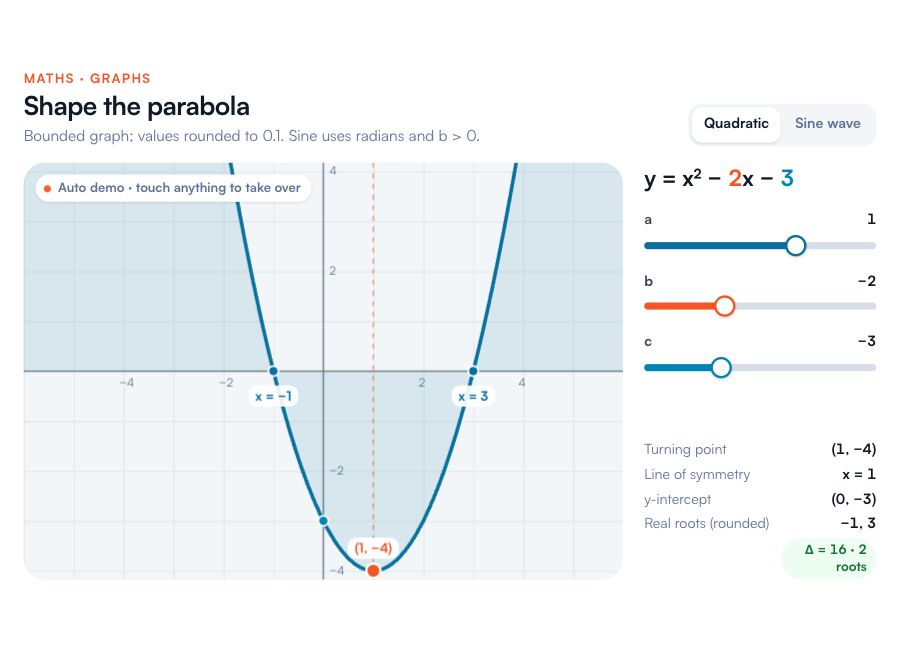
Pupils should predict a graph change, vary one coefficient and explain the result using both the equation and a feature. They should recognise linear or constant cases when the quadratic coefficient is zero and check rounded readouts against exact working where appropriate.