
Maths
Solving equations: watch the move, then make your move
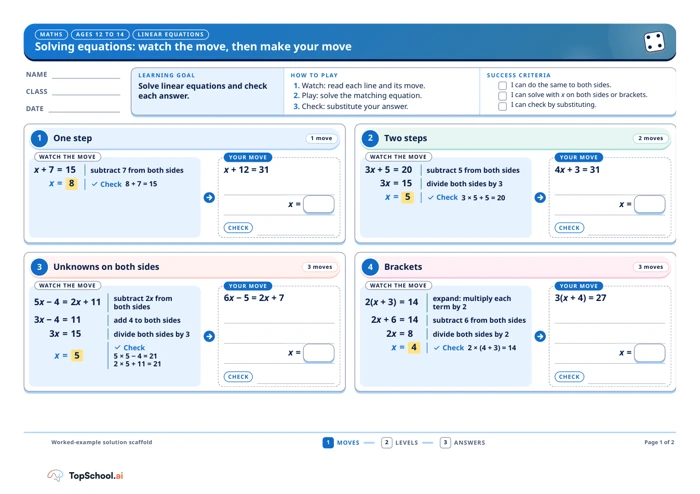
Study worked moves for linear equations, solve a matching equation and check by substitution. Pupils then practise more questions, find an error in a worked solution and create an equation for a partner. Use it for independent practice.
Read the material
Study worked moves for linear equations, solve a matching equation and check by substitution. Pupils then practise more questions, find an error in a worked solution and create an equation for a partner. Use it for independent practice.
Activity. Use the preview for diagrams and layout.
Page 1
NAME
CLASS
DATE
LEARNING GOAL
Solve linear equations and check
each answer.
HOW TO PLAY
1. Watch: read each line and its move.
2. Play: solve the matching equation.
3. Check: substitute your answer.
SUCCESS CRITERIA
I can do the same to both sides.
I can solve with x on both sides or brackets.
I can check by substituting.
1
One step
1 move
2
Two steps
2 moves
3
Unknowns on both sides
3 moves
4
Brackets
3 moves
Worked-example solution scaffold
1
MOVES
2
LEVELS
3
ANSWERS
MATHS
AGES 12 TO 14
LINEAR EQUATIONS
Solving equations: watch the move, then make your move
x + 7 = 15
x = 8
WATCH THE MOVE
subtract 7 from both sides
Check 8 + 7 = 15
x + 12 = 31
CHECK
YOUR MOVE
x =
3x + 5 = 20
3x = 15
x = 5
WATCH THE MOVE
subtract 5 from both sides
divide both sides by 3
Check 3 × 5 + 5 = 20
4x + 3 = 31
CHECK
YOUR MOVE
x =
5x − 4 = 2x + 11
3x − 4 = 11
3x = 15
x = 5
WATCH THE MOVE
subtract 2x from
both sides
add 4 to both sides
divide both sides by 3
Check
5 × 5 − 4 = 21
2 × 5 + 11 = 21
6x − 5 = 2x + 7
CHECK
YOUR MOVE
x =
2(x + 3) = 14
2x + 6 = 14
2x = 8
x = 4
WATCH THE MOVE
expand: multiply each
term by 2
subtract 6 from both sides
divide both sides by 2
Check 2 × (4 + 3) = 14
3(x + 4) = 27
CHECK
YOUR MOVE
x =
Page 1 of 2
Page 2
5
Level up
6 equations
Solve each equation. Show every move. Check by substituting, then colour the token.
6
Spot the mistake
5 points
One move by a rival player is wrong. Find it, then make the right move.
EXPLAIN THE MISTAKE
MAKE THE RIGHT MOVE
CHECK
BONUS ROUND
Make your own move: write an equation with unknowns on
both sides that has the answer x = 6. Swap with a partner.
HOW SURE AM I?
Not yet
Getting there
Got it
Worked-example solution scaffold
1
MOVES
2
LEVELS
3
ANSWERS
MATHS
AGES 12 TO 14
LINEAR EQUATIONS
Level up, then spot the mistake
LEVEL
1
a
5x + 2 = 37
b
2x − 9 = 11
x =
x =
LEVEL
2
c
8x + 1 = 3x + 21
d
9x − 7 = 4x + 8
x =
x =
LEVEL
3
e
4(x − 2) = 3x + 5
f
2(2x + 1) = 5
x =
x =
1
5(x − 2) = 3x + 4
the equation
2
5x + 10 = 3x + 4
expand the brackets
3
2x + 10 = 4
subtract 3x from both sides
4
2x = −6
subtract 10 from both sides
5
x = −3
divide both sides by 2
The mistake is on line
RIVAL'S MOVE
Page 2 of 2
Page 1
Solving equations: watch the move, then make
your move
Teacher companion
Mathematics | Pupils aged 12 to 14
Use with the exact 2-page original file. Keep pupil or staff activity pages separate from this teacher companion.
When to use it
Use this after pupils have met inverse operations and are ready to solve equations with
brackets or unknowns on both sides. It suits a guided practice lesson where pupils can record
and check each algebraic move before trying a related problem.
Purpose
Solve one-step and multi-step linear equations, explain operations applied to both sides and
check a solution by substitution with clear working.
Start here
Review the worked examples and check the algebra, layout and answer guidance before use.
Explain that the same operation must be applied to both sides, and that substitution can test
whether a proposed value works.
A teaching sequence
1. Read a worked example, name the operation at each line and solve its matching equation;
write the same operation on both sides and check by substitution.
2. Attempt the six levelled equations, progressing to brackets and unknowns on both sides.
Show enough working to explain each change.
3. Inspect the rival’s solution, identify the first incorrect move, explain the error and write a
corrected step.
4. Create an equation with unknowns on both sides that has x = 6 as its solution, then
exchange it with a partner.
Checking guidance
Your Move answers: x = 19, 7, 3, 5. Level Up a-f: x = 7, 10, 4, 3, 13, 3/4. Substitute each value
in the printed equation to verify both sides.
First invalid line in the rival solution is line 2: 5(x - 2) must expand to 5x - 10. Correct route: 5x
- 10 = 3x + 4; 2x = 14; x = 7.
Bonus example: 4x + 6 = 3x + 12 has x = 6. Check other pupil-written equations by solving
and substitution. These answers agree with the existing exact-original teacher key, rather
than the different Year 6 edition.
Support
Use balance scales or colour coding to show matching operations on both sides. Reduce the
number of lines to one move at a time, offer a substitution frame and allow pupils to explain a
step aloud before recording.
Take it further
Ask pupils to write two distinct equations with the same solution, compare the move
sequences or create an equation with brackets on both sides and verify a chosen solution.
Then explain which approach is easiest to check.
Things to keep in mind
This guide supports the exact original equations, not the separate Year 6 edition. Check
mathematical working and substitutions as well as the final values, and review suitability
against the intended course.
Solving equations: watch the move, then make your move
Teacher companion | Page 1
Page 1
Solving equations: teacher checking guide
Teacher checking guide
Supports
: “Solving equations: watch the move, then make your move”. Keep this guide apart from
pupil copies. It does not support the Year 6 Equation moves worksheet.
Question or group
Checked answer
Page 1: Your move, in order
x = 19; x = 7; x = 3; x = 5
Page 2: a, b, c
a: x = 7; b: x = 10; c: x = 4
Page 2: d, e, f
d: x = 3; e: x = 13; f: x = 3/4
1. Spot the rival’s mistake
The expansion should be 5x − 10, not 5x + 10. Then 2x = 14, so x = 7; both sides of the original equation equal 25.
2. Bonus example
3x + 2 = 2x + 8 has x = 6; substituting gives 20 = 20.
3. Before scoring
Accept equivalent exact forms for f, including 3/4 and 0.75. The rival’s wrong result is an intentional error-analysis
prompt, not an answer. A pupil’s own bonus equation needs its own substitution check.


Page 1 of 1
A teaching sequence
Solve one-step and multi-step linear equations, explain operations applied to both sides and check a solution by substitution with clear working.
Watch, solve and substitute
Read a worked example, name the operation at each line and solve its matching equation; write the same operation on both sides and check by substitution.
Did you apply the same operation to both sides?
Solve the levelled equations
Attempt the six levelled equations, progressing to brackets and unknowns on both sides. Show enough working to explain each change.
Which written line shows how you handled the brackets?
Find the first wrong move
Inspect the rival’s solution, identify the first incorrect move, explain the error and write a corrected step.
What should happen when 5 multiplies the negative term in the bracket?
Create an equation for six
Create an equation with unknowns on both sides that has x = 6 as its solution, then exchange it with a partner.
Does substituting 6 make both sides equal?
Before you teach
Look for the thinking behind an answer, choose the support your class needs and leave room for an independent response.
What to look for
Your Move answers: x = 19, 7, 3, 5. Level Up a-f: x = 7, 10, 4, 3, 13, 3/4. Substitute each value in the printed equation to verify both sides. First invalid line in the rival solution is line 2: 5(x - 2) must expand to 5x - 10. Correct route: 5x - 10 = 3x + 4; 2x = 14; x = 7. Bonus example: 4x + 6 = 3x + 12 has x = 6. Check other pupil-written equations by solving and substitution. These answers agree with the existing exact-original teacher key, rather than the different Year 6 edition.
Give a little support
Use balance scales or colour coding to show matching operations on both sides. Reduce the number of lines to one move at a time, offer a substitution frame and allow pupils to explain a step aloud before recording.
Take the idea further
Ask pupils to write two distinct equations with the same solution, compare the move sequences or create an equation with brackets on both sides and verify a chosen solution. Then explain which approach is easiest to check.
Things to keep in mind
This guide supports the exact original equations, not the separate Year 6 edition. Check mathematical working and substitutions as well as the final values, and review suitability against the intended course.
Keep the idea. Make it yours.
Bring your topic, learning goal and class context to PLAI™, then review what you create.
Another starting point
Explore a different teaching task from this selection.
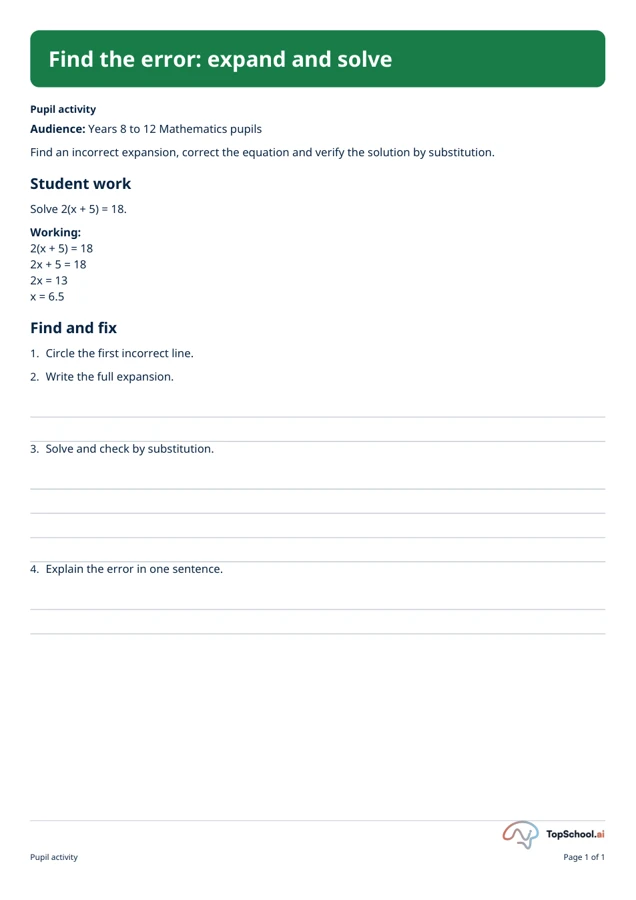
Find the error: expand and solve
Circle the first line that is not equivalent to the original equation.
Explore resource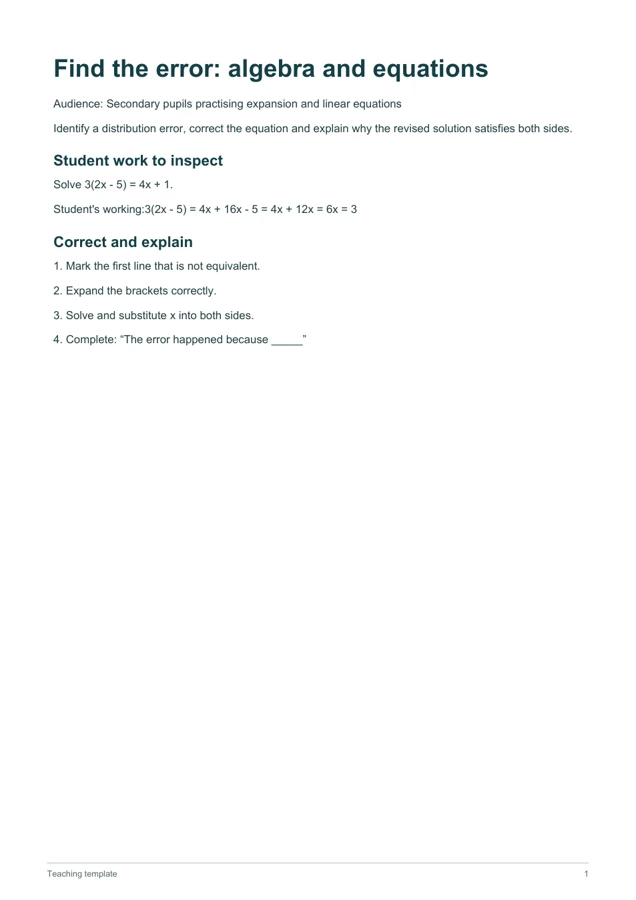
Find the error: algebra and equations
Read the student's work and circle the first incorrect step.
Explore resourceIdeas to try with your class
Sample teaching perspectives on what to try, what to adapt and what to watch for.
Meet The Creators
Meet the creators whose teaching interests connect with this template. Find an approach to try with your class.

Hollie Braithwaite
Revision is more useful when it responds to a specific gap pupils have shown, rather than covering a broad topic simply because it appears in a generic pack.
Meet the creator
Tom Ridgway
I run Cornbrook events for pupils in every year group, so participation has to be possible beyond the students who are already confident about joining in.
Meet the creator
One Last Sticky Note
The two-page maths scaffold for ages 12 to 14 organises linear equations into one-step, two-step, unknowns-on-both-sides and brackets levels. Pupils watch a worked move, solve a matching equation and substitute the answer to check it.
Paperclip Perspective
The success criteria emphasise doing the same operation to both sides and checking by substitution. The worked examples show the operation sequence, not just the final value.
Step by Step
Cover the answer section while the pupil completes each move, then substitute the result into the original equation. Progress to brackets or x on both sides when the earlier steps are secure.
Pencil Case Pal
The ages 12 to 14 scaffold covers one-step, two-step, brackets and x-on-both-sides equations; it is not a diagnostic of all algebra skills. Check each worked transformation for equality and follow the course notation.