
Study and learning skills
Chunk it
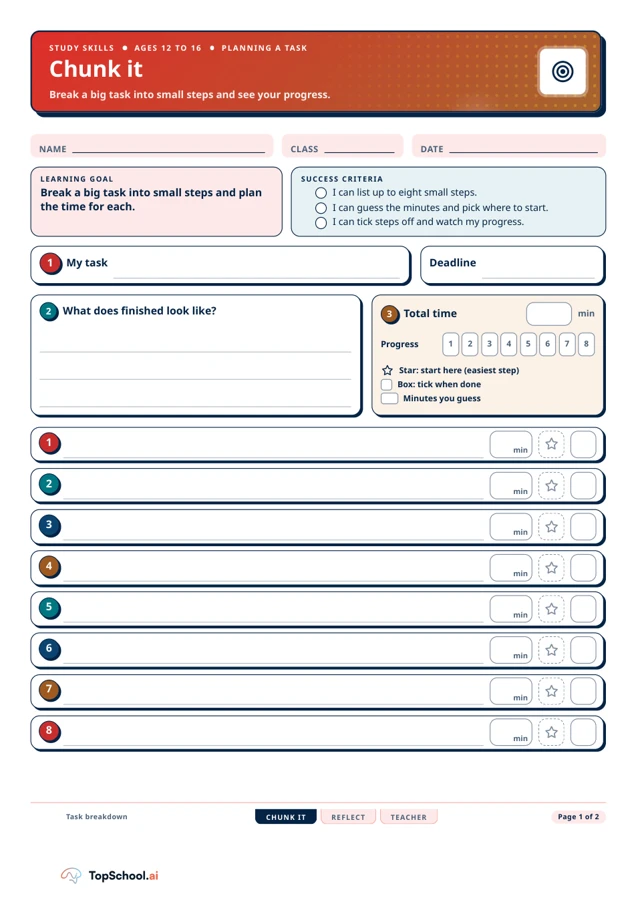
Turn one larger task into manageable steps, estimate the time each may take and mark progress. A completed history-essay example models task planning, while the reflection prompts help pupils consider what support they used.
Read the material
Turn one larger task into manageable steps, estimate the time each may take and mark progress. A completed history-essay example models task planning, while the reflection prompts help pupils consider what support they used.
Complete resource. Use the preview for diagrams and layout.
Page 1
NAME
CLASS
DATE
LEARNING GOAL
Break a big task into small steps and plan
the time for each.
SUCCESS CRITERIA
I can list up to eight small steps.
I can guess the minutes and pick where to start.
I can tick steps off and watch my progress.
Task breakdown
CHUNK IT
REFLECT
TEACHER
Page 1 of 2
STUDY SKILLS
AGES 12 TO 16
PLANNING A TASK
Chunk it
Break a big task into small steps and see your progress.
1
My task
Deadline
2
What does finished look like?
3
Total time
min
Progress
1
2
3
4
5
6
7
8
Star: start here (easiest step)
Box: tick when done
Minutes you guess
1
min
2
min
3
min
4
min
5
min
6
min
7
min
8
min
Page 2
Task breakdown
CHUNK IT
REFLECT
TEACHER
Page 2 of 2
STUDY SKILLS
AGES 12 TO 16
INDEPENDENCE
How independent was I?
EXAMPLE
A history essay, already chunked
Total 120 min. Copy the idea, not the words.
1
Read the question
5 min
2
Underline the key words
5 min
3
Gather three sources
20 min
4
Plan with a spider diagram
15 min
5
Write the introduction
15 min
6
Write the body paragraphs
40 min
7
Write the conclusion
10 min
8
Proofread
10 min
Independence scale
Tick one shape per step
I did it alone
I asked a friend
I asked an adult
1
Alone
Friend
Adult
2
Alone
Friend
Adult
3
Alone
Friend
Adult
4
Alone
Friend
Adult
5
Alone
Friend
Adult
6
Alone
Friend
Adult
7
Alone
Friend
Adult
8
Alone
Friend
Adult
What helped me start
One thing to do differently
Steps done alone
out of
Compare with yourself only. Aim to grow,
not to match anyone.
My task
TEMPLATE 2
Deadline
1
min
2
min
3
min
4
min
5
min
6
min
7
min
8
min
A teaching sequence
Define what finished looks like, plan up to eight steps, estimate total time and reflect on what helped the pupil begin and work independently.
Plan small, ordered steps
List small steps, star a starting point and compare their estimated minutes with the total time. Use the history-essay example to distinguish reading, planning, drafting and proofreading, then adapt the plan to the pupil's task.
Do the estimated minutes add up to a realistic total for your task?
Mark completed work
Use the progress row to mark steps as they are completed.
Which step is finished enough to tick off?
Reflect on useful support
On the reflection page, note which steps were completed alone, with a friend or with an adult, what helped the pupil start and one change for next time.
What helped you start, and what would you change in your next plan?
Before you teach
Look for the thinking behind an answer, choose the support your class needs and leave room for an independent response.
What to look for
Before pupils begin, check that steps are specific actions, the time estimates are plausible and the total fits the deadline. Afterwards, ask whether the pupil’s reflection identifies a useful starting point or support rather than rating independence against classmates.
Give a little support
Offer a short task and model how to split it into three actions. Provide time choices, let the pupil select where to begin and use a visual timer or checklist if helpful.
Take the idea further
Ask the pupil to compare an estimate with the time actually used and decide what to adjust next time. They can identify which step could be prepared in advance or completed with a partner.
Things to keep in mind
Time estimates are planning aids rather than deadlines that define ability. The independence scale is descriptive, not a judgement of a pupil; asking a friend or adult is appropriate support. Keep the completed reflection private and compare the pupil only with their own previous plans.
Keep the idea. Make it yours.
Bring your topic, learning goal and class context to PLAI™, then review what you create.
Ideas to try with your class
Sample teaching perspectives on what to try, what to adapt and what to watch for.
Meet The Creators
Meet the creators whose teaching interests connect with this template. Find an approach to try with your class.
Hannah Goldberg
I plan secondary learning adjustments as familiar tools in everyday classroom practice before examinations, discussing what helps and checking that teachers can apply the agreed approach consistently.
Meet the creator
Rachel Kaminski
I coordinate access arrangements and targeted support through evidence of normal classroom practice, asking what barriers pupils meet, what has been tried and what teachers have observed.
Meet the creator
Hannah Zwelithini-Grant
Regular review gives families and teachers a chance to discuss what is working, what needs adjustment and whether a new support should be tried.
Meet the creator
Hannah Zielinski
I make inclusion plans understandable to families and organise access evidence around the decision it supports, with clear language, reliable records and appropriate boundaries for personal information.
Meet the creator
Sarah Brogan
I provide named-plan learning support in Year 7, shaping prompts around the activity in front of the learner rather than using a general sheet for every lesson.
Meet the creator
Michaela Rourke
I shape Year 9 support around the current activity, using clear actions and check-ins that help pupils see the next step while keeping their opportunity to act independently.
Meet the creator
Planning List
The two-page study-skills sheet for ages 12 to 16 asks pupils to define what finished looks like, split a task into up to eight steps, estimate total time, choose a starting point and reflect on what helped them begin.
Chalk & Chai
The checklist connects planning to independence by asking what the pupil can do without help and what they may need to ask. Checking off steps makes progress visible during a larger task.
Helpful Highlighter
Help the pupil make each step small enough to start and revise time estimates after trying the plan. Agree what support is available while still leaving the pupil ownership of the starting point.
Spare Pencil
Time estimates are planning guesses, not promises or measures of effort. Review the plan after use and adjust for the task's actual demands rather than treating missed estimates as failure.