
Science
Plant cell: label the structures
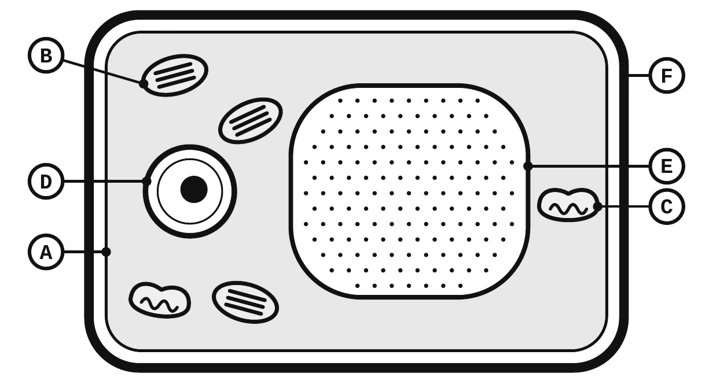
Label cell wall, membrane, cytoplasm, nucleus, chloroplasts and vacuole on a simplified plant-cell diagram.
Follow each numbered pointer to a plant-cell structure. This is a simplified diagram, not drawn to scale.
Read the complete materialRead the material
Label cell wall, membrane, cytoplasm, nucleus, chloroplasts and vacuole on a simplified plant-cell diagram.
Pupil document. Use the preview for diagrams and layout.
Page 1
Teaching template
1
Plant cell: label the structures
Audience: Pupils learning introductory plant-cell structures
Label cell wall, membrane, cytoplasm, nucleus, chloroplasts and vacuole on a simplified plant-cell diagram.
Word bank
cell wall - cell membrane - cytoplasm - nucleus - chloroplast - vacuole
1
2
3
4
5
6
Write the matching word beside each number. Simplified, not to scale.
1. Label all six structures.
2. Which structure controls what enters and leaves?
3. Which structure contains cell sap?
Page 1
Teaching template
1
Plant cell: label the structures: teacher notes
Teacher key
1 wall, 2 membrane, 3 chloroplast, 4 vacuole, 5 nucleus, 6 cytoplasm.
A teaching sequence
Label cell wall, membrane, cytoplasm, nucleus, chloroplasts and vacuole on a simplified plant-cell diagram.
Follow each numbered pointer to a plant-cell structure. This is a simplified diagram, not drawn to scale.
Read the complete materialFollow each numbered leader
Match each numbered leader to one term.
Which structure does the end of this leader point to?
Follow each numbered pointer to a plant-cell structure. This is a simplified diagram, not drawn to scale.
Read the complete materialUse the six-term bank once each
Use each word-bank term once.
Have you distinguished the wall from the membrane rather than using one term twice?
Explain two structure functions
Choose two structures and state one function for each.
Which lesson source supports the function you wrote?
Follow each numbered pointer to a plant-cell structure. This is a simplified diagram, not drawn to scale.
Read the complete materialCheck the diagram boundaries
Check that the wall is the outer boundary and chloroplasts are within the cell.
Are the wall at the outside and chloroplasts inside the simplified cell?
Before you teach
Look for the thinking behind an answer, choose the support your class needs and leave room for an independent response.
What to look for
Key: 1 cell wall, 2 membrane, 3 chloroplast, 4 vacuole, 5 nucleus, 6 cytoplasm. Ask, “Which boundary controls movement into and out of the cell?”
Give a little support
Keep the word bank visible and colour wall and membrane differently.
Take the idea further
Compare with an animal cell and identify structures not usually shown in an animal-cell diagram.
Things to keep in mind
The diagram is simplified and not to scale. Confirm terminology and expected detail for the year group.
Keep the idea. Make it yours.
Bring your topic, learning goal and class context to PLAI™, then review what you create.
Another starting point
Explore a different teaching task from this selection.
Vocabulary matching: cells and science words
Check the diagram, definitions and science terminology against the course materials. Explain that each cell word should be matched to both a meaning and a pointer, then model how to cross out a definition once it is used.
Explore resource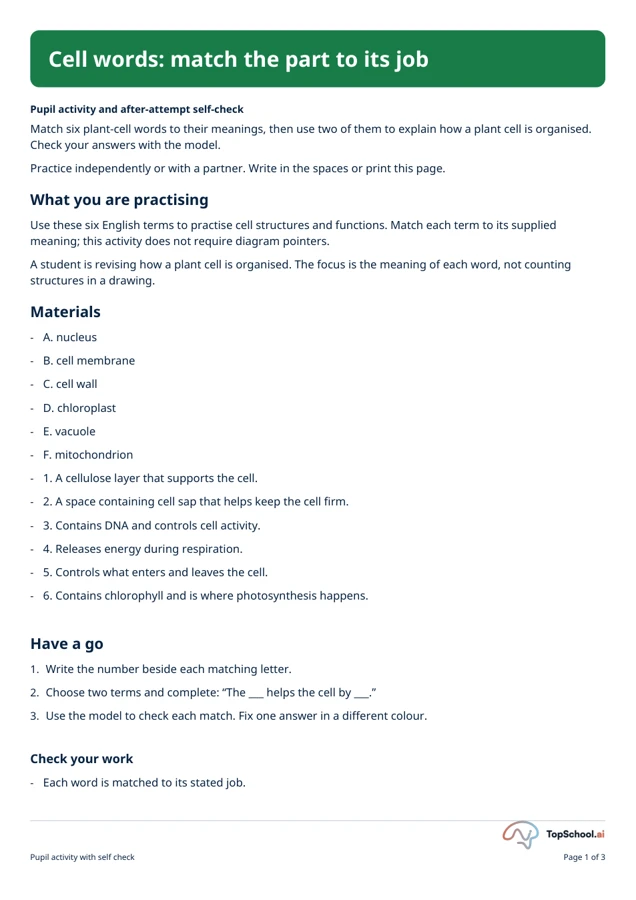
Cell words: match the part to its job
Begin with this case: A student is revising how a plant cell is organised. The focus is the meaning of each word, not counting structures in a drawing.
Explore resourceIdeas to try with your class
Sample teaching perspectives on what to try, what to adapt and what to watch for.
Meet The Creators
Meet the creators whose teaching interests connect with this template. Find an approach to try with your class.
Arjun Nair
I want pupils to interpret practical data, explain what changed and what they measured, and reconsider their first ideas when observations suggest a better question.
Meet the creator
Sarah Whitcombe
Mangroves, reefs and tropical ecology give us plenty to investigate, so I look for ways to connect the syllabus with what pupils can observe around them.
Meet the creator
Gentle Reminder
The one-page schematic has six numbered pointers and a word bank for cell wall, membrane, cytoplasm, nucleus, chloroplast and vacuole. Two follow-up questions check membrane function and where cell sap is found.
Book and Biscuit
This is a focused introductory label task: name each structure, then connect two labels to a function. The “simplified, not to scale” note limits what pupils should infer from the diagram’s relative size.
After the Bell
Read the word bank aloud and trace each pointer endpoint before writing a label. The six terms can be tackled in smaller groups, with the questions about entry and exit and cell sap used as a check after labelling.
Kind Check-In
The schematic is not to scale and only asks about selected structures. Check that each pointer clearly indicates its intended feature, and use a trusted science source for more detailed plant-cell claims.