
Science
Vocabulary matching: cells and science words
Match plant-cell vocabulary with definitions and diagram pointers, then practise using words such as variable, hypothesis and anomaly in context. The two tasks connect scientific terms with meanings and examples. Use it after initial teaching.
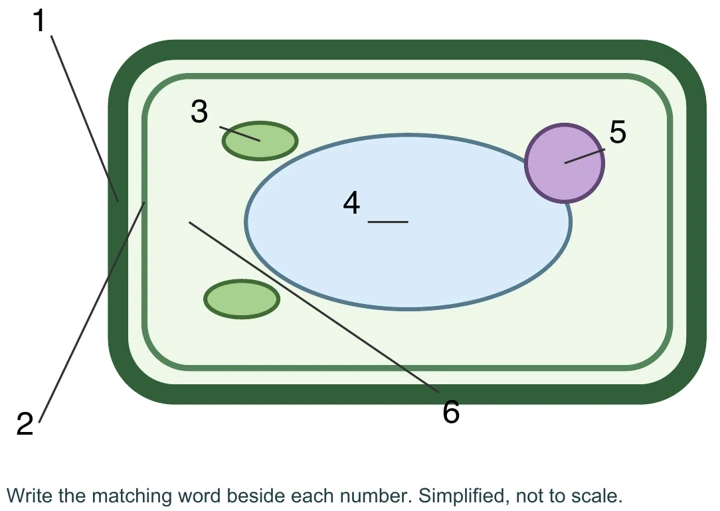
Use the pointers to match cell words to structures. Keep the simplified drawing and its labels together.
Read the complete materialRead the material
Match plant-cell vocabulary with definitions and diagram pointers, then practise using words such as variable, hypothesis and anomaly in context. The two tasks connect scientific terms with meanings and examples. Use it after initial teaching.
Complete resource. Use the preview for diagrams and layout.
Page 1
SCIENCE
AGES 11 TO 14
CELLS
Vocabulary matching
Match each cell word to its meaning and its pointer.
NAME
CLASS
DATE
LEARNING GOAL
Match six cell words to their meanings and to
the right part of a plant cell.
SUCCESS CRITERIA
I can match a word to its meaning.
I can find each part on the diagram.
E N T R Y
1
Look at the plant cell
Pointers A to F
B
D
A
F
E
C
NOTES TO SELF
START HERE
Read all six meanings
before you write.
A dot shows where each
line ends. The cell has 3
chloroplasts and 2
mitochondria, but only one
of each is pointed to.
Cross out each meaning
when you use it.
E N T R Y
2
Match words, meanings and pointers
12 marks
For each word write the meaning letter (a to f), then the pointer letter (A to F).
WORDS
MY ANSWERS
MEANINGS
1
nucleus
DEF
DIAG
a
A space filled with cell sap that helps keep the
cell firm
2
cell membrane
DEF
DIAG
b
Contains the DNA and controls what the cell does
3
cell wall
DEF
DIAG
c
Where respiration releases energy for the cell
4
chloroplast
DEF
DIAG
d
Controls what enters and leaves the cell
5
vacuole
DEF
DIAG
e
Strong outer layer of cellulose that supports a
plant cell
6
mitochondrion
(plural: mitochondria)
DEF
DIAG
f
Contains chlorophyll, where photosynthesis
happens
Vocabulary matching activities
Page 1 of 2
Page 2
SCIENCE
AGES 11 TO 14
WORKING SCIENTIFICALLY AND CELLS
Science words in use
NAME
CLASS
DATE
E N T R Y
1
Match the words
6 marks
Write the meaning letter (a to f) in the box for each word.
WORDS
ANSWER
MEANINGS
1
variable
DEF
a
A result that does not fit the pattern
2
conclusion
DEF
b
A prediction that can be tested
3
hypothesis
DEF
c
Gives similar results when repeated
4
repeatable
DEF
d
Something that can change
5
control variable
DEF
e
What the results show
6
anomaly
DEF
f
Something kept the same to make a test fair
E N T R Y
2
Use the words
6 marks
Word bank
The temperature of 9.8 °C was much higher than
the other results, so it was the
.
Before the test, I wrote a
 that
bigger seeds grow into taller plants.
Using the same amount of water for every plant
makes the water a
.
At the end, I wrote a
 to say what
my results show.
The temperature can change from one test to the
next, so it is a
.
My results are
 because I repeated
the test and got similar results.
REPEATABLE
HYPOTHESIS
ANOMALY
VARIABLE
CONCLUSION
CONTROL VARIABLE
1
2
3
4
5
6
E N T R Y
3
Draw a plant cell
1
2
3
E N T R Y
4
My own word card
WORD
MEANING
SENTENCE
LABEL 3 PARTS
PICTURE
Vocabulary matching activities
Page 2 of 2
A teaching sequence
Recall selected cell structures and scientific vocabulary by matching each term to a definition or diagram pointer, then applying terms in a sentence.
Use the pointers to match cell words to structures. Keep the simplified drawing and its labels together.
Read the complete materialRead cell definitions and follow pointer ends
Read all six plant-cell definitions and inspect the diagram pointers before entering answers. Match nucleus, cell membrane, cell wall, chloroplast, vacuole and mitochondrion to a definition and pointer.
Does the definition and pointer match rely on the endpoint rather than picture counts?
Use investigation words and label a drawing
Use the second page to match the meanings of variable, conclusion, hypothesis, repeatable, control variable and anomaly. Complete the six word-bank sentences, then draw a plant cell and label three parts.
Which supplied meaning supports the word-bank sentence you completed?
Check uncertain matches and add a word card
Review uncertain matches using a checked source and add a personally useful science word card. Ask pupils to justify one choice by referring to its definition.
What checked source and definition justify the chosen meaning?
Before you teach
Look for the thinking behind an answer, choose the support your class needs and leave room for an independent response.
What to look for
Check every definition and pointer against a reliable biology source, including the distinction between cell wall and cell membrane. Ask pupils to use each working-scientifically term accurately in context, and prepare a reviewed answer guide before scoring. Ask for a reason for one match.
Give a little support
Provide a labelled reference diagram, rehearse unfamiliar words aloud and offer a word bank with one definition at a time. Pupils may point or explain a match orally before recording the letters.
Take the idea further
Ask pupils to explain how two cell structures work together or write a new investigation example using variable, control variable, hypothesis and conclusion accurately. Then compare their examples with a partner.
Things to keep in mind
The worksheet introduces selected plant-cell and investigation terms only. Review the diagram and definitions against the taught course, and do not treat the matching score as evidence of complete biology or practical-investigation understanding. Check the answer guide too.
Keep the idea. Make it yours.
Bring your topic, learning goal and class context to PLAI™, then review what you create.
Another starting point
Explore a different teaching task from this selection.
Plant cell: label the structures
Read the word bank and trace the outer and inner boundaries before labelling.
Explore resourceIdeas to try with your class
Sample teaching perspectives on what to try, what to adapt and what to watch for.
Meet The Creators
Meet the creators whose teaching interests connect with this template. Find an approach to try with your class.
Sarah Whitcombe
Mangroves, reefs and tropical ecology give us plenty to investigate, so I look for ways to connect the syllabus with what pupils can observe around them.
Meet the creator
Zainab Sheikh
The house role gives student captains responsibility for events, and I want them to be able to take a plan forward rather than wait for an adult to explain every detail.
Meet the creator
Reece Fairclough
I support newly arrived Year 8 EAL pupils through lesson-specific task breakdowns and check-ins, clarifying the first action and checking understanding before giving them room to continue.
Meet the creator
Coffee Before Copies
This two-page science task asks pupils aged 11 to 14 to match six cell words to meanings and pointers on a plant-cell diagram, then use terms in a sentence. It notes that the cell has three chloroplasts and two mitochondria but points to only one of each.
Kind Check-In
The note about multiple organelles helps pupils distinguish a label's pointer from the number of structures in the cell. Reading all six meanings before writing can reduce random matching.
One More Question
Review the meanings first, then trace each diagram pointer to the structure it names. Ask pupils to use one term in a sentence after matching so recall is connected to meaning.
Quietly Curious
The diagram points to one example of each of two structures even though more are drawn. Check the visual labels carefully and do not imply that the pointer identifies every chloroplast or mitochondrion.