Science
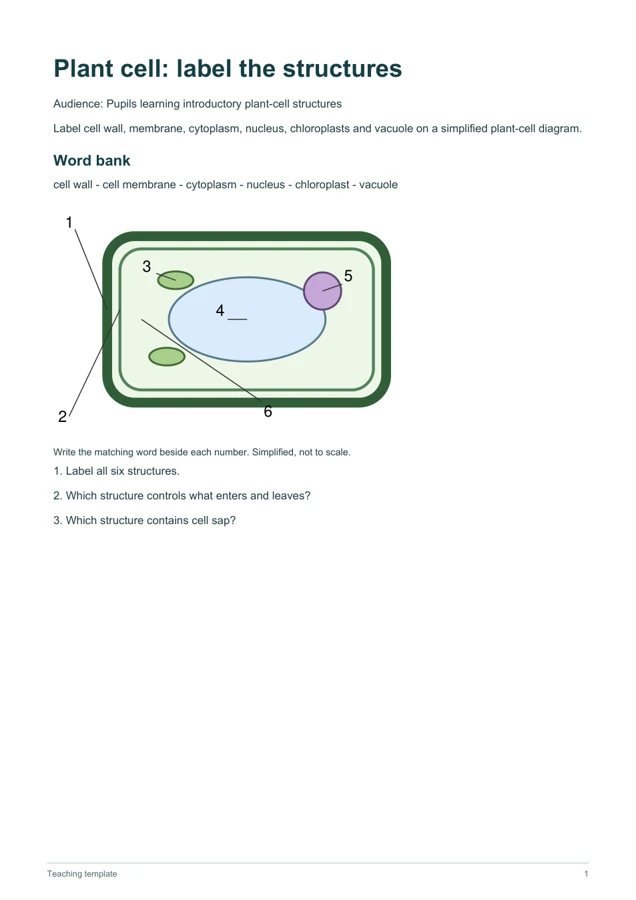
Plant cell: label the structures
Label cell wall, membrane, cytoplasm, nucleus, chloroplasts and vacuole on a simplified plant-cell diagram.
Head of Science
I want pupils to interpret practical data, explain what changed and what they measured, and reconsider their first ideas when observations suggest a better question.
Explore the collectionI teach Physics and combined Science across secondary and lead the department. Practical work matters when pupils have data they need to interpret. I do not want an investigation to confirm a result they were given in advance; I want pupils to work out what their observations can support.
Planning an investigation means choosing a question, collecting useful evidence and deciding how to record it. Pupils need to be able to explain what changed, what they measured and where the limits of their result lie. A surprising result can be productive when it leads them to check their method and reconsider an assumption.
I look for resources that make the reasoning around practical work visible. A table or planning frame can help pupils organise data, while questions can guide them towards interpretation rather than a copied conclusion. I value the point where evidence prompts a better question and the class can explain why its first idea needs another look.
Give practical work a question whose result is not supplied.
Ask pupils to interpret and check their own data.
Use unexpected results to revisit a method or explanation.
Explore these templates and decide what fits your own setting.
Science
Label cell wall, membrane, cytoplasm, nucleus, chloroplasts and vacuole on a simplified plant-cell diagram.
Science
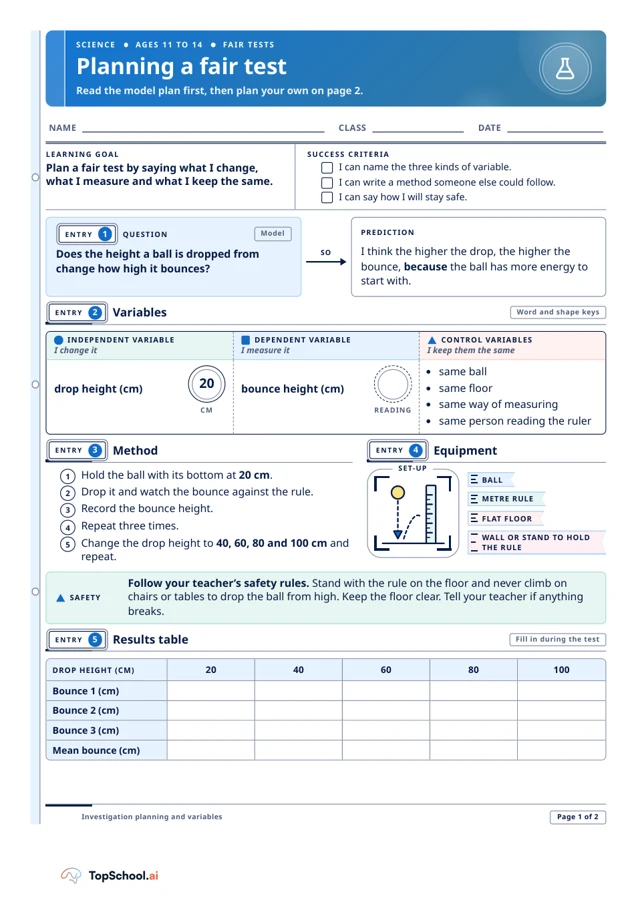
Plan a fair test with a clear question, variables, repeatable method and appropriate safety steps.
Science
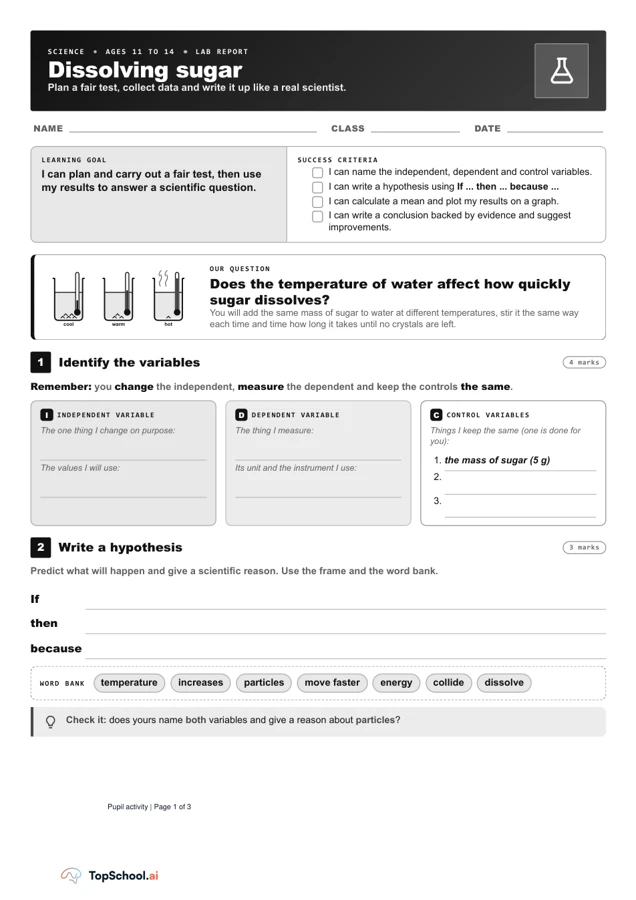
Pupils should specify a repeatable fair test, record all raw readings with units, calculate means and represent their actual data. Their conclusion should cite two results and their evaluation should connect two specific limitations with practical improvements.