
Science
Cell words: match the part to its job
Match six plant-cell words to their meanings, then use two of them to explain how a plant cell is organised. Check your answers with the model.
Read the material
Match six plant-cell words to their meanings, then use two of them to explain how a plant cell is organised. Check your answers with the model.
Pupil activity and after-attempt self-check. Use the preview for diagrams and layout.
Page 1
Cell words: match the part to its job
Pupil activity and after-attempt self-check
Match six plant-cell words to their meanings, then use two of them to explain how a plant cell is organised.
Check your answers with the model.
Practice independently or with a partner. Write in the spaces or print this page.
What you are practising
Use these six English terms to practise cell structures and functions. Match each term to its supplied
meaning; this activity does not require diagram pointers.
A student is revising how a plant cell is organised. The focus is the meaning of each word, not counting
structures in a drawing.
Materials
-
A. nucleus
-
B. cell membrane
-
C. cell wall
-
D. chloroplast
-
E. vacuole
-
F. mitochondrion
-
1. A cellulose layer that supports the cell.
-
2. A space containing cell sap that helps keep the cell firm.
-
3. Contains DNA and controls cell activity.
-
4. Releases energy during respiration.
-
5. Controls what enters and leaves the cell.
-
6. Contains chlorophyll and is where photosynthesis happens.
Have a go
1. Write the number beside each matching letter.
2. Choose two terms and complete: “The ___ helps the cell by ___.”
3. Use the model to check each match. Fix one answer in a different colour.
Check your work
-
Each word is matched to its stated job.
Pupil activity with self check
Page 1 of 3
Page 2
Cell words: match the part to its job
-
The explanation names a structure and gives its role.
-
The sentence uses “because” or “by” to connect word and function.
Your working space
My matches: A ___ B ___ C ___ D ___ E ___ F ___
My explanation: The ________ helps the cell by ________
One answer I checked or changed: ________
Need a hand?
Cover the definitions and reveal two at a time. Say each term aloud, then point to the matching definition
number.
Ready for more?
Choose two structures and compare their jobs using “whereas”.
Remember
This page checks word meanings only. It has no diagram labelling or assessment score.
Pupil activity with self check
Page 2 of 3
Page 3
Cell words: match the part to its job
Self-check: use after your first attempt
Model answers
Matches: A - 3, B - 5, C - 1, D - 6, E - 2, F - 4. Example: “The cell wall supports the plant cell because it is a
cellulose layer around it.” Keep “cell wall” and “cell membrane” separate; they do different jobs.
Pupil activity with self check
Page 3 of 3
A teaching sequence
Connect each plant-cell term to its job and use accurate vocabulary in a short explanation.
Match words to their jobs
Read the six plant-cell terms A-F and numbered definitions 1-6. Match each letter to one definition number on the worksheet; do not use diagram pointers because this page asks about word meanings rather than counting or labelling parts.
Which definition describes the cell membrane rather than the wall?
Explain two cell functions
Choose two matched terms and complete “The ___ helps the cell by ___” for one structure. Then compare the two structures’ jobs using “whereas”, so your response names each part and distinguishes its function.
Does “whereas” distinguish the two structures' different jobs?
Check and correct a match
Check against A-3, B-5, C-1, D-6, E-2 and F-4, then correct one answer in another colour. Preserve the meaning: the wall supports the cell, whereas the membrane controls what enters and leaves.
Can you explain the function as well as copy the model's number?
Revisit unclear meanings
If two meanings remain unclear, cover the definitions and reveal two at a time; say each term, point to its matching number and explain why. Ask the Science teacher to confirm course wording before using this task for scored assessment.
Which two definitions need another explanation before a scored task?
Before you teach
Look for the thinking behind an answer, choose the support your class needs and leave room for an independent response.
What to look for
Matches: A to 3, B to 5, C to 1, D to 6, E to 2, F to 4. Example: “The cell wall supports the plant cell because it is a cellulose layer around it.” Keep “cell wall” and “cell membrane” separate; they do different jobs. Check that the vocabulary matches your science course and class.
Give a little support
Cover the definitions and reveal two at a time. Say each term aloud, then point to the matching definition number.
Take the idea further
Choose two structures and compare their jobs using “whereas”.
Things to keep in mind
This page checks word meanings only. It has no diagram labelling or assessment score.
Keep the idea. Make it yours.
Bring your topic, learning goal and class context to PLAI™, then review what you create.
Another starting point
Explore a different teaching task from this selection.
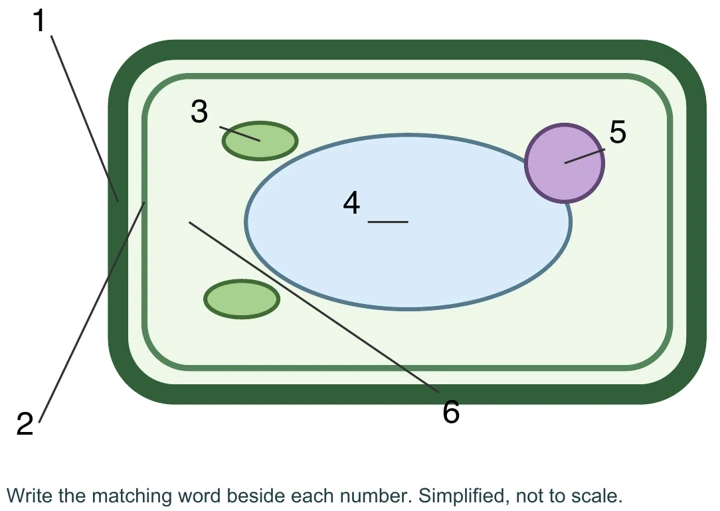
Plant cell: label the structures
Read the word bank and trace the outer and inner boundaries before labelling.
Explore resourceIdeas to try with your class
Sample teaching perspectives on what to try, what to adapt and what to watch for.
Meet The Creators
Meet a creator whose teaching interests connect with this template.

Planning List
This three-page pupil activity matches six plant-cell terms (nucleus, cell membrane, cell wall, chloroplast, vacuole and mitochondrion) to supplied meanings, then uses two terms to explain organisation. It explicitly says there are no diagram pointers.
Five More Minutes
The match-and-explain sequence checks word meaning without mixing in the separate diagram-pointer task used by other cell resources. The model answer supports a short explanation of how the cell is organised.
Kindly Red Pen
Cover the meanings for the first retrieval attempt, then uncover and check. Let pupils choose two structures with different functions and rehearse the explanation with the word bank before writing.
Margin Note
This task assesses selected English terms and functions, not cell labelling or the full biology of a plant cell. Check the model meanings against the unit and do not add diagram scoring.