
Maths
Problem solver: understand, plan, solve, check
Break a multi-step word problem into four stages: understand, plan, solve and check. A worked bake-sale example shows a bar model, ordered calculations, an estimate and inverse check before pupils tackle a farm-trip problem and a further cups question.
Read the material
Break a multi-step word problem into four stages: understand, plan, solve and check. A worked bake-sale example shows a bar model, ordered calculations, an estimate and inverse check before pupils tackle a farm-trip problem and a further cups question.
Activity. Use the preview for diagrams and layout.
Page 1
NAME
CLASS
DATE
LEARNING GOAL
I can solve a word problem with more
than one step by breaking it into
smaller parts.
SUCCESS CRITERIA
I can pick out what I know and what I need.
I can draw a bar model and order the steps.
I can check my answer and give its units.
WORKED EXAMPLE
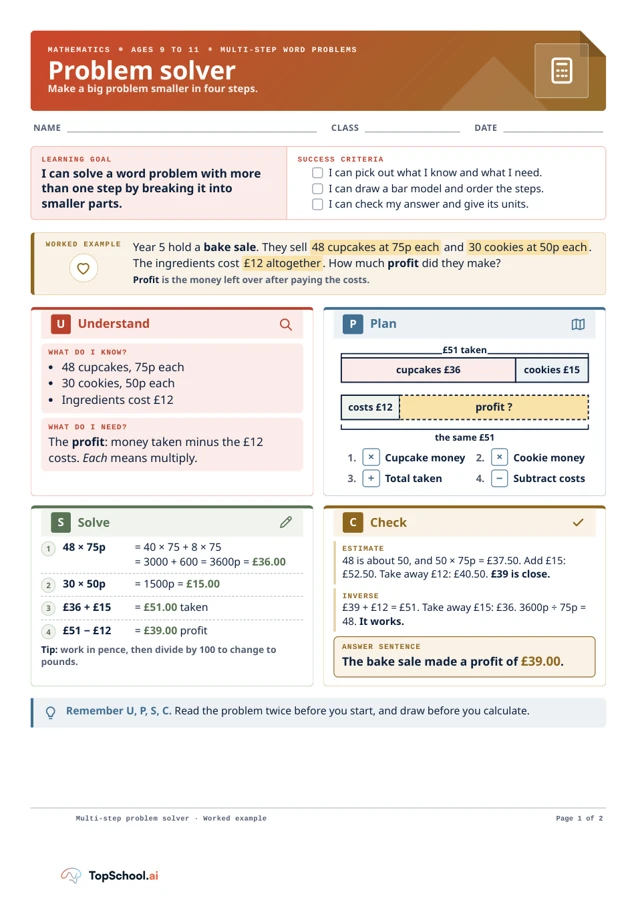
Year 5 hold a bake sale. They sell 48 cupcakes at 75p each and 30 cookies at 50p each .
The ingredients cost £12 altogether . How much profit did they make?
Profit is the money left over after paying the costs.
Remember U, P, S, C. Read the problem twice before you start, and draw before you calculate.
Multi-step problem solver · Worked example
MATHEMATICS
AGES 9 TO 11
MULTI-STEP WORD PROBLEMS
Problem solver
Make a big problem smaller in four steps.
U
Understand
WHAT DO I KNOW?
48 cupcakes, 75p each
30 cookies, 50p each
Ingredients cost £12
WHAT DO I NEED?
The profit: money taken minus the £12
costs. Each means multiply.
P
Plan
£51 taken
cupcakes £36
cookies £15
costs £12
profit ?
the same £51
1.
×
Cupcake money
2.
×
Cookie money
3.
+
Total taken
4.
−
Subtract costs
S
Solve
1
48 × 75p
= 40 × 75 + 8 × 75
= 3000 + 600 = 3600p = £36.00
2
30 × 50p
= 1500p = £15.00
3
£36 + £15
= £51.00 taken
4
£51 − £12
= £39.00 profit
Tip: work in pence, then divide by 100 to change to
pounds.
C
Check
ESTIMATE
48 is about 50, and 50 × 75p = £37.50. Add £15:
£52.50. Take away £12: £40.50. £39 is close.
INVERSE
£39 + £12 = £51. Take away £15: £36. 3600p ÷ 75p =
48. It works.
ANSWER SENTENCE
The bake sale made a profit of £39.00.
Page 1 of 2
Page 2
YOUR PROBLEM
30 pupils in Year 6 go on a trip to a farm. The coach costs £375 altogether, shared equally
between the pupils. Each pupil also needs a farm ticket costing £6.50. Each pupil pays
with a £20 note. How much change does each pupil get?
CLUE WORDS
altogether +
each ×
shared equally ÷
change −
left over −
GO FURTHER
For sports day, Mr Osei makes 6 jugs of
lemonade. Each jug holds 1.5 litres. He pours it
into cups that hold 250 ml. 30 children have one
cup each. How many cups of lemonade are left
over?
Hint: 1 litre = 1000 ml.
Answer:
cups
Multi-step problem solver · Your turn
How did you do?
Not yet
Getting there
Got it
PROBLEM SOLVER
YOUR TURN
Solve it in four steps
U
Understand
WHAT DO I KNOW?
WHAT DO I NEED TO FIND?
P
Plan
MY STEPS IN ORDER
1.
2.
3.
S
Solve
Show every step. Number each one to match your plan.
C
Check
ESTIMATE OR USE THE INVERSE
ANSWER SENTENCE WITH UNITS (£ OR P)
Draw a bar model. Label the parts you know and put ? on the
part you need.
Page 2 of 2
A teaching sequence
Solve a multi-step problem by identifying known information, ordering calculations and checking the result.
Understand the bake-sale question
Follow the worked bake-sale example. Use U to understand: list amounts and write the question in your own words.
Which amounts are known and which amount is being asked for?
Plan the relationships in a bar model
Use P to plan: draw and label a bar model, order the steps and choose whether to multiply, add, divide or subtract.
Why does each operation fit this problem rather than a clue word alone?
Solve with units and check
Use S to solve in order, keeping pounds and pence clear. Use C to check with an estimate or inverse operation, then write an answer with units.
Does the estimate or inverse operation support the recorded profit?
Apply the cycle to the new problems
Apply the cycle to the £375 coach shared by thirty pupils, £6.50 ticket and change from £20. Then calculate 250 ml cups from six 1.5-litre jugs, the thirty served and the cups left, checking units and method.
Have you checked the coach share, ticket and change, or the litre-to-millilitre conversion?
Before you teach
Look for the thinking behind an answer, choose the support your class needs and leave room for an independent response.
What to look for
Check that the plan answers the question, the operations are applied in order, units are consistent and the result is plausible. Ask pupils to use an estimate or inverse relationship, not merely repeat the same calculation. Review whether money is expressed in pounds or pence consistently.
Give a little support
Underline what is known and circle what is being asked. Use counters or a bar model before calculating, and give pupils sentence starters for each U-P-S-C stage. Work with one operation at a time and keep a money-conversion reminder visible.
Take the idea further
Ask pupils to write a similar multi-step problem with a different context and produce an estimate before solving. They can exchange problems and check a partner’s result using a different method.
Things to keep in mind
Clue words can have different meanings in context; operation choice should follow the relationship in the problem. The resource models a small set of arithmetic structures and does not include an answer key or every possible checking strategy.
Keep the idea. Make it yours.
Bring your topic, learning goal and class context to PLAI™, then review what you create.
Ideas to try with your class
Sample teaching perspectives on what to try, what to adapt and what to watch for.
Meet The Creators
Meet the creators whose teaching interests connect with this template. Find an approach to try with your class.
Anita Sharma
A short plan can help the adults agree what to do, but it should remain connected to the pupil’s experience and be reviewed rather than filed away.
Meet the creator
Maya Tan
I plan adaptation before the lesson, choosing accessible texts, vocabulary support and preparation time so pupils with different starting points can join the same Year 4 conversation.
Meet the creator
Cerys Evans
Staying connected to classroom learning helps me understand what pupils know through the work itself, alongside the information a report or assessment may provide.
Meet the creator
Rachel Duffield
I plan a two-year rolling curriculum with clear subject maps and adaptable sequences, while asking what support helps an anxious pupil feel ready to take part in class.
Meet the creator
After the Bell
The worked bake-sale example separates 48 cupcakes at 75p, 30 cookies at 50p and £12 costs, then orders four calculations to find £39 profit. A bar model shows money taken, costs and the remainder.
Spare Pencil
For ages 9 to 11, U-P-S-C (understand, plan, solve, check) asks pupils to read twice and draw before calculating. The check combines an estimate with an inverse calculation, reinforcing both reasonableness and arithmetic.
Thoughtful Pause
The worked example converts pence into pounds after multiplying, then uses the same steps for a pupil’s own problem. Pupils can label each bar segment before writing the sequence of operations.
Good Question
The bake sale is fictional and the example includes only ingredient costs. Keep the £39 result tied to the stated figures and distinguish this simplified profit from a real event’s other costs.