
PE and health
My fitness log: record and review progress
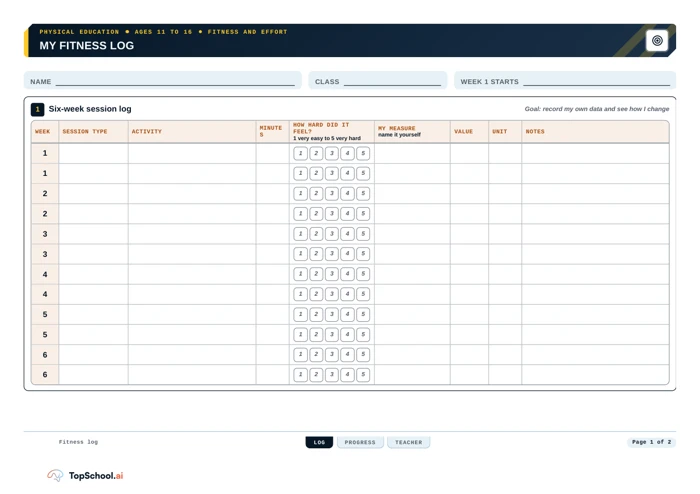
Track activity, perceived effort and one personal measure over six weeks. A graph, weekly effort record and review prompts help pupils notice patterns and set a next step, alongside reminders to warm up, rest and tell a teacher if something hurts.
Read the material
Track activity, perceived effort and one personal measure over six weeks. A graph, weekly effort record and review prompts help pupils notice patterns and set a next step, alongside reminders to warm up, rest and tell a teacher if something hurts.
Complete resource. Use the preview for diagrams and layout.
Page 1
NAME
CLASS
WEEK 1 STARTS
Fitness log
LOG
PROGRESS
TEACHER
Page 1 of 2
PHYSICAL EDUCATION
AGES 11 TO 16
FITNESS AND EFFORT
MY FITNESS LOG
1
Six-week session log
Goal: record my own data and see how I change
WEEK
SESSION TYPE
ACTIVITY
MINUTE
S
HOW HARD DID IT
FEEL?
1 very easy to 5 very hard
MY MEASURE
name it yourself
VALUE
UNIT
NOTES
1
1
2
3
4
5
1
1
2
3
4
5
2
1
2
3
4
5
2
1
2
3
4
5
3
1
2
3
4
5
3
1
2
3
4
5
4
1
2
3
4
5
4
1
2
3
4
5
5
1
2
3
4
5
5
1
2
3
4
5
6
1
2
3
4
5
6
1
2
3
4
5
Page 2
Fitness log
LOG
PROGRESS
TEACHER
Page 2 of 2
PHYSICAL EDUCATION
AGES 11 TO 16
MY PROGRESS
MY PROGRESS AND REVIEW
2
My measure over six weeks
Label axes: 1 km time, press-ups...
Wk 1
Wk 2
Wk 3
Wk 4
Wk 5
Wk 6
Bottom axis
Write the label and unit
3
My effort each week
Shade from 1 up
Wk 1
1
2
3
4
5
Wk 2
1
2
3
4
5
Wk 3
1
2
3
4
5
Wk 4
1
2
3
4
5
Wk 5
1
2
3
4
5
Wk 6
1
2
3
4
5
Key: 1 very easy to 5 very hard. Shade up to how hard most sessions felt.
Success criteria
I can log effort and my own measure.
I can plot my results.
I can train safely.
4
Goal and review
My goal
What changed
Next step
5
Look after yourself
Warm up first. Get ready before you push hard.
Rest days matter. Rest is part of getting fitter.
Stop if anything hurts and tell your teacher.
A teaching sequence
Record activity and perceived effort, plot one measure and reflect on a safe personal goal.
Record a consistent session measure
Each session, record week, activity, minutes, perceived effort and one named measure with its unit. Use the same method each week.
Is the same named measure and method used each week?
Plot values and perceived effort
Plot the six weekly values with labelled axes and shade the effort scale to show how hard most sessions felt.
Are both graph axes labelled with the measure and unit?
Review a safe next step
Record a goal, any change and a next step using the six-week table without expecting improvement. Follow the printed warm-up and rest reminders, stopping and telling the teacher if hurt.
Was the measure taken the same way, without expecting improvement every week?
Before you teach
Look for the thinking behind an answer, choose the support your class needs and leave room for an independent response.
What to look for
Check that the measure is named, the unit is consistent and the graph axes are labelled. Ask pupils to describe a pattern without assuming that every week must improve. Review the goal for safety and suitability, and respond to any report of pain or concern.
Give a little support
Let pupils select a measure that is suitable and accessible, with teacher guidance. Provide a sample graph and allow supported recording. Modify activities or measures for disability, health needs, equipment access and individual circumstances; effort ratings should not be treated as a competition.
Take the idea further
Ask pupils to compare effort and results over time, identify a factor that may explain a change and plan a safe adjustment. They can explain why consistent measurement methods matter and what the log cannot show about overall health.
Things to keep in mind
The log is a personal learning record, not a medical assessment or fitness diagnosis. A change in one chosen measure does not represent all aspects of fitness. Keep completed health-related information private and follow school guidance for activity, adaptation and storage.
Keep the idea. Make it yours.
Bring your topic, learning goal and class context to PLAI™, then review what you create.
Ideas to try with your class
Sample teaching perspectives on what to try, what to adapt and what to watch for.
Meet The Creators
Meet the creators whose teaching interests connect with this template. Find an approach to try with your class.

Wei Zhang
I teach Physical Education across the secondary phase and start planning with the pupil who may be least ready to join in.
Meet the creator
Sofia Almeida
I begin secondary PE planning with less-confident pupils, organising participation around available facilities and time so the task offers a workable first step within our practical constraints.
Meet the creator
Kofi Mensah
I want Physical Education to give every year group meaningful movement and a sense that improvement belongs to them, whether or not they already identify as sporty.
Meet the creator
Pham Van Phuc
I welcome pupils joining secondary PE during the year through a manageable first task, clear demonstrations and familiar routines, building from the experience they bring to the group.
Meet the creatorMichelle Ogunbiyi
I plan adaptable PE fitness and skills work alongside practical fixture arrangements, considering facilities, transport and lesson time while keeping the intended skill visible for different starting points.
Meet the creator
Tea Break Notes
The six-week log records activity type, minutes, perceived effort from very easy to very hard and a pupil-selected measure with unit. The second page plots one measure and asks for a goal, review and next step.
Glue Stick Club
For ages 11 to 16, the sheet combines personal data with a simple trend over six weeks. The safety box says warm up, rest and stop if something hurts, making recovery part of the reflection.
After the Bell
Pupils choose and label their measure, which allows different activities to be recorded without forcing everyone into the same performance test. The effort scale can support discussion alongside the plotted values.
Notes Between Bells
The measure and effort score are personal records, not a clinical assessment or ranking of pupils. Follow the stop-and-tell-teacher guidance, and do not interpret a six-week graph as proof of fitness without context.