
Business and economics
Business vocabulary cards: six shop terms
For Years 9 to 13 Business pupils, explain six business terms and use them accurately in a short example about a small shop.
Read the material
For Years 9 to 13 Business pupils, explain six business terms and use them accurately in a short example about a small shop.
Pupil document. Use the preview for diagrams and layout.
Page 1
Teaching template
1
Business vocabulary cards: six shop terms
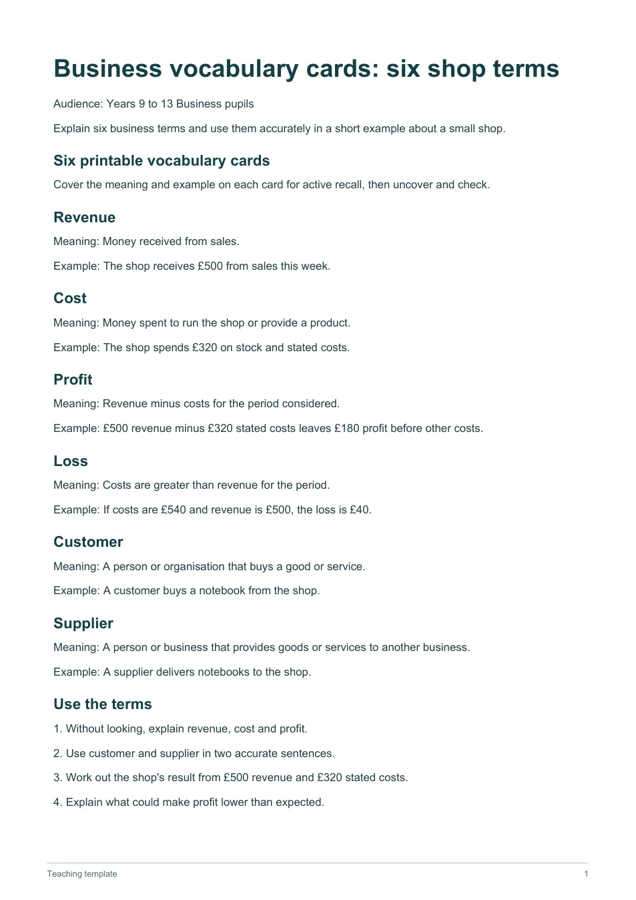
Audience: Years 9 to 13 Business pupils
Explain six business terms and use them accurately in a short example about a small shop.
Six printable vocabulary cards
Cover the meaning and example on each card for active recall, then uncover and check.
Revenue
Meaning: Money received from sales.
Example: The shop receives £500 from sales this week.
Cost
Meaning: Money spent to run the shop or provide a product.
Example: The shop spends £320 on stock and stated costs.
Profit
Meaning: Revenue minus costs for the period considered.
Example: £500 revenue minus £320 stated costs leaves £180 profit before other costs.
Loss
Meaning: Costs are greater than revenue for the period.
Example: If costs are £540 and revenue is £500, the loss is £40.
Customer
Meaning: A person or organisation that buys a good or service.
Example: A customer buys a notebook from the shop.
Supplier
Meaning: A person or business that provides goods or services to another business.
Example: A supplier delivers notebooks to the shop.
Use the terms
1. Without looking, explain revenue, cost and profit.
2. Use customer and supplier in two accurate sentences.
3. Work out the shop's result from £500 revenue and £320 stated costs.
4. Explain what could make profit lower than expected.
Page 1
Teaching template
1
Business vocabulary cards: six shop terms:
teacher notes
Teacher check
£500 - £320 = £180 profit before any unstated costs. Ask, “Could the shop have high revenue but low profit
if its costs are also high?”
A teaching sequence
Explain six business terms and use them accurately in a short example about a small shop.
Recall, then check meanings
Cover the meanings and examples; recall each term from its prompt. Check the card, then explain the term in your own words.
Can you explain the key meaning before uncovering the card?
Use terms for the shop
Use two terms accurately in a sentence about the shop.
Does your sentence distinguish the customer from the supplier?
Separate revenue from profit
Explain how profit differs from revenue.
Which stated costs must be subtracted from the shop's revenue?
Before you teach
Look for the thinking behind an answer, choose the support your class needs and leave room for an independent response.
What to look for
The six cards pair each term with its meaning and a concrete shop example. £500 revenue less £320 stated costs leaves £180 before other costs. Ask, “Could high revenue still produce low profit?”
Give a little support
Keep definitions visible and use “Revenue is _____” and “A cost is _____” sentence frames.
Take the idea further
Choose a fictional shop and describe one decision using revenue, cost, profit and customer.
Things to keep in mind
Check definitions against the current course glossary, especially where local specifications define terms differently. The shop figures are fictional and count only the costs stated.
Keep the idea. Make it yours.
Bring your topic, learning goal and class context to PLAI™, then review what you create.
Another starting point
Explore a different teaching task from this selection.
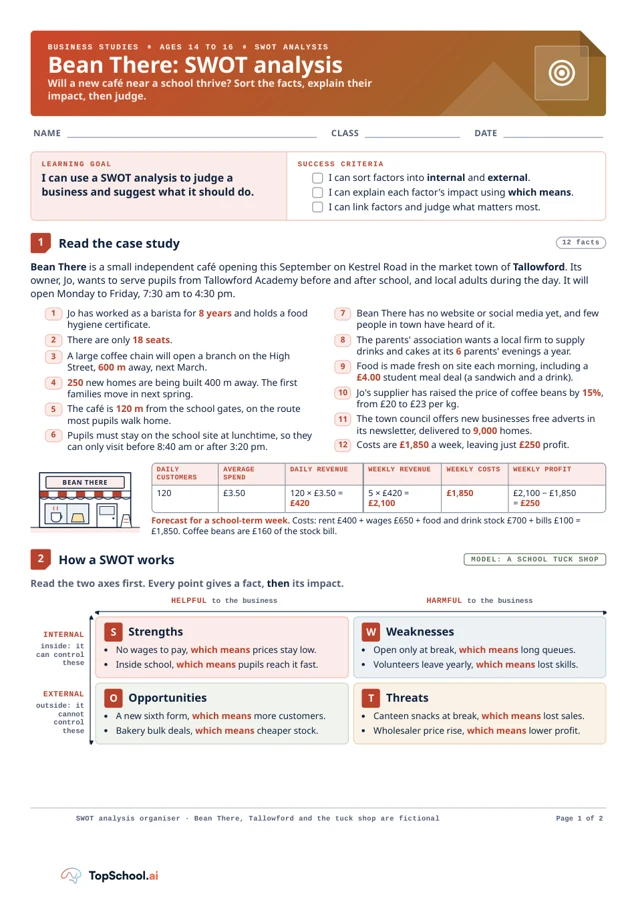
Bean There: SWOT analysis
Read the Bean There case and distinguish what Jo can control from what is happening outside the café. Review the forecast and cost notes before deciding which facts matter.
Explore resource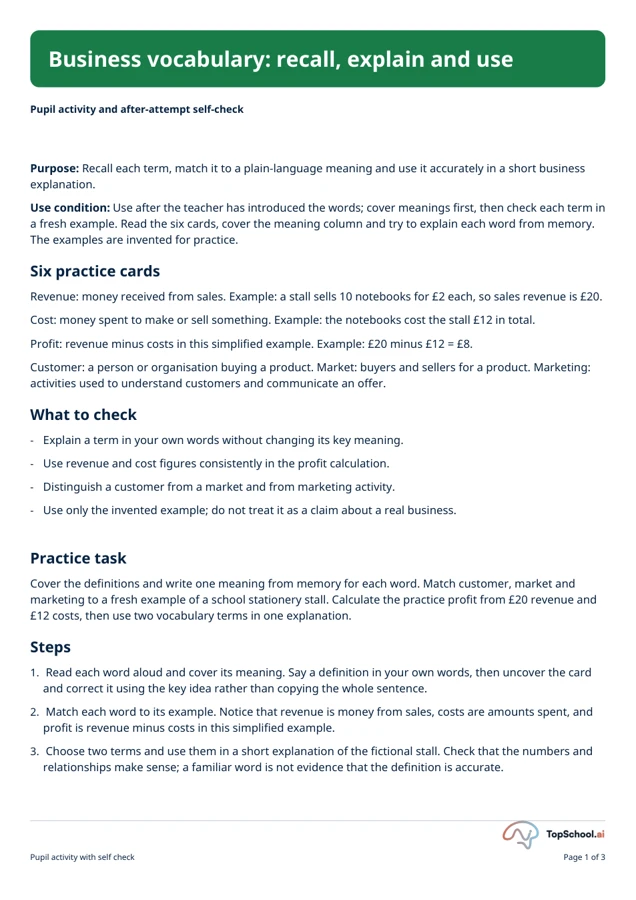
Business vocabulary: recall, explain and use
Read the six cards, cover the meaning column and try to explain each word from memory. The examples are invented for practice.
Explore resourceIdeas to try with your class
Sample teaching perspectives on what to try, what to adapt and what to watch for.
Meet The Creators
Meet a creator whose teaching interests connect with this template.

Chalk Dust & Checklists
The one-page business set for Years 9 to 13 defines six shop terms and gives a short example for each. Revenue is sales received; the example contrasts £500 sales with £320 in stated costs to show £180 profit.
Kind Check-In
The figures let pupils connect revenue, cost and profit in a small-shop context. The cards are intended for active recall by covering the meaning and example before checking.
Open Book Pause
Ask the pupil to explain one term from memory, uncover the card and compare the explanation with its definition. Then ask for a fresh example that preserves the distinction between revenue and profit.
Margin Note
The £500, £320 and £180 amounts are illustrative card examples, not a real shop's accounts. Check that “cost” covers the stated period and items before applying the terms to actual business data.