Business and economics
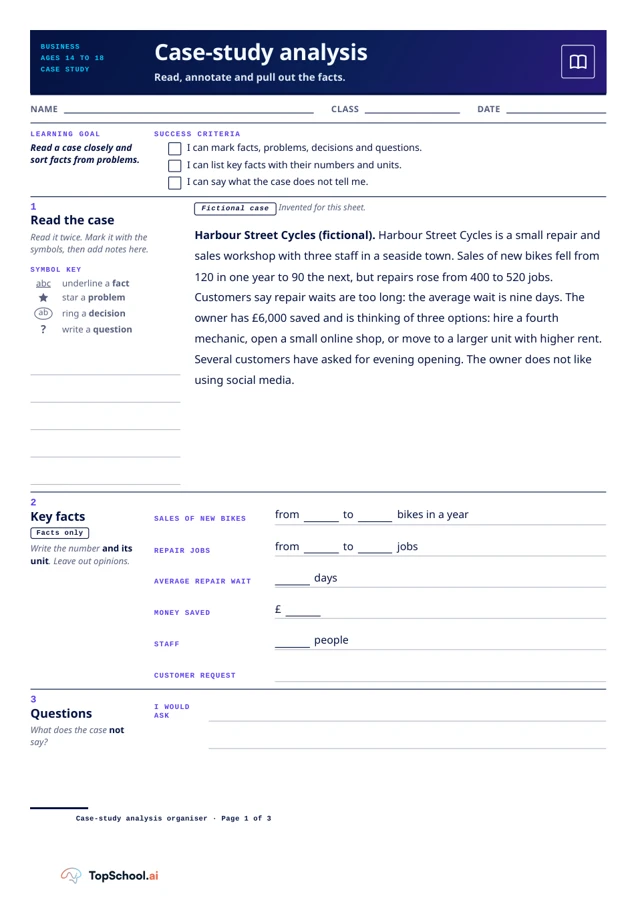
Case-study analysis: Harbour Street Cycles
Extract case facts, calculate percentage change, compare options and make a recommendation that acknowledges missing information.

Economics and Business teacher
I ask pupils to draw the economic diagram before arguing a position, then connect its relationships and assumptions with a nearby example and a reasoned claim.
Explore the collectionI teach Economics and Business from Year 9 through A Level. I like to connect an idea with the economic activity pupils can observe around them. A nearby example can make an abstract concept easier to question, provided we still examine the model rather than assume the example proves it.
My starting point is to draw the diagram before arguing a position. The model gives us a shared way to identify what is changing and which relationships matter. Pupils can then use it to explain an effect, consider a different condition and decide whether their first view still holds.
I look for resources that help pupils move between a model, a real example and a reasoned claim. A diagram should make the thinking clearer, not simply decorate an opinion. I want pupils to show how the evidence and assumptions connect, then recognise where the model simplifies a more complicated situation.
Draw a model before debating a conclusion.
Connect economic concepts with observable examples.
Identify assumptions and limits when applying a model.
Explore these templates and decide what fits your own setting.
Business and economics
Extract case facts, calculate percentage change, compare options and make a recommendation that acknowledges missing information.
Business and economics
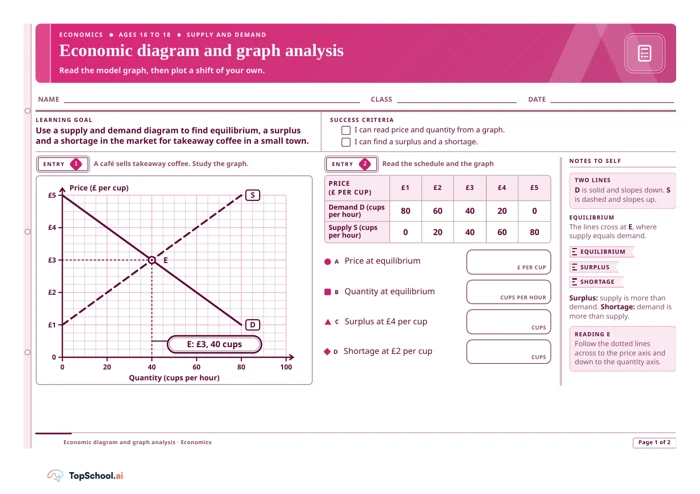
Find equilibrium, calculate a surplus or shortage and explain a demand shift using a supply-and-demand graph.
Business and economics
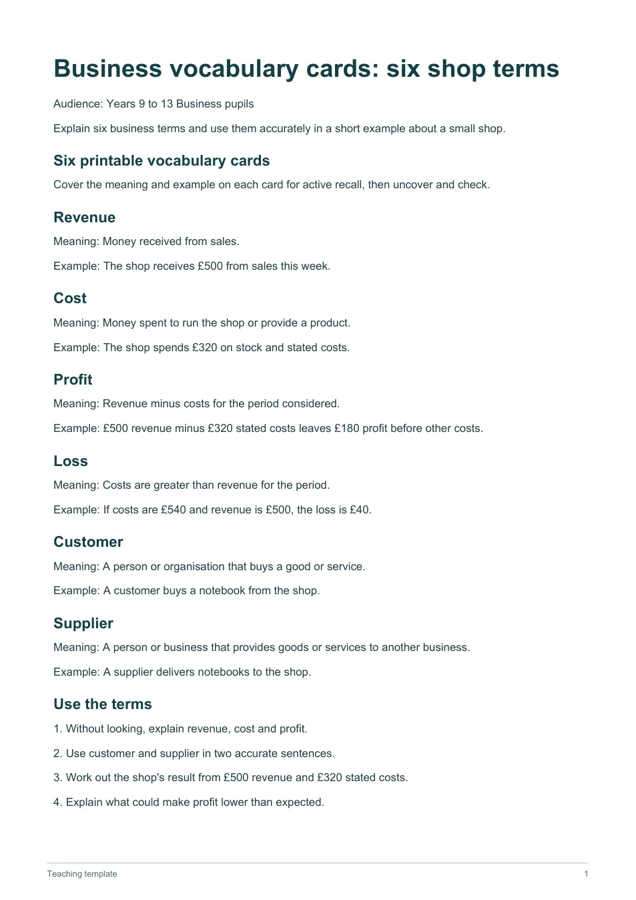
Explain six business terms and use them accurately in a short example about a small shop.
Business and economics
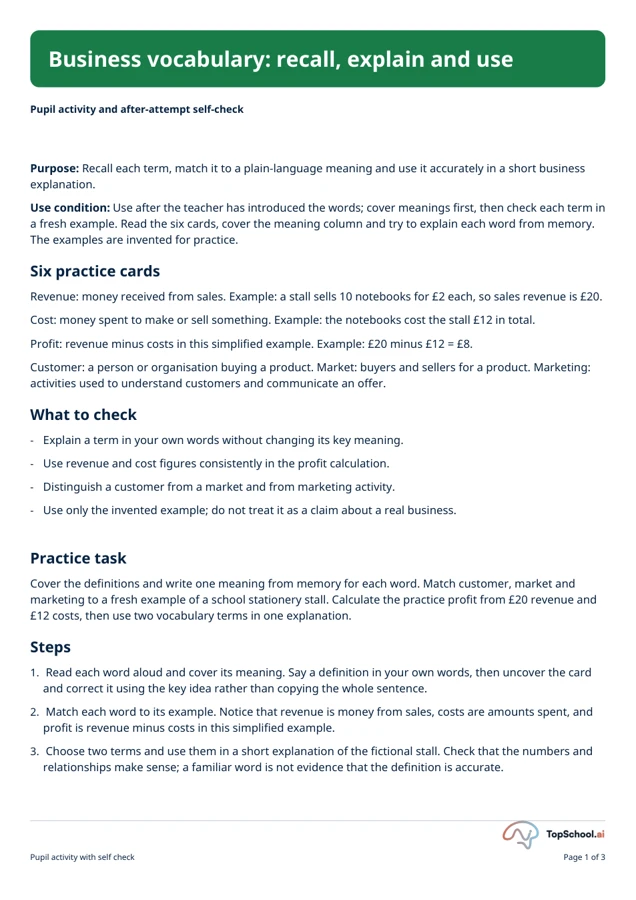
Recall each term, match it to a plain-language meaning and use it accurately in a short business explanation.