
Business and economics
Business vocabulary: recall, explain and use
A Business vocabulary set for practising six core terms through definition recall, example matching and one short explanation.
Read the material
A Business vocabulary set for practising six core terms through definition recall, example matching and one short explanation.
Pupil activity and after-attempt self-check. Use the preview for diagrams and layout.
Page 1
Business vocabulary: recall, explain and use
Pupil activity and after-attempt self-check
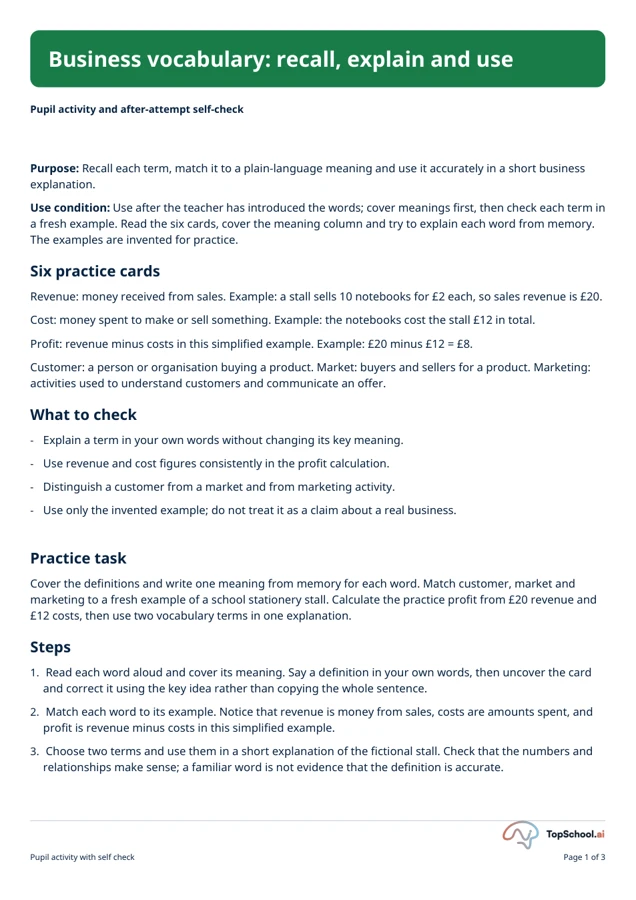
Purpose: Recall each term, match it to a plain-language meaning and use it accurately in a short business
explanation.
Use condition: Use after the teacher has introduced the words; cover meanings first, then check each term in
a fresh example. Read the six cards, cover the meaning column and try to explain each word from memory.
The examples are invented for practice.
Six practice cards
Revenue: money received from sales. Example: a stall sells 10 notebooks for £2 each, so sales revenue is £20.
Cost: money spent to make or sell something. Example: the notebooks cost the stall £12 in total.
Profit: revenue minus costs in this simplified example. Example: £20 minus £12 = £8.
Customer: a person or organisation buying a product. Market: buyers and sellers for a product. Marketing:
activities used to understand customers and communicate an offer.
What to check
-
Explain a term in your own words without changing its key meaning.
-
Use revenue and cost figures consistently in the profit calculation.
-
Distinguish a customer from a market and from marketing activity.
-
Use only the invented example; do not treat it as a claim about a real business.
Practice task
Cover the definitions and write one meaning from memory for each word. Match customer, market and
marketing to a fresh example of a school stationery stall. Calculate the practice profit from £20 revenue and
£12 costs, then use two vocabulary terms in one explanation.
Steps
1. Read each word aloud and cover its meaning. Say a definition in your own words, then uncover the card
and correct it using the key idea rather than copying the whole sentence.
2. Match each word to its example. Notice that revenue is money from sales, costs are amounts spent, and
profit is revenue minus costs in this simplified example.
3. Choose two terms and use them in a short explanation of the fictional stall. Check that the numbers and
relationships make sense; a familiar word is not evidence that the definition is accurate.
Pupil activity with self check
Page 1 of 3
Page 2
Business vocabulary: recall, explain and use
4. Check a second example in which costs change but sales stay the same. Ask which term changes and
which remains fixed.
Working space
Term I can define without looking: ________
Example that shows its meaning: ________
Revenue £_____ minus costs £_____ = simplified profit £_____
Two-term explanation: ________
Support and next action
Reveal one definition at a time, offer the first letter as a cue, or explain the word orally before writing. Keep
the example numbers visible for the final check.
Next action: Ask students to explain how the revenue and cost figures produce the simplified profit. Correct
a term by returning to its definition and example, then try a new number.
Check
A useful answer distinguishes revenue from profit, names costs as spending and uses at least two terms
correctly in a complete explanation.
Limits
These are English Business terms with fictional examples; confirm the course glossary before use.
Pupil activity with self check
Page 2 of 3
Page 3
Business vocabulary: recall, explain and use
Self-check: use after your first attempt
Model response or judgement
The fictional stall receives £20 in revenue and has £12 in costs, so its simplified profit is £8. A customer buys a
notebook; the market includes the people and sellers for notebooks; marketing is how the stall learns about
those buyers and communicates its offer.
Pupil activity with self check
Page 3 of 3
A teaching sequence
Recall each term, match it to a plain-language meaning and use it accurately in a short business explanation.
Recall each business term
Read each word aloud and cover its meaning. Say a definition in your own words, then uncover the card and correct it using the key idea rather than copying the whole sentence.
What key idea stays the same when you explain the definition in your own words?
Match words and examples
Match each word to its example. Notice that revenue is money from sales, costs are amounts spent, and profit is revenue minus costs in this simplified example.
Which example describes a customer, a market or marketing activity?
Explain the stall's result
Choose two terms and use them in a short explanation of the fictional stall. Check that the numbers and relationships make sense; a familiar word is not evidence that the definition is accurate.
How do £20 revenue and £12 costs produce the simplified profit?
Change costs and compare
Check a second example in which costs change but sales stay the same. Ask which term changes and which remains fixed.
If sales stay the same, which term changes when costs rise?
Before you teach
Look for the thinking behind an answer, choose the support your class needs and leave room for an independent response.
What to look for
A useful answer distinguishes revenue from profit, names costs as spending and uses at least two terms correctly in a complete explanation.
Give a little support
Reveal one definition at a time, offer the first letter as a cue, or explain the word orally before writing. Keep the example numbers visible for the final check.
Take the idea further
Add a new fictional product and explain how a change in price or cost could affect revenue or profit, stating any assumption.
Things to keep in mind
These are English Business terms with fictional examples; confirm the course glossary before use.
Keep the idea. Make it yours.
Bring your topic, learning goal and class context to PLAI™, then review what you create.
Another starting point
Explore a different teaching task from this selection.
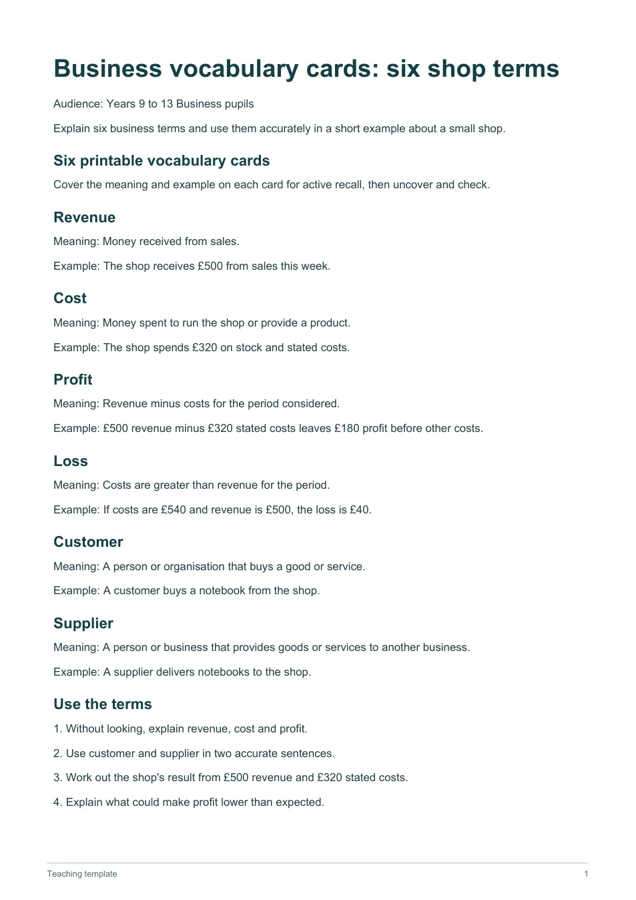
Business vocabulary cards: six shop terms
Read each term, cover its definition and explain it in your own words.
Explore resourceIdeas to try with your class
Sample teaching perspectives on what to try, what to adapt and what to watch for.
Meet The Creators
Meet a creator whose teaching interests connect with this template.

Book and Biscuit
This three-page pupil activity asks learners to cover six business-card meanings, recall each term, match it to a plain-language definition and use it in a short explanation. The examples, such as selling ten £2 notebooks for £20 revenue, are invented for practice.
Spare Pencil
The activity follows teacher introduction and asks for a fresh example after recall, so pupils practise more than matching. Its after-attempt self-check can reveal which terms need another explanation.
Steady Marker
Read the six cards once, cover the meanings, then check each answer against the printed example. Ask the learner to explain the £20 calculation before moving to a new shop example.
Paperclip Perspective
The sales examples are invented and do not describe a real stall or business. Verify arithmetic and keep revenue distinct from profit when pupils write their own cases.