
Business and economics
Bean There: SWOT analysis
Analyse a fictional café using twelve case facts and a weekly forecast. Sort internal and external factors, explain their effect on the business, link them into a strategy and judge which factor may matter most.
Read the material
Analyse a fictional café using twelve case facts and a weekly forecast. Sort internal and external factors, explain their effect on the business, link them into a strategy and judge which factor may matter most.
Activity. Use the preview for diagrams and layout.
Page 1
NAME
CLASS
DATE
LEARNING GOAL
I can use a SWOT analysis to judge a
business and suggest what it should do.
SUCCESS CRITERIA
I can sort factors into internal and external.
I can explain each factor's impact using which means.
I can link factors and judge what matters most.
Read the case study
12 facts
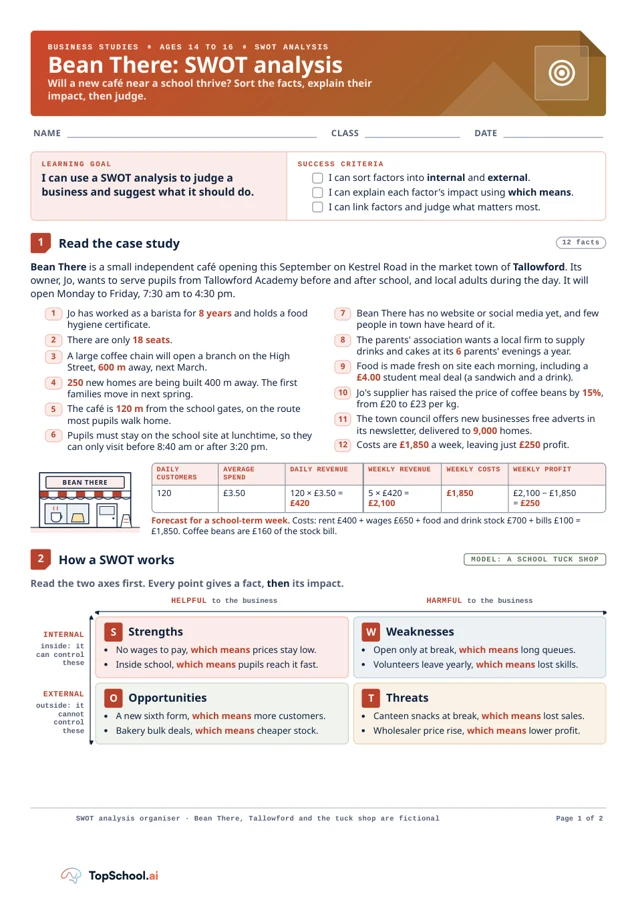
Bean There is a small independent café opening this September on Kestrel Road in the market town of Tallowford. Its
owner, Jo, wants to serve pupils from Tallowford Academy before and after school, and local adults during the day. It will
open Monday to Friday, 7:30 am to 4:30 pm.
1
Jo has worked as a barista for 8 years and holds a food
hygiene certificate.
2
There are only 18 seats.
3
A large coffee chain will open a branch on the High
Street, 600 m away, next March.
4
250 new homes are being built 400 m away. The first
families move in next spring.
5
The café is 120 m from the school gates, on the route
most pupils walk home.
6
Pupils must stay on the school site at lunchtime, so they
can only visit before 8:40 am or after 3:20 pm.
7
Bean There has no website or social media yet, and few
people in town have heard of it.
8
The parents' association wants a local firm to supply
drinks and cakes at its 6 parents' evenings a year.
9
Food is made fresh on site each morning, including a
£4.00 student meal deal (a sandwich and a drink).
10
Jo's supplier has raised the price of coffee beans by 15%,
from £20 to £23 per kg.
11
The town council offers new businesses free adverts in
its newsletter, delivered to 9,000 homes.
12
Costs are £1,850 a week, leaving just £250 profit.
BEAN THERE
DAILY
CUSTOMERS
AVERAGE
SPEND
DAILY REVENUE
WEEKLY REVENUE
WEEKLY COSTS
WEEKLY PROFIT
120
£3.50
120 × £3.50 =
£420
5 × £420 =
£2,100
£1,850
£2,100 − £1,850
= £250
Forecast for a school-term week. Costs: rent £400 + wages £650 + food and drink stock £700 + bills £100 =
£1,850. Coffee beans are £160 of the stock bill.
How a SWOT works
MODEL: A SCHOOL TUCK SHOP
Read the two axes first. Every point gives a fact, then its impact.
S
Strengths
No wages to pay, which means prices stay low.
Inside school, which means pupils reach it fast.
W
Weaknesses
Open only at break, which means long queues.
Volunteers leave yearly, which means lost skills.
O
Opportunities
A new sixth form, which means more customers.
Bakery bulk deals, which means cheaper stock.
T
Threats
Canteen snacks at break, which means lost sales.
Wholesaler price rise, which means lower profit.
SWOT analysis organiser · Bean There, Tallowford and the tuck shop are fictional
BUSINESS STUDIES
AGES 14 TO 16
SWOT ANALYSIS
Bean There: SWOT analysis
Will a new café near a school thrive? Sort the facts, explain their
impact, then judge.
1
2
HELPFUL to the business
HARMFUL to the business
INTERNAL
inside: it
can control
these
EXTERNAL
outside: it
cannot
control
these
Page 1 of 2
Page 2
Build Bean There's SWOT
8 marks
Write the fact numbers in each box, then explain two of them with which means ...
S
Strengths
FACTS
What does Bean There have that will win customers?
W
Weaknesses
FACTS
What inside the café could cost it sales?
O
Opportunities
FACTS
What is happening in Tallowford that Jo could use?
T
Threats
FACTS
What could hurt sales? Bean rise: £
 a week.
TOWS: link two facts, then say what Jo should do
6 marks
S
+
O
Use a strength to grab an
opportunity
FACTS
+
W +
O
Fix a weakness using an
opportunity
FACTS
+
S
+
T
Use a strength to defend
against a threat
FACTS
+
Judge: what is the most important factor?
6 marks
The most important factor is
because
which means
This matters more than
However, it depends on
Weigh it up: which
factor could change the
£250 weekly profit the
most, and how soon? A
threat arriving next
March may matter more
than a small weakness
today.
SWOT analysis organiser · Total 20 marks
How confident am I?
Not yet
Getting there
Got it
BEAN THERE
YOUR ANALYSIS
Your SWOT, strategy and judgement
3
HELPFUL to the business
HARMFUL to the business
INTERNAL
inside: Jo
can control
these
EXTERNAL
outside: Jo
cannot
control
these
4
5
Page 2 of 2
A teaching sequence
Classify strengths, weaknesses, opportunities and threats, use case evidence to explain impact, connect factors in a TOWS strategy and justify a priority.
Sort the twelve business facts
Place each numbered fact in a SWOT category and explain at least two with “which means…”.
Which case detail supports your SWOT category?
Check the two SWOT axes
Check whether an item is internal or external and whether it is helpful or harmful to the business. Use the case rather than assumptions about cafés in general.
Is the factor within Jo's control, and is it helpful or harmful?
Turn linked facts into action
Choose two connected facts for each TOWS prompt and state a practical action Jo could take.
How does your chosen strength help Jo use the opportunity?
Judge impact and timing
Judge the most important factor by considering the £250 weekly forecast profit, timing and possible effect. Explain what would change the judgement.
What information is missing before you can calculate the bean-price effect?
Before you teach
Look for the thinking behind an answer, choose the support your class needs and leave room for an independent response.
What to look for
Check that each classification is supported by a numbered fact and that pupils explain a likely business effect. Ask them to distinguish the café’s current position from future changes, such as homes or a competitor arriving next year.
Give a little support
Colour-code internal/external facts and helpful/harmful effects. Model one fact-to-impact sentence, then give pupils a short list of fact numbers to place before they complete the full analysis.
Take the idea further
Ask pupils to estimate how a 15% supplier price change might affect the stated weekly forecast if the relevant cost base were known. Have them identify which extra information they would need before calculating an exact profit effect.
Things to keep in mind
Bean There and Tallowford are labelled fictional. The forecast is a teaching case, not a market estimate. Do not treat the stated figures as evidence about a real café. The exact effect of the coffee-bean price rise cannot be calculated from the information shown without additional purchasing quantities.
Keep the idea. Make it yours.
Bring your topic, learning goal and class context to PLAI™, then review what you create.
Another starting point
Explore a different teaching task from this selection.
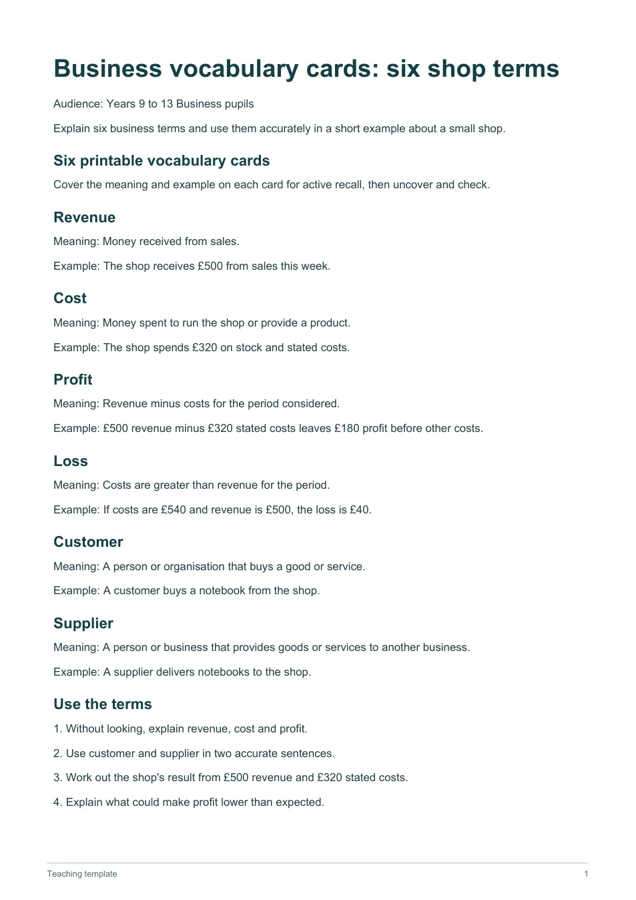
Business vocabulary cards: six shop terms
Read each term, cover its definition and explain it in your own words.
Explore resourceIdeas to try with your class
Sample teaching perspectives on what to try, what to adapt and what to watch for.
Meet The Creators
Meet a creator whose teaching interests connect with this template.

Bright Margins
This two-page business case asks pupils to sort internal strengths and weaknesses from external opportunities and threats, explain impact using “which means,” connect factors in a TOWS strategy and justify a priority for the fictional Bean There café.
Open Book Pause
The case gives 12 facts about an independent café opening on Kestrel Road in Tallowford, targeting pupils from Tallowford Academy. Connecting factors through TOWS moves the task from listing to a reasoned business choice.
One More Question
Label each fact as internal or external before placing it, then ask how it could affect the stated customer group. Use a sentence starter to connect one strength or weakness to an opportunity or threat.
Pocketful of Stories
Bean There and Tallowford are a case study, not a real business forecast. Keep recommendations tied to the supplied facts and identify assumptions that would need market evidence.