
Maths
Round-robin tournament planner
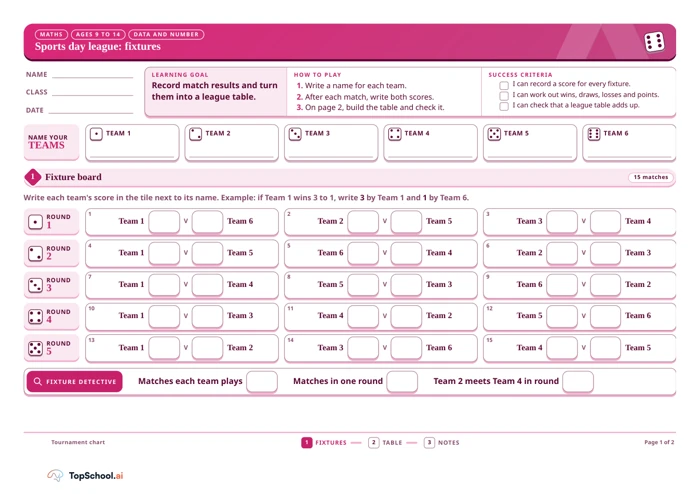
Plan a six-team round robin, record results and use the table to compare performance. The fixtures and example show how to complete a match row and calculate wins, draws, losses, goal difference and points. Agree event rules before play.
Read the material
Plan a six-team round robin, record results and use the table to compare performance. The fixtures and example show how to complete a match row and calculate wins, draws, losses, goal difference and points. Agree event rules before play.
Activity. Use the preview for diagrams and layout.
Page 1
NAME
CLASS
DATE
LEARNING GOAL
Record match results and turn
them into a league table.
HOW TO PLAY
1. Write a name for each team.
2. After each match, write both scores.
3. On page 2, build the table and check it.
SUCCESS CRITERIA
I can record a score for every fixture.
I can work out wins, draws, losses and points.
I can check that a league table adds up.
NAME YOUR
TEAMS
TEAM 1
TEAM 2
TEAM 3
TEAM 4
TEAM 5
TEAM 6
Fixture board
15 matches
Write each team's score in the tile next to its name. Example: if Team 1 wins 3 to 1, write 3 by Team 1 and 1 by Team 6.
ROUND
1
ROUND
2
ROUND
3
ROUND
4
ROUND
5
FIXTURE DETECTIVE
Matches each team plays
Matches in one round
Team 2 meets Team 4 in round
Tournament chart
1
FIXTURES
2
TABLE
3
NOTES
MATHS
AGES 9 TO 14
DATA AND NUMBER
Sports day league: fixtures
1
Team 1
V
Team 6
1
Team 2
V
Team 5
2
Team 3
V
Team 4
3
Team 1
V
Team 5
4
Team 6
V
Team 4
5
Team 2
V
Team 3
6
Team 1
V
Team 4
7
Team 5
V
Team 3
8
Team 6
V
Team 2
9
Team 1
V
Team 3
10
Team 4
V
Team 2
11
Team 5
V
Team 6
12
Team 1
V
Team 2
13
Team 3
V
Team 6
14
Team 4
V
Team 5
15
Page 1 of 2
Page 2
W win = 3 points
D
draw = 1 point
L
loss = 0 points
P = W + D + L
Difference = For − Against
Points = 3 × W + D
League table
After 5 rounds
Fill one row per team. For = goals scored, Against = goals let in. Rank by points for Pos.
TEAM
P
W
D
L
FOR
AGAINST
DIFFERENCE
POINTS
POS
EXAMPLE
Comets (not a real result)
5
3
1
1
9
5
+4
10
–
Team 1
Team 2
Team 3
Team 4
Team 5
Team 6
CHECK IT
Total W
= total L
Total For
= Against
Total P
should be 30
Difference total
should be 0
Cross-results grid
Each match goes in two cells. Team 1 beats Team 6 by 3 to 1?
Row T1, column T6: 3–1. Row T6, column T1: 1–3.
ROW TEAM
SCORES
FIRST
T1
T2
T3
T4
T5
T6
T1
NO MATCH
T2
NO MATCH
T3
NO MATCH
T4
NO MATCH
T5
NO MATCH
T6
NO MATCH
BONUS ROUND
Eight teams each play every other team
once. How many matches?
Tournament chart
1
FIXTURES
2
TABLE
3
NOTES
MATHS
AGES 9 TO 14
LEAGUE TABLE
Sports day league: table
2
3
Page 2 of 2
A teaching sequence
Organise a six-team round robin, record match outcomes consistently and use the stated points system and goal difference to describe standings.
Arrange all fifteen pairings
Use the fixture list to organise the 15 pairings, making sure each team meets every other team once.
Does every team meet each other team once?
Record and confirm match scores
Record each score immediately after a match and keep a separate record if the result needs confirming.
Is any disputed result kept separate until agreed?
Build the league table
Update each team’s played, won, drawn, lost, goals for and against, goal difference and points using the printed points rule.
Do played, goal difference and points follow the printed rules?
Cross-check before sharing standings
Check that each team has played five matches and that the results in the fixture list agree with the table before sharing the standings with teams.
Do five matches per team, total wins and losses, and goals for and against agree?
Before you teach
Look for the thinking behind an answer, choose the support your class needs and leave room for an independent response.
What to look for
Check that all 15 pairings appear once, scores are copied correctly, goal difference equals goals for minus goals against, and points follow the agreed rule. Resolve any tie using the organiser’s pre-agreed local rule rather than assuming the sheet defines every tie-break.
Give a little support
Use team names or symbols consistently, assign an adult to confirm results and update the table, and explain one completed row before play. For a shorter event, agree which fixtures to omit before starting.
Take the idea further
Ask pupils to check the schedule mathematically, compare two teams’ records or create a tie-break rule and test it against a hypothetical tied table. They can also explain how a draw changes each team’s points.
Things to keep in mind
The chart does not provide venue, safety, inclusion or tie-break arrangements. Adapt match lengths and participation so the event suits the setting, and check sport rules, supervision, access and equipment before play. Agree how to handle a disputed result.
Keep the idea. Make it yours.
Bring your topic, learning goal and class context to PLAI™, then review what you create.
Another starting point
Explore a different teaching task from this selection.
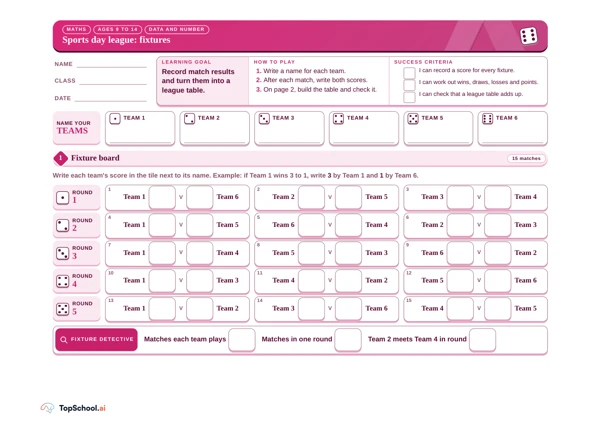
Sports day league: fixtures and table
Name Teams 1 to 6 and find the first fixture. Model Team 1 beating Team 6 by 3 to 1, then enter 3 to 1 in the Team 1 row and the reversed score in the Team 6 row of the cross-results grid.
Explore resourceIdeas for using this resource
Sample teaching perspectives on what to try, what to adapt and what to watch for.
Meet The Creators
Meet the creators whose teaching interests connect with this template. Find an approach to try with your class.

Gavin Stourton
I adapt games through space, equipment and roles so pupils with different confidence and experience can practise, make decisions and contribute while keeping the activity’s purpose clear.
Meet the creator
Michelle Ogunbiyi
I plan adaptable PE fitness and skills work alongside practical fixture arrangements, considering facilities, transport and lesson time while keeping the intended skill visible for different starting points.
Meet the creator
Coffee Before Copies
This two-page round-robin planner gives six team spaces and 15 fixtures, then asks pupils to record both scores and build a league table using wins, draws, losses, points and goal difference.
Pocketful of Stories
The fixture board and table connect each match result to the standings, and the check prompt asks whether the totals add up. This makes the chart a useful application of arithmetic and consistent record keeping.
Step by Step
Name all six teams before starting, enter both scores after each match and verify each team's played count against its fixtures. Model the points and goal-difference calculation before pupils complete the table.
Organised Pile
This six-team tournament chart assumes 15 fixtures and the printed points method. Confirm tie-break rules before using its table for actual standings.