
PE and health
PE learning and sportsmanship reflection
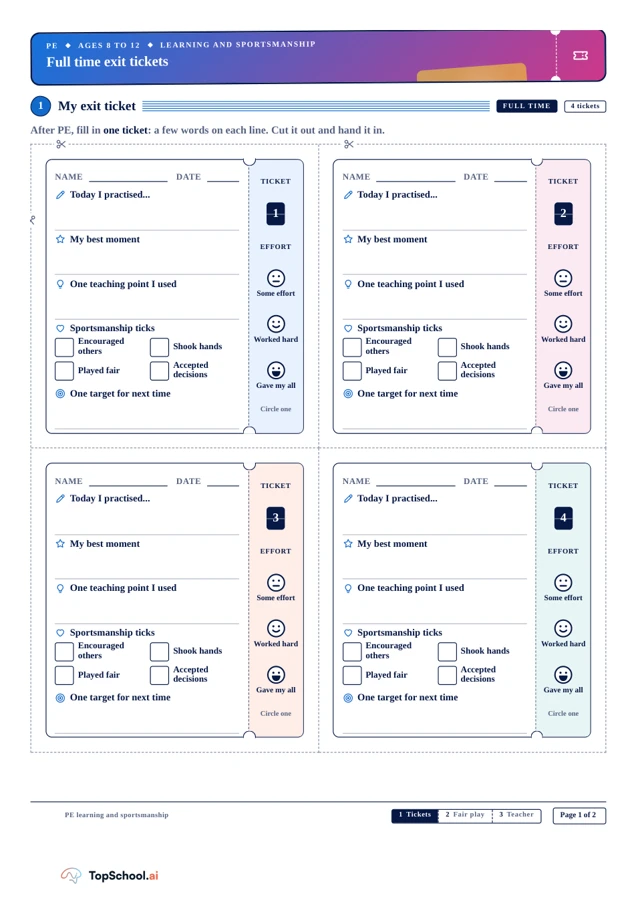
Use a short exit ticket to reflect on a PE lesson, then consider how sportsmanship showed up in play. The second page adds a self-check about fair play and a class charter for shared expectations.
Read the material
Use a short exit ticket to reflect on a PE lesson, then consider how sportsmanship showed up in play. The second page adds a self-check about fair play and a class charter for shared expectations.
Activity. Use the preview for diagrams and layout.
Page 1
1
My exit ticket
FULL TIME
4 tickets
After PE, fill in one ticket: a few words on each line. Cut it out and hand it in.
PE learning and sportsmanship
1 Tickets
2 Fair play
3 Teacher
PE
AGES 8 TO 12
LEARNING AND SPORTSMANSHIP
Full time exit tickets
NAME
DATE
Today I practised...
My best moment
One teaching point I used
Sportsmanship ticks
Encouraged
others
Shook hands
Played fair
Accepted
decisions
One target for next time
NAME
DATE
Today I practised...
My best moment
One teaching point I used
Sportsmanship ticks
Encouraged
others
Shook hands
Played fair
Accepted
decisions
One target for next time
NAME
DATE
Today I practised...
My best moment
One teaching point I used
Sportsmanship ticks
Encouraged
others
Shook hands
Played fair
Accepted
decisions
One target for next time
NAME
DATE
Today I practised...
My best moment
One teaching point I used
Sportsmanship ticks
Encouraged
others
Shook hands
Played fair
Accepted
decisions
One target for next time
TICKET
EFFORT
Some effort
Worked hard
Gave my all
Circle one
1
TICKET
EFFORT
Some effort
Worked hard
Gave my all
Circle one
2
TICKET
EFFORT
Some effort
Worked hard
Gave my all
Circle one
3
TICKET
EFFORT
Some effort
Worked hard
Gave my all
Circle one
4
Page 1 of 2
Page 2
2
Sportsmanship self-check
1ST HALF
Read each sentence. Tick one box: Always, Sometimes or Not yet. Be honest: this check is for you.
WHEN I PLAY, I...
ALWAYS
SOMETIMES
NOT YET
1
encourage my teammates, even when we are losing.
2
shake hands or say "well played" at the end.
3
play by the rules, even when nobody is watching.
4
accept the referee's or umpire's decision without arguing.
5
win without showing off and lose without sulking.
6
include everyone and pass to all my teammates.
7
check on a player who falls and tell an adult.
A time I showed fair play
A "Not yet" I will work on, and how
3
Our fair play charter
FULL TIME
Agree your class rules together. Add yours on the blank lines, then sign.
In our class, we...
play by the rules and play fair.
cheer every player, on both teams.
shake hands at the end, win or lose.
Stay safe: warm up first, work at your own level, and stop if anything hurts and tell your teacher.
PE learning and sportsmanship
1 Tickets
2 Fair play
3 Teacher
PE
AGES 8 TO 12
FAIR PLAY
How do I play fair?
1
2
3
4
5
6
FAIR PLAY
ALL OF US
TEAM SHEET: SIGN HERE
Page 2 of 2
Page 1
PE learning and sportsmanship reflection
Teacher companion
Physical Education | Pupils aged 8 to 12
Use with the exact 2-page original file. Keep pupil or staff activity pages separate from this teacher companion.
When to use it
Use an exit ticket after pupils have practised a skill or taken part in a game. The fair-play
self-check can support a later reflection or class discussion. Introduce the prompts as
opportunities to notice behaviour and set a next step, not as a public ranking of pupils.
Purpose
Describe a PE skill practised, identify an example of fair play and set one specific target for a
future lesson.
Start here
Choose one ticket prompt and explain that pupils should reflect on their own actions. Read the
safety reminder on page 2 before using the class charter.
A teaching sequence
1. After PE, ask pupils to complete one of the four tickets with a skill practised, a best moment
and a teaching point they used.
2. Invite pupils to tick the sportspersonship actions they showed, such as encouraging
teammates or accepting a decision.
3. Use the self-check to identify one fair-play behaviour to keep and one to develop, without
asking pupils to compare scores publicly.
4. Agree the class charter together, add a class rule on the blank line and revisit it before a
later activity.
Checking guidance
Look for a specific action and a target the pupil can try next time, such as encouraging a
teammate or accepting a decision. Ask, “What did you do that someone else could notice?” If
the response is only “I was good”, invite a concrete example without naming or judging
another pupil.
A useful target names a repeatable action: “Next lesson I will encourage a teammate after an
error.” Ask for the pupil’s own observed example rather than turning the ticket into a score.
Support
Offer pupils a choice of a spoken response, a brief phrase or a tick before writing. Model a
neutral example of an observable action and allow pupils to leave a prompt blank if they need
more time to reflect.
Take it further
Ask pupils to choose one charter commitment and describe how it would look during a specific
game situation. At the next lesson, invite them to reflect on whether they tried it and what
they might adjust.
Things to keep in mind
The ticket invites reflection and does not independently assess skill or fair play. Adapt the
charter and safety statement to the activity and school expectations. Use reflections
formatively; avoid comparing pupils or using the self-check to label them.
PE learning and sportsmanship reflection
Teacher companion | Page 1
A teaching sequence
Describe a PE skill practised, identify an example of fair play and set one specific target for a future lesson.
Record one PE learning moment
After PE, ask pupils to complete one of the four tickets with a skill practised, a best moment and a teaching point they used.
Which teaching point did you use during the activity?
Describe respectful play
Invite pupils to tick the sportspersonship actions they showed, such as encouraging teammates or accepting a decision.
Which observable action helped someone participate?
Choose one fair-play next step
Use the self-check to identify one fair-play behaviour to keep and one to develop, without asking pupils to compare scores publicly.
What could you do differently without comparing scores publicly?
Agree the class charter
Agree the class charter together, add a class rule on the blank line and revisit it before a later activity.
How will the greeting and safety wording fit this activity and group?
Before you teach
Look for the thinking behind an answer, choose the support your class needs and leave room for an independent response.
What to look for
Look for a specific action and a target the pupil can try next time, such as encouraging a teammate or accepting a decision. Ask, “What did you do that someone else could notice?” If the response is only “I was good”, invite a concrete example without naming or judging another pupil. A useful target names a repeatable action: “Next lesson I will encourage a teammate after an error.” Ask for the pupil’s own observed example rather than turning the ticket into a score.
Give a little support
Offer pupils a choice of a spoken response, a brief phrase or a tick before writing. Model a neutral example of an observable action and allow pupils to leave a prompt blank if they need more time to reflect.
Take the idea further
Ask pupils to choose one charter commitment and describe how it would look during a specific game situation. At the next lesson, invite them to reflect on whether they tried it and what they might adjust.
Things to keep in mind
The ticket invites reflection and does not independently assess skill or fair play. Adapt the charter and safety statement to the activity and school expectations. Use reflections formatively; avoid comparing pupils or using the self-check to label them.
Keep the idea. Make it yours.
Bring your topic, learning goal and class context to PLAI™, then review what you create.
Ideas to try with your class
Sample teaching perspectives on what to try, what to adapt and what to watch for.
Meet The Creators
Meet the creators whose teaching interests connect with this template. Find an approach to try with your class.

Liam Dawes
A prompt or checklist can help pupils reflect on a skill, but it should not reduce physical education to a written task.
Meet the creator
Wei Zhang
I teach Physical Education across the secondary phase and start planning with the pupil who may be least ready to join in.
Meet the creator
Gavin Stourton
I adapt games through space, equipment and roles so pupils with different confidence and experience can practise, make decisions and contribute while keeping the activity’s purpose clear.
Meet the creator
Adam Threlkeld
I connect GCSE PE theory with practical sport, choosing examples and exam questions that help students explain a concept in terms of the activity they experience.
Meet the creator
Glue Stick Club
The two-page sheet offers four exit tickets for a practised skill, best moment, teaching point, sportsmanship and next target, then a self-check and class fair-play charter. Effort has three choices, from some effort to “gave my all”.
Planning List
For ages 8 to 12, the sequence links a PE lesson to fair play examples such as accepting decisions, including everyone and checking on an injured player. The charter asks the class to agree shared rules.
Quietly Curious
A pupil can complete a few words on a cut-out ticket, then reflect on one action they showed or want to improve. The self-check includes Always, Sometimes and Not yet, with the instruction that it is for the pupil.
Spare Pencil
Effort and sportsmanship are reflection prompts, not a character score. Keep self-assessment honest and private, and follow the listed safety instruction to warm up and tell a teacher if anything hurts.