
Wellbeing and personal development
After the assembly: reflecting on respect
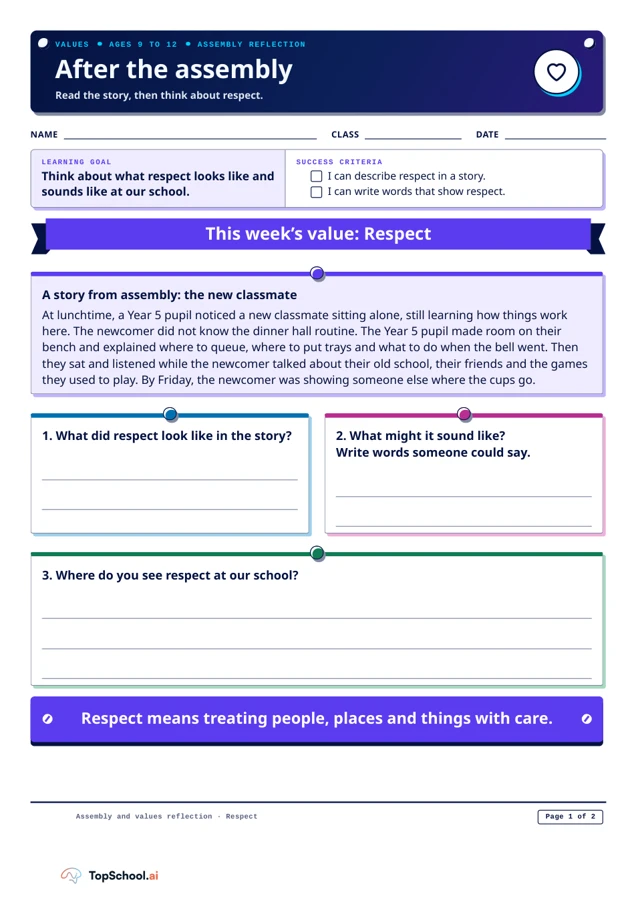
Use a short school story to help pupils describe what respect can look and sound like, choose one action for the week and notice examples in daily life. The two-page reflection ends with space to design a readable corridor sign.
Read the material
Use a short school story to help pupils describe what respect can look and sound like, choose one action for the week and notice examples in daily life. The two-page reflection ends with space to design a readable corridor sign.
Complete resource. Use the preview for diagrams and layout.
Page 1
NAME
CLASS
DATE
LEARNING GOAL
Think about what respect looks like and
sounds like at our school.
SUCCESS CRITERIA
I can describe respect in a story.
I can write words that show respect.
Assembly and values reflection · Respect
Page 1 of 2
VALUES
AGES 9 TO 12
ASSEMBLY REFLECTION
After the assembly
Read the story, then think about respect.
This week’s value: Respect
A story from assembly: the new classmate
At lunchtime, a Year 5 pupil noticed a new classmate sitting alone, still learning how things work
here. The newcomer did not know the dinner hall routine. The Year 5 pupil made room on their
bench and explained where to queue, where to put trays and what to do when the bell went. Then
they sat and listened while the newcomer talked about their old school, their friends and the games
they used to play. By Friday, the newcomer was showing someone else where the cups go.
1. What did respect look like in the story?
2. What might it sound like?
Write words someone could say.
3. Where do you see respect at our school?
Respect means treating people, places and things with care.
Page 2
NAME
CLASS
DATE
Each day, write one moment. When did I show it? When did I see it?
Design a sign for our corridor about respect.
Assembly and values reflection · Respect
Page 2 of 2
VALUES
AGES 9 TO 12
RESPECT
From words to actions
1
My respect promise this week
I will show respect by...
Choose one thing you will do. Make it small and make it real.
2
Noticing respect, Monday to Friday
Monday
Tuesday
Wednesday
Thursday
Friday
3
A quiet moment
How did it feel to be treated with respect?
Go further
YOUR SIGN
Draw or write. Make it bold enough to read
from across the corridor.
A teaching sequence
Explain what respect looks and sounds like in a scenario, choose a personal action and notice examples across the week.
Find respect in the story
Identify actions in the story that show respect, then write or discuss words someone could use in a similar situation.
Which action helped the newcomer understand the routine?
Choose a small promise
Ask where pupils notice respect at school and invite them to choose one small action for their own weekly promise.
What might another person notice if you try that action?
Notice through the week
Use the Monday-to-Friday boxes to record one moment of showing or seeing respect, without requiring a personal account.
Can you record an observed moment without sharing a private experience?
Reflect and design a sign
Complete the quiet reflection and design a corridor sign with a message that can be read from a distance. Help pupils choose one manageable action without assuming the story is real.
Could someone read your chosen message from across the corridor?
Before you teach
Look for the thinking behind an answer, choose the support your class needs and leave room for an independent response.
What to look for
Look for a description of a specific action and how it could communicate respect, followed by a manageable chosen action. Ask: “What might the other person notice?” Use the story as a discussion prompt. Keep it separate from claims about a real pupil or assembly.
Give a little support
Offer spoken, drawn or private responses and let pupils pass on any question that feels too personal. Rephrase “Where do you see respect?” with concrete school examples, while avoiding naming pupils as examples without their agreement.
Take the idea further
Have pupils revisit their promise at the end of the week and choose one example that shows what happened. They can revise the corridor sign for a specific audience, checking whether its words and size communicate clearly.
Things to keep in mind
Keep personal reflections optional and use the story as a starting point for discussion rather than requiring pupils to share personal experiences.
Keep the idea. Make it yours.
Bring your topic, learning goal and class context to PLAI™, then review what you create.
Ideas to try with your class
Sample teaching perspectives on what to try, what to adapt and what to watch for.
Meet The Creators
Meet the creators whose teaching interests connect with this template. Find an approach to try with your class.

Helena Marsh
Time is limited, so I want to remove tasks that do not help and give staff space to concentrate on the work that matters.
Meet the creator
Cerys Evans
Staying connected to classroom learning helps me understand what pupils know through the work itself, alongside the information a report or assessment may provide.
Meet the creator
Catherine Redfern
Standing in front of a class helps me understand the conditions staff are working in and the effect that a leadership decision may have on teaching.
Meet the creator
Grace Whitfield
I introduce Religious Education through questions, warm explanations and discussion, making space for pupils to explore beliefs and practices without assuming their family’s experience of faith.
Meet the creator
After the Bell
The new-classmate story makes respect concrete through making room, explaining the dinner-hall routine and listening. Page 2 shifts from interpreting the story to a small personal action, a Monday-to-Friday noticing log and a corridor sign.
Board Eraser
For ages 9 to 12, the two-page sequence connects the assembly value to words and actions during the week. Pupils can draw or write a sign, while the daily boxes provide repeated chances to notice respect rather than only define it.
One Last Sticky Note
The story gives specific moments pupils can point to before they describe what respect might sound like. Keep the personal “quiet moment” question sensitive to choice; the fictional classmate example can support discussion without asking for a private disclosure.
Kind Check-In
A pupil’s reflection is not evidence that a value has been consistently practised or that a personal experience should be shared. Use the week log as an invitation to notice examples, not as a judgement about a child’s character.