How to write multiple choice questions with useful distractors
Use one Year 5 question about temperatures crossing zero to write wrong answers that give you something useful to ask next.

On this page5 sections
Imagine you ask what happens when a temperature below zero rises. One pupil reads the starting temperature as a positive number. Another starts in the right place but moves down the scale. Both get the question wrong, and each needs a different conversation.
A distractor is an incorrect option in a multiple-choice question. To write a useful one, work out what answer a pupil could reach by making a particular mistake. Then think about what you’d ask if they chose it. This is one way to use diagnostic questions to explore pupils’ reasoning.
Decide what you want to check
For this example, you want to find out whether pupils can start below zero and count forwards through it. The Year 5 maths programme of study in England includes interpreting negative numbers in context and counting through zero. Try the question once pupils have met temperatures below zero and know that a rise means the temperature goes up.
Solve the question before you write any options. Then picture where a pupil might go astray. Did they start at the wrong number, move in the wrong direction or lose track of which side of zero they were on? Follow each line of thinking far enough to see what answer it would give.
Try the temperature question
Pupil question
At 7 am, the temperature was −4°C. By noon, it had risen by 7°C. What was the temperature at noon? Choose one answer.
- A. −11°C
- B. −3°C
- C. 3°C
- D. 11°C
Teacher answer
C. 3°C. Starting at −4°C, it takes a rise of four degrees to reach 0°C. There are three degrees of the rise left. Keep going in the same direction and you reach 3°C. You can check by starting at 3°C and counting back seven degrees to −4°C.
What each wrong answer can tell you
- A. −11°C. A pupil might start at −4°C and count down seven degrees. Ask, “If the temperature rises by one degree, what will it be?” If they say −5°C, put −5°C and −3°C on a scale and ask which one is warmer.
- B. −3°C. A pupil might work out that there are three degrees left after reaching zero, then keep the minus sign from the starting temperature. Ask them to point to where they would go one degree after zero if the temperature were still rising.
- D. 11°C. A pupil might read −4°C as 4°C and add seven. Ask them to mark both starting temperatures on the same scale and say which one matches the question.
The choice gives you a place to start. A pupil might have guessed or used a different method that led to the same answer. Ask someone who chose C to show where they crossed zero and how many degrees were left. Hearing that step can help you decide whether to move on or spend more time on the scale.
Read the question as a pupil
Cover the options and work through the wording. Then read each choice and check that only one answers the question. Keep the options in the same form and replace any you can’t explain with a plausible line of thinking. The University of Waterloo’s question-writing guidance shows how wording and layout can give away an answer.
Keep the access support pupils usually use. If you read the question aloud, say “minus four degrees Celsius” and read every option in the same way. In a digital activity, check the answer and feedback in the pupil view.
Try it with a Library worksheet
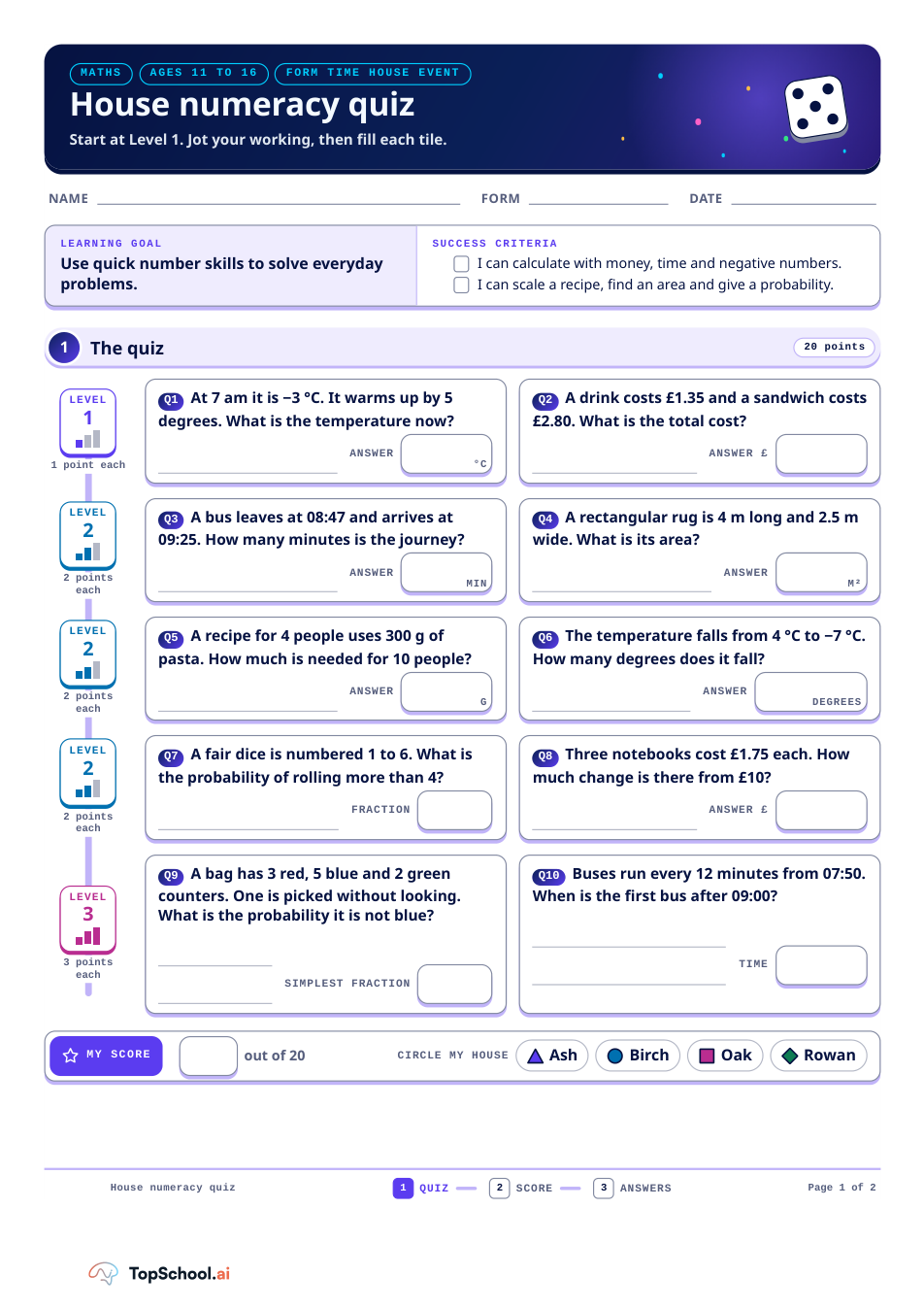
In the Year 5 example, pupils use the rise to work out the final temperature. Question 6 in the House numeracy quiz turns that around. It gives the starting and finishing temperatures, 4°C and −7°C, and asks how far the temperature fell. Count four degrees down to zero, then seven more to −7°C. That’s a drop of 11 degrees.
Three degrees would be a useful wrong option. A pupil might read −7°C as 7°C and find the difference between 4 and 7. Ask them to mark both temperatures on a number line and count the steps between them.
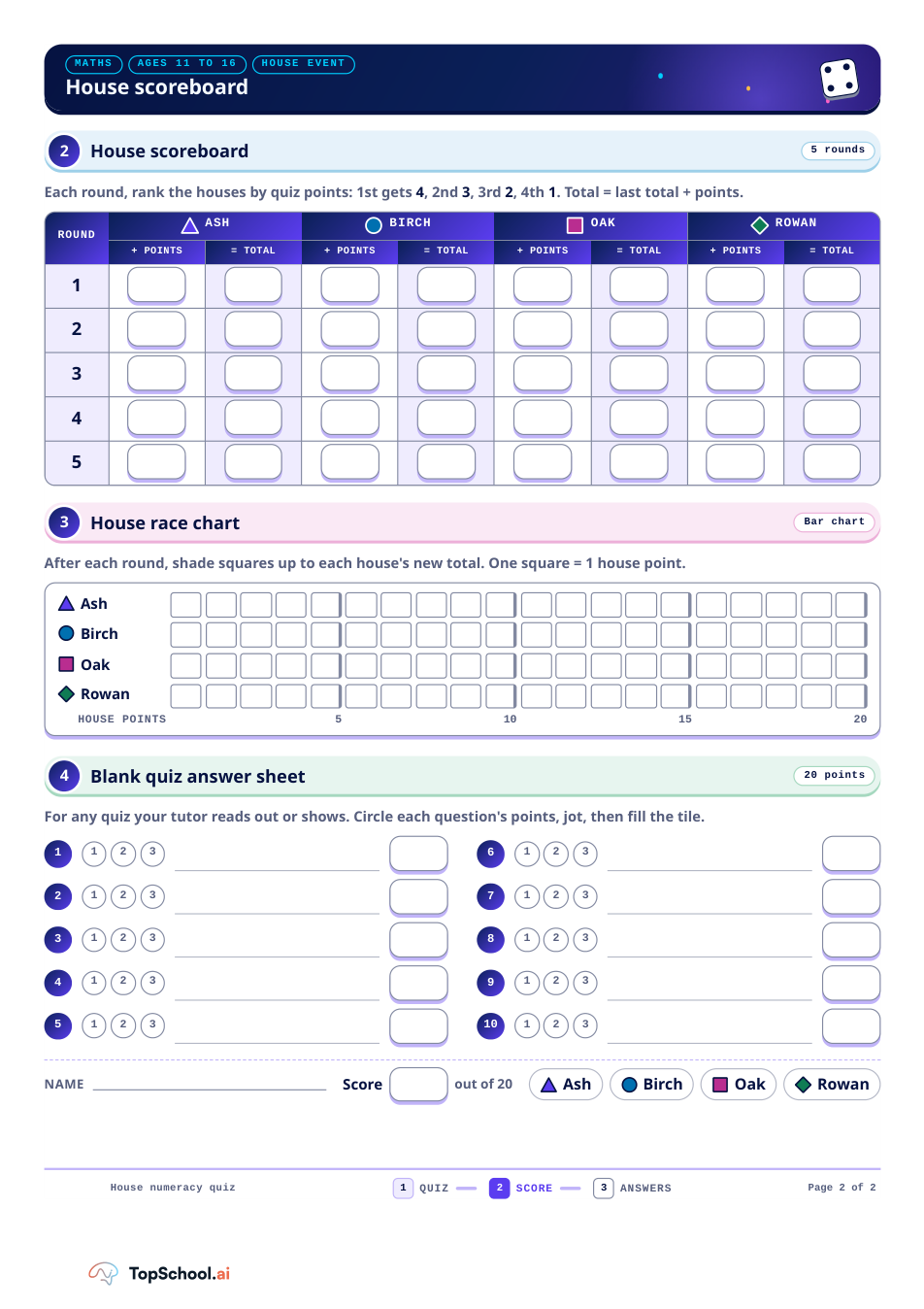
The full quiz is for ages 11 to 16. Try writing the other options for question 6, then check the correct answer against the teacher notes. Open the worksheet and teacher notes in the Library.