What makes a worksheet worth doing?
Give every question a purpose. Create, adapt and check worksheets that reveal pupils' thinking and help you decide what to teach next.

On this page5 sections
You need a worksheet for the next lesson. You could write it yourself, adapt an existing resource or use AI to prepare a draft. Whichever route you choose, start with what pupils need to learn and the response that will help you see their understanding.
A useful worksheet combines accurate content, clear questions and appropriate support with a plan for what happens after pupils respond. It can provide practice and help you identify what needs further teaching. Its contribution to progress depends on how you teach with it, respond to pupils' work and give them opportunities to improve.
Start with the learning goal
Write the goal as something pupils will be able to do: explain a relationship, apply a method or justify a choice. Consider what they already know and where they may need a model, a worked example or guided practice before working independently.
Then inspect the questions. If your goal is explanation, include a prompt that asks for a reason. If it is applying an idea, include a situation where pupils must choose how to use it. A completed page gives you more useful information when its questions require the thinking you intended.
Choose how to produce the worksheet
Create it yourself. Start with the learning goal, write the prompt and work through an answer before adding more questions. This lets you choose the language, examples and level of support for the lesson. Check that each question has a purpose and that the answers cover the reasoning pupils may use.
Adapt an existing resource. Read the whole task and its answer guidance before selecting it. Adjust vocabulary, examples, question order or response space to suit your class. Work through it again after editing: changing a diagram or number can also change the answer.
Use AI to prepare a draft. Specify the learning goal, relevant prior learning, response format and support you want. A teaching brief without pupil data can give the draft useful context. Check every question and answer before use, including whether the task fits the intended curriculum and class. Keep responsibility for the final teaching decisions with the teacher.
Choose print or digital delivery around the response you need and pupils' access. Paper may give space for written working; an interactive task may let pupils manipulate a model. Add an explanation prompt when you need reasoning that the format does not capture on its own.
Check the quality before using it
Work through the worksheet as a pupil would, then check four things:
- Accuracy: Check facts, calculations, diagrams, labels and the complete answer path. Include acceptable alternative answers where relevant.
- Purpose: Check that the questions require the intended learning, with support suited to pupils’ prior knowledge.
- Access: Check that instructions, text and diagrams are readable, and pupils have a usable way to respond in the planned format.
- Follow-up: Identify what an answer could reveal and what you will ask, explain or revisit in response.
Revise a task that contains an essential error, misses the learning goal or creates an access barrier before using it. For an AI draft, the wider guidance to review AI-generated lesson materials provides further checks.
Worked example: change the question, change the evidence
Illustrative teaching example: A teacher is choosing a starter or guided-practice task for pupils who recognise simple fractions and understand equal partitioning, including thirds. Adapt the starting pair if thirds are not yet secure.
The same model can be used in a worksheet, a discussion or an interactive task. What you ask pupils to do determines what their response can reveal. Here, equivalent fractions name the same number. NCETM's guidance on equivalent fractions explains the relationship between the numerator and denominator.
Shade two thirds and four sixths. Use Compare to check them.
| Pupil response | Example prompt | Answer guidance |
|---|---|---|
| Recognise | Which is equivalent to 2/3: 4/6 or 2/6? | 4/6. Ask how the pupil decided if you need evidence of their reasoning. |
| Explain | Explain why 2/3 = 4/6. | Split every third into two equal parts. The whole and shaded amount stay fixed; three parts become six, and two shaded parts become four. |
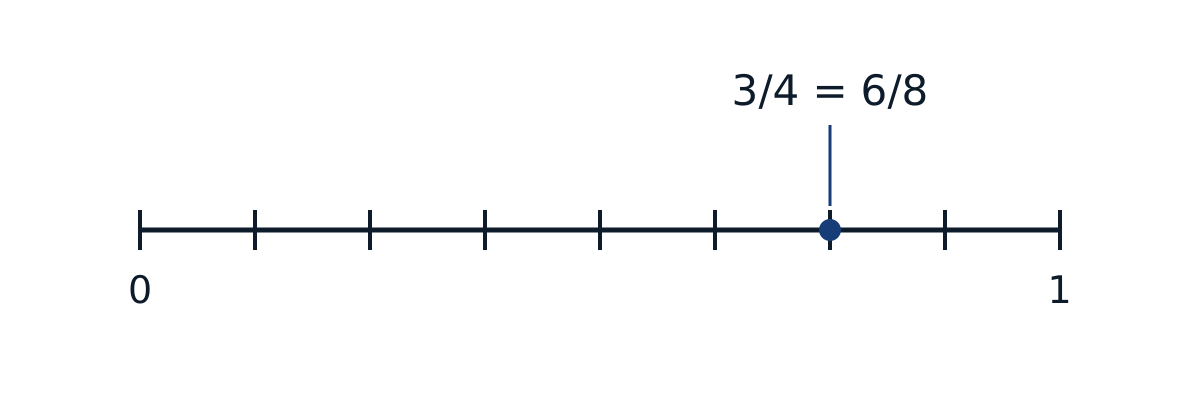
| Use another representation | Place 3/4 and 6/8 on a number line from 0 to 1. | Both lie at the same point, three quarters of the unit from 0. |
| Test a non-example | Are 2/3 and 2/6 equivalent because both numerators are 2? Explain. | No. For the same whole, sixths are smaller than thirds; 2/6 = 1/3, not 2/3. |
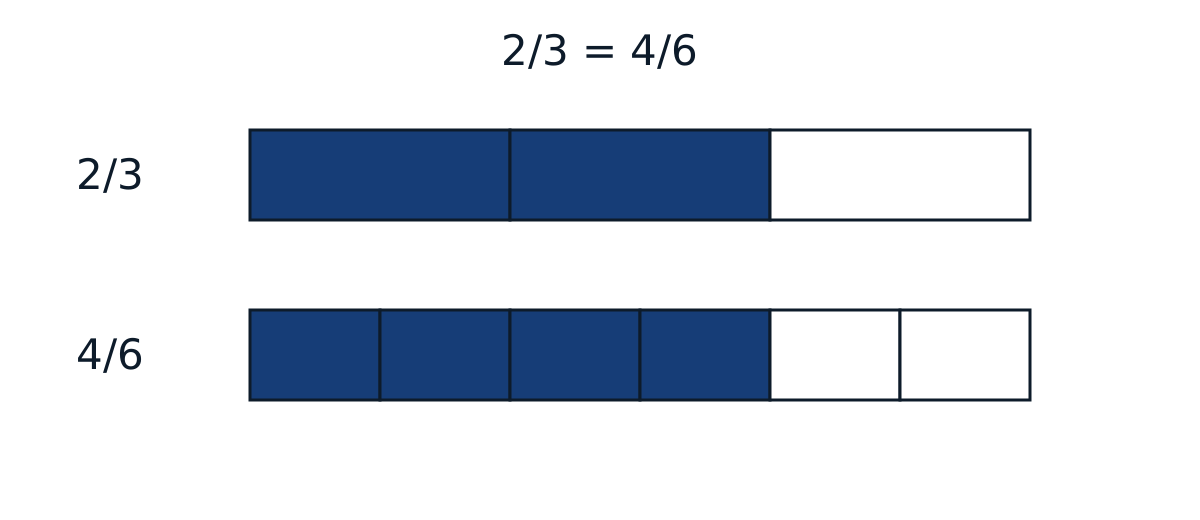
When comparing shaded amounts in separate diagrams, use equal-sized wholes. Numerical equivalence is a separate point: different-sized physical wholes do not make 2/3 and 4/6 unequal as numbers.
The U.S. IES fractions practice guide recommends number lines as one way to develop understanding of fractions as numbers. Here, that prompt probes the idea in another representation. Choose the variation that serves your learning goal; pupils may need different starting points and support.
Use pupils’ responses to plan the next step
Plan how pupils will use feedback as well as how you will give it. The EEF's guidance on teacher feedback, for pupils aged 5 to 18 across subjects, emphasises clear learning intentions, identifying gaps in understanding and giving pupils opportunities to act on feedback. These principles help you decide how to use a worksheet within teaching.
In the fractions example, a pupil might select 4/6 correctly but struggle to explain why it equals 2/3. You could revisit the equal partitions together, ask the pupil to improve the explanation, then check a different pair. If a pupil explains confidently, you could ask them to show the relationship on a number line. Use their response to choose the next task.
Look for progress across subsequent work: a clearer explanation, a corrected misconception or use of the idea in a new question with less support. One correct response is a starting point for further checking. Keep refining the worksheet and your teaching as you learn more about what pupils understand.