
One answer to check before using an interactive teaching activity
Check the question, settings and reasoning behind one answer, then decide what still needs review before using the activity.
On this page4 sections
You are preparing an interactive activity for a lesson. It gives an answer and an explanation, but you need to know whether they fit the question and the conditions on screen. Work through one important answer before deciding how to use the material. Circuit Lab, an existing interactive example, shows what this check can establish and where further review is still needed.
Match the answer to the task
Circuit Lab asks: “You remove one bulb from a parallel circuit. What happens to the others?”
Selecting Stay lit gives this feedback:
Right. Each bulb has its own branch across the full battery voltage, so the others stay just as bright.
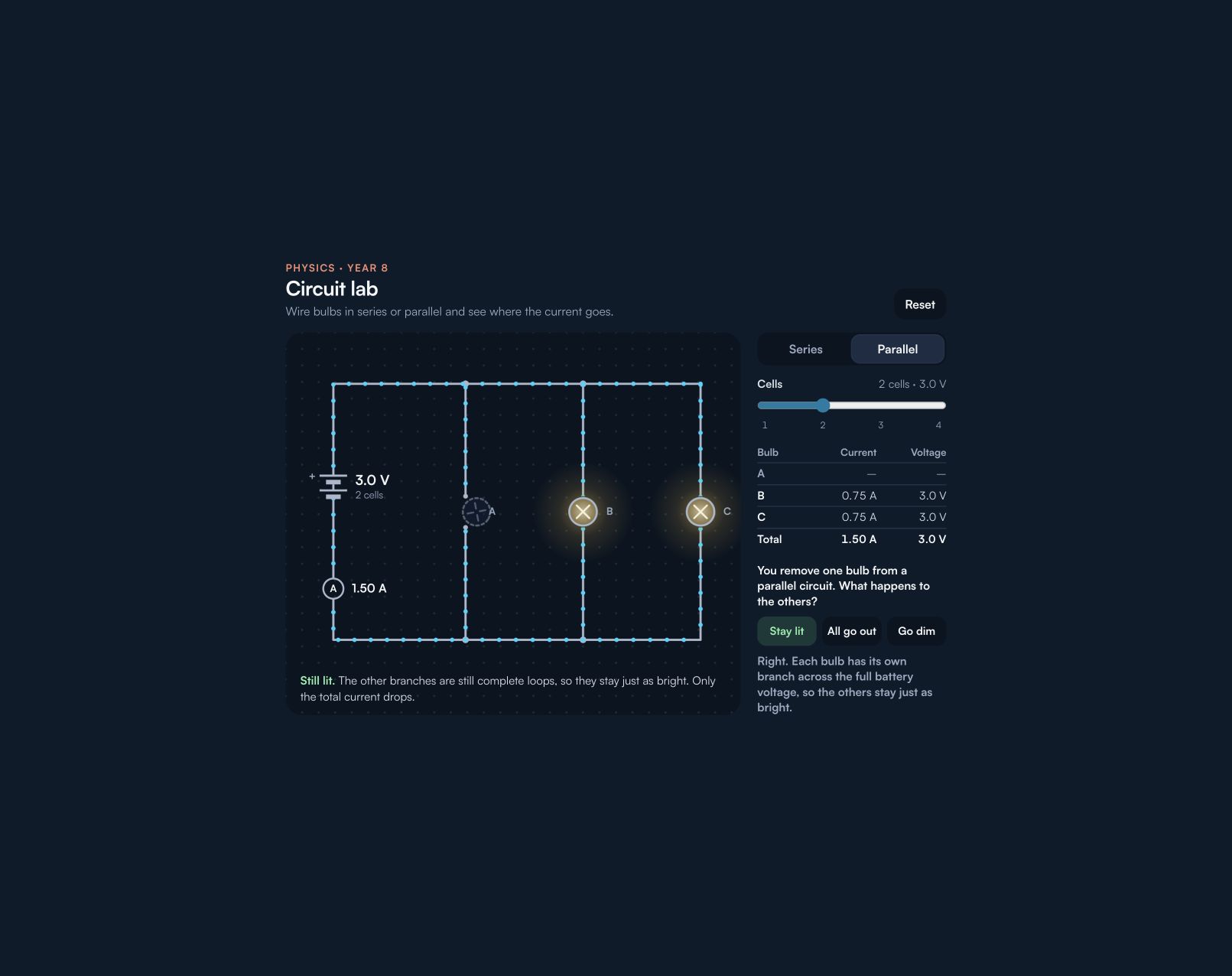
Check the setup alongside those words. The activity opens in Series, although the question specifies Parallel. For this example, select Parallel, keep two cells and three connected bulbs, then remove bulb A.
The remaining bulbs stay lit in that view. Before accepting the explanation, check which paths remain complete and compare the readouts. The displayed mode matters as much as the answer choice.
Work out why the answer holds
The model uses two 1.5 V cells, giving 3.0 V, and treats each bulb as a fixed 4 ohm resistance. The readouts use V for volts and A for amperes, the units of voltage and current. Here, Ohm’s law gives the current in each connected branch: 3.0 V ÷ 4 ohms = 0.75 A.
Opening A leaves B and C connected across the same supply. OpenStax’s explanation of parallel circuits supports checking each branch against the source voltage.
| Model reading | All three bulbs connected | Bulb A removed |
|---|---|---|
| Voltage across B and C, each | 3.0 V | 3.0 V |
| Current through B and C, each | 0.75 A | 0.75 A |
| Total current from the supply | 2.25 A | 1.50 A |
The branch readings remain unchanged while total current falls. That distinction supports the answer: in this model, the remaining bulbs stay at the same brightness. The removed branch shows dashes in the readout; its current is not displayed.
View full-size screenshot
State the model conditions
Keep the fixed supply voltage and bulb resistance beside the conclusion. They explain why the result holds here.
A real practical may need additional conditions. A battery has internal resistance, so its terminal voltage can change with the current it supplies, as OpenStax explains. The activity’s fixed-voltage calculation does not establish unchanged brightness for every physical circuit.
When teaching from the example, describe the result as behaviour within this model. That qualification preserves the useful explanation without treating the screen as a measurement of real equipment.
Use the result to guide further review
The answer can be retained with its setup and model conditions made clear. For the next activity you review, record one important question, the settings you checked and the reasoning that supports its answer. Resolve any mismatch before using that task.
Then examine the rest of the material: other important answers, instructions, diagrams, access and suitability for your pupils and lesson. One correct answer is only part of that judgement. Keep the wider review connected to the actual version you plan to teach from.