
Maths
House numeracy quiz: questions and scoreboard
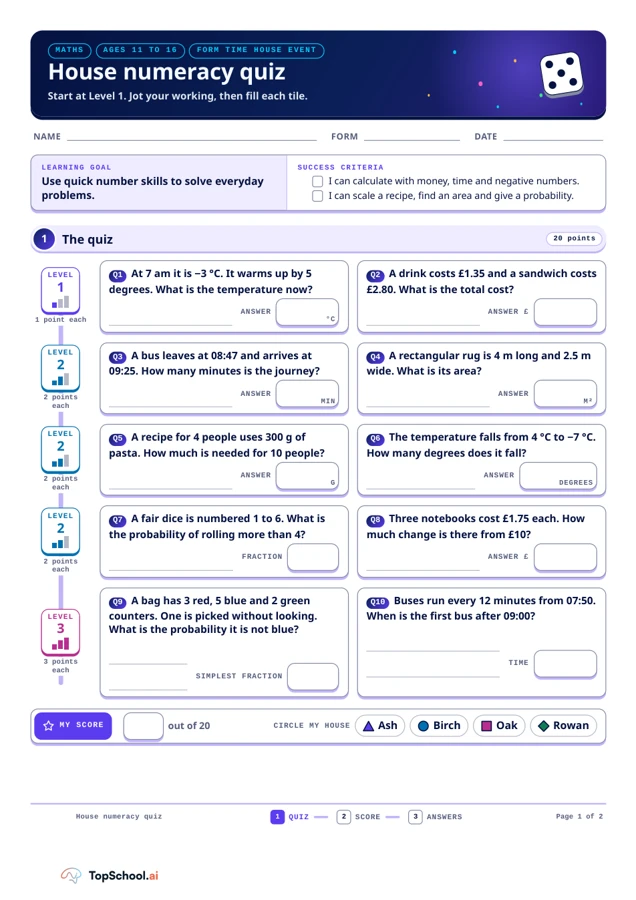
Run a house-event numeracy quiz with ten questions about temperature, money, time, area, scaling, probability and bus times. A scoreboard awards points for round placings, while a bar-chart race and reusable answer sheet support a multi-round event.
Read the material
Run a house-event numeracy quiz with ten questions about temperature, money, time, area, scaling, probability and bus times. A scoreboard awards points for round placings, while a bar-chart race and reusable answer sheet support a multi-round event.
Activity. Use the preview for diagrams and layout.
Page 1
NAME
FORM
DATE
LEARNING GOAL
Use quick number skills to solve everyday
problems.
SUCCESS CRITERIA
I can calculate with money, time and negative numbers.
I can scale a recipe, find an area and give a probability.
1
The quiz
20 points
MY SCORE
out of 20
CIRCLE MY HOUSE
Ash
Birch
Oak
Rowan
House numeracy quiz
1
QUIZ
2
SCORE
3
ANSWERS
MATHS
AGES 11 TO 16
FORM TIME HOUSE EVENT
House numeracy quiz
Start at Level 1. Jot your working, then fill each tile.
LEVEL
1
1 point each
Q1
At 7 am it is −3 °C. It warms up by 5
degrees. What is the temperature now?
ANSWER
Q2
A drink costs £1.35 and a sandwich costs
£2.80. What is the total cost?
ANSWER £
°C
LEVEL
2
2 points
each
Q3
A bus leaves at 08:47 and arrives at
09:25. How many minutes is the journey?
ANSWER
Q4
A rectangular rug is 4 m long and 2.5 m
wide. What is its area?
ANSWER
MIN
M²
LEVEL
2
2 points
each
Q5
A recipe for 4 people uses 300 g of
pasta. How much is needed for 10 people?
ANSWER
Q6
The temperature falls from 4 °C to −7 °C.
How many degrees does it fall?
ANSWER
G
DEGREES
LEVEL
2
2 points
each
Q7
A fair dice is numbered 1 to 6. What is
the probability of rolling more than 4?
FRACTION
Q8
Three notebooks cost £1.75 each. How
much change is there from £10?
ANSWER £
LEVEL
3
3 points
each
Q9
A bag has 3 red, 5 blue and 2 green
counters. One is picked without looking.
What is the probability it is not blue?
SIMPLEST FRACTION
Q10
Buses run every 12 minutes from 07:50.
When is the first bus after 09:00?
TIME
Page 1 of 2
Page 2
2
House scoreboard
5 rounds
Each round, rank the houses by quiz points: 1st gets 4, 2nd 3, 3rd 2, 4th 1. Total = last total + points.
ROUND
ASH
BIRCH
OAK
ROWAN
+ POINTS
= TOTAL
+ POINTS
= TOTAL
+ POINTS
= TOTAL
+ POINTS
= TOTAL
1
2
3
4
5
3
House race chart
Bar chart
After each round, shade squares up to each house's new total. One square = 1 house point.
Ash
Birch
Oak
Rowan
HOUSE POINTS
5
10
15
20
4
Blank quiz answer sheet
20 points
For any quiz your tutor reads out or shows. Circle each question's points, jot, then fill the tile.
1
1
2
3
2
1
2
3
3
1
2
3
4
1
2
3
5
1
2
3
6
1
2
3
7
1
2
3
8
1
2
3
9
1
2
3
10
1
2
3
NAME
Score
out of 20
Ash
Birch
Oak
Rowan
House numeracy quiz
1
QUIZ
2
SCORE
3
ANSWERS
MATHS
AGES 11 TO 16
HOUSE EVENT
House scoreboard
Page 2 of 2
Page 1
House numeracy quiz: questions and scoreboard
Teacher companion
Mathematics | Pupils aged 11 to 16
Use with the exact 2-page original file. Keep pupil or staff activity pages separate from this teacher companion.
When to use it
Use as a tutor-led or house-event activity after checking the questions and score rules. The
quiz progresses from one-point items to three-point items. Explain whether pupils work
individually or in teams and how answers will be marked.
Purpose
Solve short number problems and follow a points system to record individual and house totals.
Start here
Begin at Level 1, show working in the answer tiles and choose the house before the quiz
starts.
A teaching sequence
1. Answer the ten quiz questions, showing working for temperature, money, time, area, recipe
scaling and probability. Continue with change and the next bus after 09:00.
2. Check each answer and record a score out of 20. For each round, rank the house scores and
award 4, 3, 2 and 1 points.
3. Add round points to previous totals and shade each house’s total on the bar chart. Use the
blank sheet for another quiz.
4. Check calculations, ties and totals before announcing. Ask, “Does the chart show quiz
marks or house points?” State clearly which total is shown.
Checking guidance
Q1-Q10: 2°C; £4.15; 38 minutes; 10 m²; 750 g; a fall of 11 degrees; 1/3 (also 2/6); £4.75; 1/2;
09:02.
Checks: Q5 scales 300 g by 10/4; Q8 costs 3 x £1.75 = £5.25; Q10 adds six 12-minute
intervals to 07:50. Printed quiz points total 20.
House points are separate: rank each round, award 4/3/2/1, and add those points to the prior
house totals. Agree a tie rule before play; it is not specified in the pupil sheet. A chart square
is one house point.
Support
Read questions aloud and display them one at a time if helpful. Allow pupils to jot working and
use agreed accessibility adjustments. Explain the difference between a question’s marks, a
team’s quiz points and the house points awarded for round position.
Take it further
Ask pupils to write a new question at each level and prepare a checked answer. They can
model how a tie changes the scoreboard, compare cumulative points with round wins or
identify a fair tie-break rule before playing.
Things to keep in mind
This is a short event quiz, not a complete assessment. The pack does not specify tie handling,
answer tolerance or a marking key. Confirm scoring and accessibility arrangements before the
event, and avoid using public rankings to label individual pupils.
House numeracy quiz: questions and scoreboard
Teacher companion | Page 1
A teaching sequence
Solve short number problems and follow a points system to record individual and house totals.
Solve and show quiz working
Answer the ten quiz questions, showing working for temperature, money, time, area, recipe scaling and probability. Continue with change and the next bus after 09:00.
What unit belongs to this temperature, time or area answer?
Check scores and house points
Check each answer and record a score out of 20. For each round, rank the house scores and award 4, 3, 2 and 1 points.
What agreed rule handles a tie before points are awarded?
Update the race chart
Add round points to previous totals and shade each house’s total on the bar chart. Use the blank sheet for another quiz.
Does the chart show quiz marks or accumulated house points?
Verify before announcing
Check calculations, ties and totals before announcing. Label whether the chart shows quiz marks or house points so readers know which total is presented.
Do the chart and recorded totals agree for every house?
Before you teach
Look for the thinking behind an answer, choose the support your class needs and leave room for an independent response.
What to look for
Q1-Q10: 2°C; £4.15; 38 minutes; 10 m²; 750 g; a fall of 11 degrees; 1/3 (also 2/6); £4.75; 1/2; 09:02. Checks: Q5 scales 300 g by 10/4; Q8 costs 3 x £1.75 = £5.25; Q10 adds six 12-minute intervals to 07:50. Printed quiz points total 20. House points are separate: rank each round, award 4/3/2/1, and add those points to the prior house totals. Agree a tie rule before play; it is not specified in the pupil sheet. A chart square is one house point.
Give a little support
Read questions aloud and display them one at a time if helpful. Allow pupils to jot working and use agreed accessibility adjustments. Explain the difference between a question’s marks, a team’s quiz points and the house points awarded for round position.
Take the idea further
Ask pupils to write a new question at each level and prepare a checked answer. They can model how a tie changes the scoreboard, compare cumulative points with round wins or identify a fair tie-break rule before playing.
Things to keep in mind
This is a short event quiz, not a complete assessment. The pack does not specify tie handling, answer tolerance or a marking key. Confirm scoring and accessibility arrangements before the event, and avoid using public rankings to label individual pupils.
Keep the idea. Make it yours.
Bring your topic, learning goal and class context to PLAI™, then review what you create.
Ideas to try with your class
Sample teaching perspectives on what to try, what to adapt and what to watch for.
Meet The Creators
Meet a creator whose teaching interests connect with this template.
Five More Minutes
The ten-question quiz spans negative temperatures, money, elapsed time, area, recipe scaling, probability and change. Each answer box names a unit or form, while the second page converts house totals into points across five rounds.
Pocketful of Stories
The levels increase the point value of questions, and pupils are asked to jot working before filling tiles. That gives the house event a clear route from individual problem solving to a team scoreboard.
Chalk Dust & Checklists
Start at Level 1 as directed, then let pupils show the arithmetic before recording the answer. The varied contexts give teachers opportunities to clarify whether the expected response is degrees, minutes, square metres, a fraction or pounds.
Kindly Red Pen
Check the answer key and scoring rules before running a competition. House points can make the event engaging, but should not be presented as a broad measure of mathematical ability.