
Languages and literacy
Writing feedback rubric
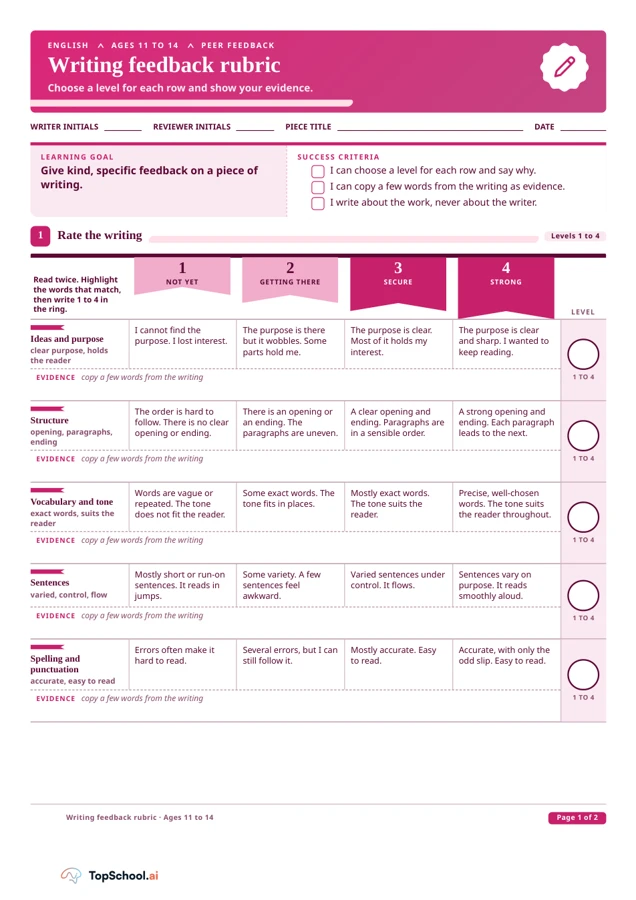
Use a four-level rubric to discuss a piece of writing, support ratings with a few quoted words and agree one next step. The second page offers sentence starters for praise, questions and a reply. Adapt criteria to the task.
Read the material
Use a four-level rubric to discuss a piece of writing, support ratings with a few quoted words and agree one next step. The second page offers sentence starters for praise, questions and a reply. Adapt criteria to the task.
Complete resource. Use the preview for diagrams and layout.
Page 1
WRITER INITIALS
REVIEWER INITIALS
PIECE TITLE
DATE
LEARNING GOAL
Give kind, specific feedback on a piece of
writing.
SUCCESS CRITERIA
I can choose a level for each row and say why.
I can copy a few words from the writing as evidence.
I write about the work, never about the writer.
1
Rate the writing
Levels 1 to 4
Read twice. Highlight
the words that match,
then write 1 to 4 in
the ring.
LEVEL
Ideas and purpose
clear purpose, holds
the reader
I cannot find the
purpose. I lost interest.
The purpose is there
but it wobbles. Some
parts hold me.
The purpose is clear.
Most of it holds my
interest.
The purpose is clear
and sharp. I wanted to
keep reading.
1 TO 4
EVIDENCE copy a few words from the writing
Structure
opening, paragraphs,
ending
The order is hard to
follow. There is no clear
opening or ending.
There is an opening or
an ending. The
paragraphs are uneven.
A clear opening and
ending. Paragraphs are
in a sensible order.
A strong opening and
ending. Each paragraph
leads to the next.
1 TO 4
EVIDENCE copy a few words from the writing
Vocabulary and tone
exact words, suits the
reader
Words are vague or
repeated. The tone
does not fit the reader.
Some exact words. The
tone fits in places.
Mostly exact words.
The tone suits the
reader.
Precise, well-chosen
words. The tone suits
the reader throughout.
1 TO 4
EVIDENCE copy a few words from the writing
Sentences
varied, control, flow
Mostly short or run-on
sentences. It reads in
jumps.
Some variety. A few
sentences feel
awkward.
Varied sentences under
control. It flows.
Sentences vary on
purpose. It reads
smoothly aloud.
1 TO 4
EVIDENCE copy a few words from the writing
Spelling and
punctuation
accurate, easy to read
Errors often make it
hard to read.
Several errors, but I can
still follow it.
Mostly accurate. Easy
to read.
Accurate, with only the
odd slip. Easy to read.
1 TO 4
EVIDENCE copy a few words from the writing
Writing feedback rubric · Ages 11 to 14
Page 1 of 2
ENGLISH
AGES 11 TO 14
PEER FEEDBACK
Writing feedback rubric
Choose a level for each row and show your evidence.
1
NOT YET
2
GETTING THERE
3
SECURE
4
STRONG
Page 2
Sentence starters
PRAISE
I liked
 because
.
PICTURE
When you wrote
I could picture
.
PUZZLED
I got lost when
.
STRONGER
One way to make
it even stronger is
.
ASK
Could you add
 to show
?
Use one to start your praise and one to start your target.
INSTEAD OF
Good
TRY
Your opening question
made me want to read
on.
INSTEAD OF
Check your spelling
TRY
Look again at the word
“because” in
paragraph 2.
Writing feedback rubric · Ages 11 to 14
Page 2 of 2
ENGLISH
AGES 11 TO 14
PEER FEEDBACK
Praise and targets
Say what worked, then one thing to try next.
Highlight your favourite
sentence, then copy it here.
PRAISE 1
Highlight your favourite
sentence, then copy it here.
PRAISE 2
TARGET
REPLY
It works because...
It works because...
My target:
How to fix it:
Try it: rewrite one sentence here.
My reply: what I will change:
A teaching sequence
Use criteria to describe strengths and a next step in a piece of writing, choose a level for each row and support the judgement with evidence from the text.
Read for meaning and criterion evidence
Read the writing twice, first for meaning and then for words that relate to each criterion.
Which words in the writing relate to the selected feedback criterion?
Choose levels with quoted evidence
Choose a level for ideas and purpose, structure, vocabulary and tone, sentences, and spelling and punctuation. Copy a few words from the text as evidence for each choice.
What few words support each judgement about the work?
Give specific praise and one manageable target
Use the second page to give specific praise, ask a question or suggest one manageable target.
Which sentence shows what works or where the writer could try a change?
Invite the writer's chosen reply
Invite the writer to reply with what they may change, while retaining their choice about revision and next steps for the draft.
What revision would the writer like to make next?
Before you teach
Look for the thinking behind an answer, choose the support your class needs and leave room for an independent response.
What to look for
Check that each rating refers to the wording of a criterion and includes evidence from the piece. Look for feedback that is specific, kind and actionable, and ensure pupils do not treat the combined ratings as a fixed measure of a person’s writing ability.
Give a little support
Model one criterion at a time with a shared text, provide a short evidence phrase to complete and let pupils dictate feedback before writing. Focus on one target rather than filling every section.
Take the idea further
Ask pupils to compare two possible targets and choose which change would most improve clarity for a reader. Invite them to revise one sentence and explain how the new version addresses the feedback.
Things to keep in mind
The rubric is a discussion aid, not a validated or standardised assessment instrument. Adapt criteria to the writing purpose and taught expectations; avoid comparing pupils by adding their levels into a single score for feedback.
Keep the idea. Make it yours.
Bring your topic, learning goal and class context to PLAI™, then review what you create.
Ideas to try with your class
Sample teaching perspectives on what to try, what to adapt and what to watch for.
Meet The Creators
Meet the creators whose teaching interests connect with this template. Find an approach to try with your class.

Joel Abraham
I pay attention when a class begins to disagree about a text, because that can be the moment pupils stop repeating a first response and start reading more closely.
Meet the creator
Nadia Okoro
Notes should be specific enough that a new teacher can use them in the next lesson, not simply describe what went well or badly.
Meet the creator
Chalk Dust & Checklists
This two-page rubric asks a reviewer to rate writing across criteria, highlight matching words as evidence and give kind, specific feedback. Its stated rule is to write about the work, never about the writer.
Coffee Before Copies
The level descriptions connect ideas and purpose, structure and other writing features to evidence from the text. Copying a few words can make a judgement easier to discuss.
Bright Idea Break
Read the piece twice, select one criterion and point to the words that fit before choosing a level. Agree one next step that the writer can act on.
Step by Step
This general rubric needs the actual writing and criteria to support a meaningful judgement. A level is not a measure of the writer as a person; keep the feedback focused on revisable features.