
Languages and literacy
Mark it up: a classic extract
Read a short extract from The Wind in the Willows, annotate how it presents hard work, and use a glossary to unpack unfamiliar words. Pupils then answer evidence questions and try a sentence shaped by the passage.
Read the material
Read a short extract from The Wind in the Willows, annotate how it presents hard work, and use a glossary to unpack unfamiliar words. Pupils then answer evidence questions and try a sentence shaped by the passage.
Activity. Use the preview for diagrams and layout.
Page 1
NAME
CLASS
DATE
LEARNING GOAL
Read closely and explain how a writer
shows hard work.
SUCCESS CRITERIA
I can use a glossary to understand tricky words.
I can mark up a text and write margin notes.
I can give evidence with its line number.
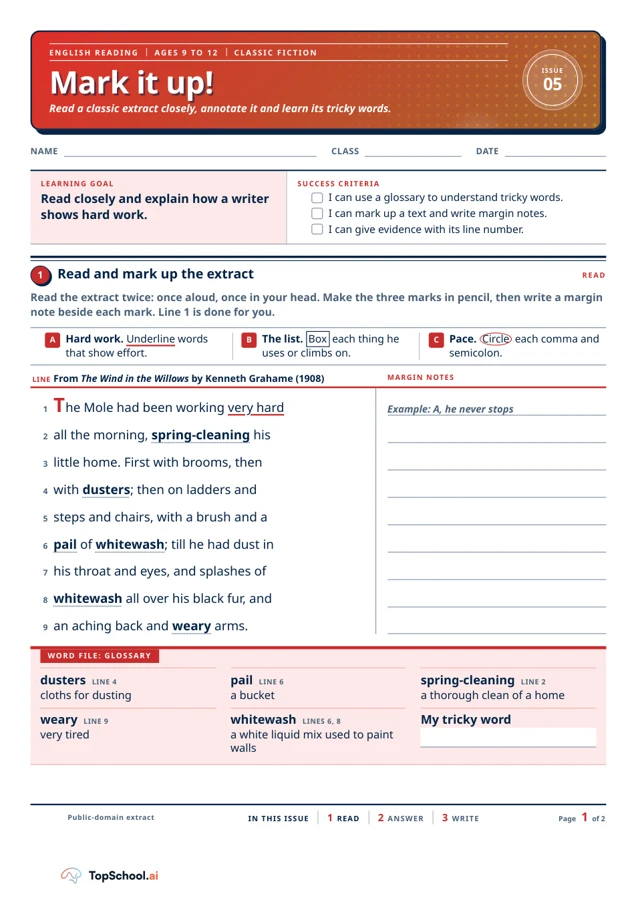
Read the extract twice: once aloud, once in your head. Make the three marks in pencil, then write a margin
note beside each mark. Line 1 is done for you.
A
Hard work. Underline words
that show effort.
B
The list. Box each thing he
uses or climbs on.
C
Pace. Circle each comma and
semicolon.
LINE From The Wind in the Willows by Kenneth Grahame (1908)
MARGIN NOTES
1 The Mole had been working very hard
Example: A, he never stops
2 all the morning, spring-cleaning his
3 little home. First with brooms, then
4 with dusters; then on ladders and
5 steps and chairs, with a brush and a
6 pail of whitewash; till he had dust in
7 his throat and eyes, and splashes of
8 whitewash all over his black fur, and
9 an aching back and weary arms.
WORD FILE: GLOSSARY
dusters LINE 4
cloths for dusting
pail LINE 6
a bucket
spring-cleaning LINE 2
a thorough clean of a home
weary LINE 9
very tired
whitewash LINES 6, 8
a white liquid mix used to paint
walls
My tricky word
Public-domain extract
IN THIS ISSUE
1 READ
2 ANSWER
3 WRITE
E N G L I S H R E A D I N G
AG E S 9 TO 1 2
C L A S S I C F I C T I O N
Mark it up!
Mark it up!
Read a classic extract closely, annotate it and learn its tricky words.
ISSUE
05
1
Read and mark up the extract
R E A D
Page 1 of 2
Page 2
NAME
CLASS
DATE
Use the extract on page 1. Copy your evidence exactly and write the line number in the box.
a
How long had the Mole been working? Tick one.
1 mark
for an hour
all the morning
all day
all night
b
Name three things the Mole cleaned or painted with.
3 marks
1
2
3
c
Find and copy one phrase that shows the work was messy.
2 marks
EVIDENCE FROM THE TEXT
LINE
d
How does the Mole feel by the end of the extract? Explain how you know.
2 marks
EVIDENCE
LINE
e
Why do you think the second sentence (lines 3 to 9) is so long?
3 marks
EVIDENCE
LINE
Write the next sentence: what does the Mole do now? Use the recipe on the right.
STYLE RECIPE
One long sentence
A list of jobs
Commas and a
semicolon
End with feelings
Text annotation and glossary sheet · Reading desk
I S S U E 0 5
T H E W I N D I N T H E W I L LOW S
R E A D I N G D E S K
Find the evidence
Find the evidence
2
Answer with evidence
C H E C K
11 marks
3
Write like Grahame
W R I T E
4 marks
Page 2 of 2
A teaching sequence
Use a glossary and purposeful annotation to explain how a writer conveys effort, then support comprehension answers with accurately copied evidence and line references.
Annotate effort, tools and pace
Annotate effort language, listed tools or places and pacing punctuation with brief notes. Use the glossary for dusters, pail, spring-cleaning, weary and whitewash, then add a pupil-chosen word.
What does your margin note explain about the marked word or punctuation?
Copy evidence with a line number
Answer the retrieval and inference questions. Copy evidence exactly and include the line number where requested.
Does the copied phrase exactly support the answer?
Discuss the long sentence
Discuss how the long sentence and list affect pace, using a detail from the extract.
How do the list and punctuation help convey continued work?
Try the extract's style
Write a next sentence that uses a long sentence, a list, commas and a semicolon, ending with a feeling.
Does your next sentence use the requested list and punctuation purposefully?
Before you teach
Look for the thinking behind an answer, choose the support your class needs and leave room for an independent response.
What to look for
Check that annotations match the requested feature, copied quotations retain the source wording, and line references identify the evidence. For the final sentence, look for the listed structural choices while allowing pupils to create their own content and phrasing. Ask them to explain one choice.
Give a little support
Read the passage in short chunks and preteach the glossary words with simple pictures or objects. Offer coloured pencils for the three annotation tasks and a sentence frame for explaining one quotation.
Take the idea further
Ask pupils to compare how the sentence sounds aloud with its punctuation, or to write a second version with shorter sentences and explain how the pace changes. Invite them to point to the exact words that create this effect.
Things to keep in mind
The questions address this brief extract only and do not assess reading ability on their own. Check that the edition and reproduced passage are suitable for the intended class, and provide an accessible text format or read-aloud where needed.
Keep the idea. Make it yours.
Bring your topic, learning goal and class context to PLAI™, then review what you create.
Ideas to try with your class
Sample teaching perspectives on what to try, what to adapt and what to watch for.
Meet The Creators
Meet the creators whose teaching interests connect with this template. Find an approach to try with your class.

Nadia Okoro
Notes should be specific enough that a new teacher can use them in the next lesson, not simply describe what went well or badly.
Meet the creator
Reece Fairclough
I support newly arrived Year 8 EAL pupils through lesson-specific task breakdowns and check-ins, clarifying the first action and checking understanding before giving them room to continue.
Meet the creator
Chalk Dust & Checklists
This two-page close-reading sheet asks pupils to read the extract twice, use a glossary and annotate effort, a list of things used or climbed on, and the pace shown by commas. A margin note and line reference support each answer.
Bright Idea Break
The three annotation marks give pupils a repeatable way to notice technique before responding. The task ties comprehension to accurately copied evidence and a line number.
Extra Page
Read aloud once, then reread silently or with support. Check the glossary before annotation and model how to refer to one marked line in a margin note.
After the Bell
The interpretation depends on the supplied classic extract and its line numbering. Confirm the extract and glossary match the edition in use, and do not accept a copied line as an explanation by itself.