
Maths
Rounding to 10 and 100
Move from number-line practice to mental rounding and real-life estimates. Three levels revisit the place-value digit to inspect and use the rule that a halfway value rounds up by place. Then check each estimate together.
Find the nearer endpoint. The worked example rounds 27 to 30 using the halfway-up convention.
Read the complete materialRead the material
Move from number-line practice to mental rounding and real-life estimates. Three levels revisit the place-value digit to inspect and use the rule that a halfway value rounds up by place. Then check each estimate together.
Activity. Use the preview for diagrams and layout.
Page 1
NAME
CLASS
DATE
LEARNING GOAL
Round whole numbers to the nearest 10
and the nearest 100.
SUCCESS CRITERIA
I can find the two tens a number is between.
I can use the rule: 5 or more rounds up.
I can round numbers in real-life problems.
1
The rounding rule
Nearest 10: look at the ones digit.
Nearest 100: look at the tens digit.
0 to 4: round down
5 or more: round up
45 rounds to
nearest 10: ones digit 5, so up
350 rounds to
nearest 100: tens digit 5, so up
349 rounds to
nearest 100: tens digit 4, so down
2
Round on the line
LEVEL 1
5 points
Draw an arrow to the number. Circle the end it is nearer to, then write it in the tile. A number on the dashed
halfway mark rounds up.
Nearest 10 each small step is 1
Example
Round 27 to the nearest 10.
25
20
30
27
ROUNDS TO
a
Round 34 to the nearest 10.
35
30
40
ROUNDS TO
b
Round 65 to the nearest 10.
65
60
70
ROUNDS TO
Nearest 100 each small step is 10
c
Round 240 to the nearest 100.
250
200
300
ROUNDS TO
d
Round 450 to the nearest 100.
450
400
500
ROUNDS TO
e
Round 180 to the nearest 100.
150
100
200
ROUNDS TO
Rounding practice
1
LINE
2
LEVELS
3
ANSWERS
MATHS
AGES 8 TO 10
ROUNDING
Rounding to 10 and 100
One skill, three levels. Use the line first, then round in your head.
0
1
2
3
4
5
6
7
8
9
50
400
300
30
Page 1 of 2
Page 2
3
Round in your head
LEVEL 2
16 points
Picture the line, look at the digit, use the rule. Watch out for tricky ones!
Nearest 10 look at the ones digit
Nearest 100 look at the tens digit
4
Rounding in real life
LEVEL 3
6 points
Read each card. Round, then write your answer in the tile.
a
A book has 265 pages. Round the number of
pages to the nearest 10.
ANSWER
b
A school has 348 pupils. Round 348 to the
nearest 10, then to the nearest 100.
NEAREST 10
NEAREST 100
c
A shop sells 146 apples on Monday and 238
apples on Tuesday. Round each number to the
nearest 10. Add them to estimate the total.
ABOUT
d
Mia says: "349 rounds to 350, and 350
rounds to 400. So 349 to the nearest 100 is 400."
Is Mia right? Explain.
BONUS ROUND
A whole number rounds to 60 to the nearest 10.
What is the smallest it could be? What is the
largest?
SMALLEST
LARGEST
HOW WELL CAN I ROUND?
LEVEL 1
LEVEL 2
LEVEL 3
Colour a token for each level you finished.
Rounding practice
1
LINE
2
LEVELS
3
ANSWERS
MATHS
AGES 8 TO 10
ROUNDING
Level up: round without the line
43
a
58
b
85
c
95
d
70
e
204
f
317
g
995
h
230
i
470
j
650
k
449
l
800
m
951
n
509
o
75
p
PAGES
APPLES
Page 2 of 2
Page 1
Rounding to 10 and 100
Teacher companion
Maths | Pupils aged 8 to 10
Use with the exact 2-page original file. Keep pupil or staff activity pages separate from this teacher companion.
When to use it
Use this when pupils are learning to round whole numbers to the nearest ten and hundred.
The first page uses number lines; the next moves to mental calculation and real-life estimates.
Keep number-line support available before moving to independent work.
Purpose
Round whole numbers to the nearest ten or hundred and explain which digit or position
determines the result.
Start here
Read the rule and model examples 45 to the nearest ten and 350 or 349 to the nearest
hundred. Point to the ones or tens digit used in each case.
A teaching sequence
1. Use the number lines to place each number, circle the nearer endpoint and record the
rounded value. For a halfway mark, apply the printed round-up rule.
2. Complete the mental-rounding set by checking the ones digit for nearest ten or the tens
digit for nearest hundred.
3. Read each real-life question carefully. Round each number to the requested place before
estimating a total.
4. Explain whether Mia’s statement about 349 and 350 is correct and show the place-value
reason. Try the bonus range question and colour a token for each level completed.
Checking guidance
Number-line answers a-e: 30, 70, 200, 500, 200. Mental rounding a-h to the nearest ten: 40,
60, 90, 100, 70, 200, 320, 1000.
Mental rounding i-p to the nearest hundred: 200, 500, 700, 400, 800, 1000, 500, 100. Real-life
a: 270 pages; c: 150 + 240 = about 390 apples.
Real-life b says, “Round 348 to the nearest 10, then to the nearest 100.” Rounding the original
348 independently gives 350 and 300. Reading “then” as a sequence gives 348 to 350 to 400.
Clarify the intended reading before marking; accept 400 when a pupil follows the literal
sequence.
Mia is incorrect: round 349 directly to the nearest hundred, giving 300. Rounding it first to a
ten changes the input and can change the result. Bonus: smallest 55, largest 64, under the
printed halfway-up rule.
Support
Use a number line with marked endpoints and place a counter on the target number. Start
with nearest ten, then model nearest hundred. Offer fewer items and let pupils state the
answer before writing it.
Take it further
Ask pupils to create a number that rounds to a chosen ten or hundred and explain the
smallest and largest possibilities. They can compare two rounding methods for estimating the
same total.
Things to keep in mind
The task teaches rounding whole numbers using the stated halfway-up convention. It does not
cover decimal rounding or alternative conventions. Read the requested place carefully in each
word problem and use the number line when mental estimates are uncertain.
Rounding to 10 and 100
Teacher companion | Page 1
A teaching sequence
Round whole numbers to the nearest ten or hundred and explain which digit or position determines the result.
Find the nearer endpoint. The worked example rounds 27 to 30 using the halfway-up convention.
Read the complete materialLocate the nearer endpoint
Use the number lines to place each number, circle the nearer endpoint and record the rounded value. For a halfway mark, apply the printed round-up rule.
What does the printed rule tell you to do at the halfway mark?
Round using place value
Complete the mental-rounding set by checking the ones digit for nearest ten or the tens digit for nearest hundred.
Which digit decides rounding to the requested place?
Estimate in context
Read each real-life question carefully. Round each number to the requested place before estimating a total.
Did you round each number to the place the question asks for?
Challenge Mia's reasoning
Explain whether Mia’s statement about 349 and 350 is correct and show the place-value reason. Try the bonus range question and colour a token for each level completed.
Why must 349 be rounded directly to the nearest hundred?
Before you teach
Look for the thinking behind an answer, choose the support your class needs and leave room for an independent response.
What to look for
Number-line answers a-e: 30, 70, 200, 500, 200. Mental rounding a-h to the nearest ten: 40, 60, 90, 100, 70, 200, 320, 1000. Mental rounding i-p to the nearest hundred: 200, 500, 700, 400, 800, 1000, 500, 100. Real-life a: 270 pages; c: 150 + 240 = about 390 apples. Real-life b says, “Round 348 to the nearest 10, then to the nearest 100.” Rounding the original 348 independently gives 350 and 300. Reading “then” as a sequence gives 348 to 350 to 400. Clarify the intended reading before marking; accept 400 when a pupil follows the literal sequence. Mia is incorrect: round 349 directly to the nearest hundred, giving 300. Rounding it first to a ten changes the input and can change the result. Bonus: smallest 55, largest 64, under the printed halfway-up rule.
Give a little support
Use a number line with marked endpoints and place a counter on the target number. Start with nearest ten, then model nearest hundred. Offer fewer items and let pupils state the answer before writing it.
Take the idea further
Ask pupils to create a number that rounds to a chosen ten or hundred and explain the smallest and largest possibilities. They can compare two rounding methods for estimating the same total.
Things to keep in mind
The task teaches rounding whole numbers using the stated halfway-up convention. It does not cover decimal rounding or alternative conventions. Read the requested place carefully in each word problem and use the number line when mental estimates are uncertain.
Keep the idea. Make it yours.
Bring your topic, learning goal and class context to PLAI™, then review what you create.
Another starting point
Explore a different teaching task from this selection.
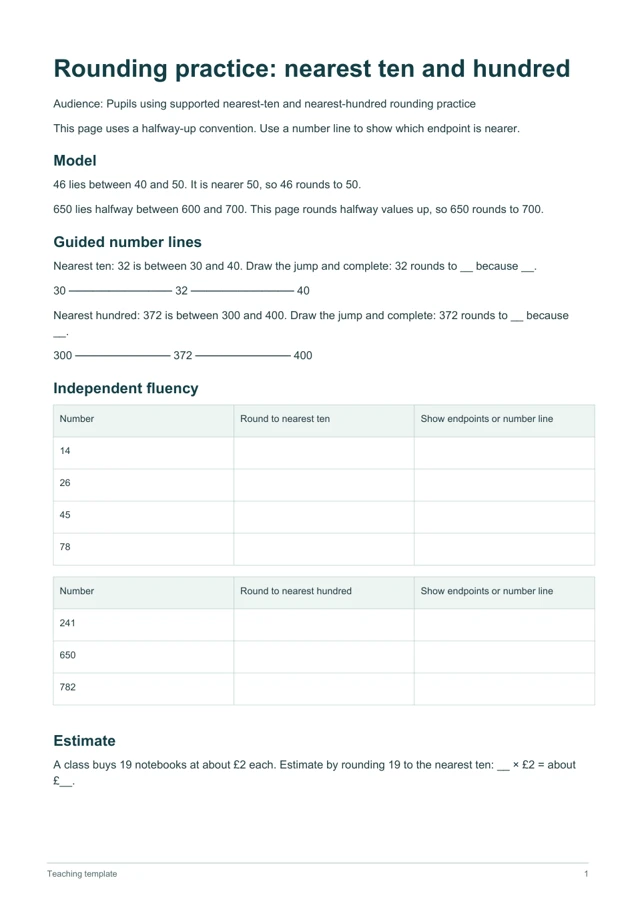
Rounding practice: nearest ten and hundred
For nearest ten, mark the two nearest tens. For nearest hundred, mark the two nearest hundreds. This page rounds exact halfway values up.
Explore resourceIdeas to try with your class
Sample teaching perspectives on what to try, what to adapt and what to watch for.
Meet The Creators
Meet the creators whose teaching interests connect with this template. Find an approach to try with your class.
Hannah Zwelithini-Grant
Regular review gives families and teachers a chance to discuss what is working, what needs adjustment and whether a new support should be tried.
Meet the creator
Helen Otway
I plan mixed-age cognition-and-learning support in small steps, agreeing an approach, observing the response and reviewing what to continue or adapt while keeping the shared skill visible.
Meet the creator
Extra Page
This two-page rounding sheet teaches nearest ten and hundred, using the ones digit for tens and the tens digit for hundreds, with 0 to 4 down and 5 or more up. Worked examples include 45 to the nearest ten and 350 to the nearest hundred.
Page-Turner Planner
The examples show the deciding digit and connect the rule to real-life problems. Asking pupils to locate the two tens a number lies between can make the nearest-ten decision more visible.
Clear Example
Use a number line to identify the neighbouring tens or hundreds before applying the halfway rule. Say which digit decides the rounding and explain why the result moves up or down.
Tea Break Notes
The sheet rounds to the nearest ten by the ones digit and nearest hundred by the tens digit, with an exact halfway value rounding up. Follow that printed convention and check which place value the question requests.