
Maths
Rounding practice: nearest ten and hundred
Use number lines, fluency questions and estimates to round to the nearest ten or hundred.
Read the material
Use number lines, fluency questions and estimates to round to the nearest ten or hundred.
Pupil document. Use the preview for diagrams and layout.
Page 1
Teaching template
1
Rounding practice: nearest ten and hundred
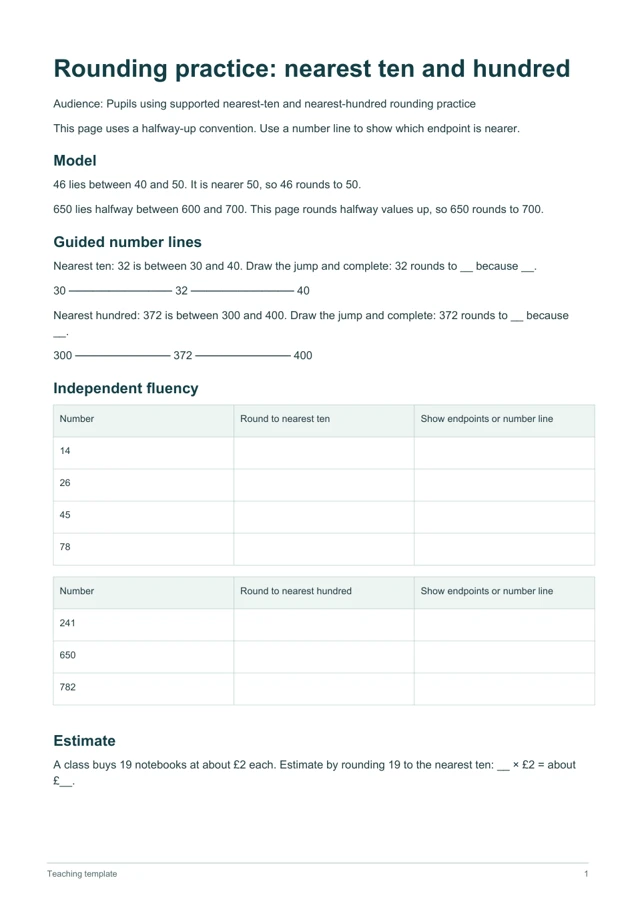
Audience: Pupils using supported nearest-ten and nearest-hundred rounding practice
This page uses a halfway-up convention. Use a number line to show which endpoint is nearer.
Model
46 lies between 40 and 50. It is nearer 50, so 46 rounds to 50.
650 lies halfway between 600 and 700. This page rounds halfway values up, so 650 rounds to 700.
Guided number lines
Nearest ten: 32 is between 30 and 40. Draw the jump and complete: 32 rounds to __ because __.
30 ───────────── 32 ───────────── 40
Nearest hundred: 372 is between 300 and 400. Draw the jump and complete: 372 rounds to __ because
__.
300 ──────────── 372 ──────────── 400
Independent fluency
Number
Round to nearest ten
Show endpoints or number line
14
26
45
78
Number
Round to nearest hundred
Show endpoints or number line
241
650
782
Estimate
A class buys 19 notebooks at about £2 each. Estimate by rounding 19 to the nearest ten: __ × £2 = about
£__.
Page 2
Teaching template
2
Check the idea
Sam says 350 rounds to 300 to the nearest hundred. Do you agree under the halfway-up rule? Explain with
a number line.
Challenge
Write a three-digit number that rounds to 500 to the nearest hundred. What other whole numbers would
round to 500?
My working or drawing: _________________________________________________________________
______________________________________________________________My explanation:
____________________________________________________________
Page 1
Teaching template
1
Rounding practice: nearest ten and hundred:
teacher notes
Teacher answer key
Guided: 32 rounds to 30; 372 rounds to 400. Nearest ten: 14→10, 26→30, 45→50, 78→80. Nearest
hundred: 241→200, 650→700, 782→800. Estimate: 19 rounds to 20; 20×£2 is about £40. Sam is incorrect
under the stated rule: 350 is halfway from 300 to 400 and rounds up to 400. Challenge example: 523
rounds to 500; whole numbers 450 to 549 round to 500 under the halfway-up rule.
A teaching sequence
Round two-digit numbers to the nearest ten and supported three-digit numbers to the nearest hundred, using number lines and the stated halfway convention.
Study the endpoints and model
Study the model and name the two endpoints.
Which two tens or hundreds contain the number?
Explain the guided rounding choices
Complete the guided nearest-ten and nearest-hundred examples.
Which endpoint is nearer on your number line?
Round independently and show a jump
Answer the independent fluency items and show a number-line jump.
Does the jump support the endpoint you selected?
Estimate, challenge and explain
Estimate a real-life total, explain a misconception and try the challenge.
How does the taught halfway-up convention affect Sam's claim about 350?
Check after teacher disclosure
Check only after the teacher opens the answer disclosure.
Which part of your reasoning needs revising after the answer is revealed?
Before you teach
Look for the thinking behind an answer, choose the support your class needs and leave room for an independent response.
What to look for
Example: 46 is nearer 50 than 40, so it rounds to 50. Example: 650 is halfway between 600 and 700, so this page rounds it up to 700.
Give a little support
Use a marked number line with the two endpoints visible. If nearest hundred has not been taught, the educator should omit that section rather than assume readiness.
Take the idea further
Create a three-digit number that rounds to 500 to the nearest hundred, then state the full range of whole numbers that would do so.
Things to keep in mind
Check that pupils can place the relevant numbers on the supplied number lines. Select nearest-ten or nearest-hundred work to match the taught sequence, and use the halfway convention only when the class teacher has introduced it.
Keep the idea. Make it yours.
Bring your topic, learning goal and class context to PLAI™, then review what you create.
Another starting point
Explore a different teaching task from this selection.
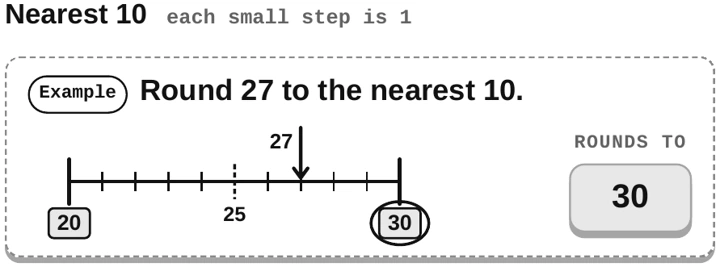
Rounding to 10 and 100
Read the rule and model examples 45 to the nearest ten and 350 or 349 to the nearest hundred. Point to the ones or tens digit used in each case.
Explore resourceIdeas to try with your class
Sample teaching perspectives on what to try, what to adapt and what to watch for.
Meet The Creators
Meet the creators whose teaching interests connect with this template. Find an approach to try with your class.
Hannah Zwelithini-Grant
Regular review gives families and teachers a chance to discuss what is working, what needs adjustment and whether a new support should be tried.
Meet the creator
Helen Otway
I plan mixed-age cognition-and-learning support in small steps, agreeing an approach, observing the response and reviewing what to continue or adapt while keeping the shared skill visible.
Meet the creator
Quietly Curious
This two-page supported practice focuses on two-digit nearest-ten examples and selected three-digit nearest-hundred examples. It explicitly uses a halfway-up convention: 46 rounds to 50 and 650 rounds to 700.
Bright Idea Break
The worked number lines ask pupils to show which endpoint is nearer, while the midpoint example makes the convention explicit. That separates distance reasoning from the rule for an exact tie.
Pencil Case Pal
Mark the endpoints and the number on a line, then count the distance to each endpoint. For an exact midpoint such as 650, apply the stated halfway-up rule.
Kind Check-In
The sheet's halfway-up convention may differ from another course or context. Teach the convention printed here and check the task's stated rule before applying it elsewhere.