
History and social studies
London is burning, 1666
Compare an adapted private diary account and an adapted official newspaper report about the Great Fire of London. A question, contextual notes and structured evaluation spaces help pupils weigh what each source can and cannot show.
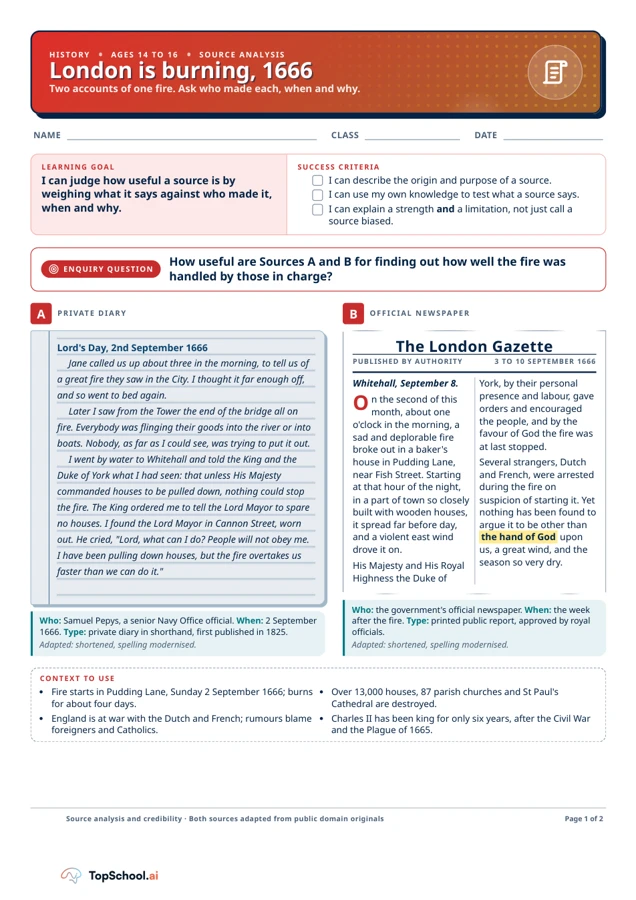
Read the material
Compare an adapted private diary account and an adapted official newspaper report about the Great Fire of London. A question, contextual notes and structured evaluation spaces help pupils weigh what each source can and cannot show.
Activity. Use the preview for diagrams and layout.
Page 1
NAME
CLASS
DATE
LEARNING GOAL
I can judge how useful a source is by
weighing what it says against who made it,
when and why.
SUCCESS CRITERIA
I can describe the origin and purpose of a source.
I can use my own knowledge to test what a source says.
I can explain a strength and a limitation, not just call a
source biased.
ENQUIRY QUESTION
How useful are Sources A and B for finding out how well the fire was
handled by those in charge?
A
PRIVATE DIARY
Who: Samuel Pepys, a senior Navy Office official. When: 2 September
1666. Type: private diary in shorthand, first published in 1825.
Adapted: shortened, spelling modernised.
B
OFFICIAL NEWSPAPER
Who: the government's official newspaper. When: the week
after the fire. Type: printed public report, approved by royal
officials.
Adapted: shortened, spelling modernised.
CONTEXT TO USE
Fire starts in Pudding Lane, Sunday 2 September 1666; burns
for about four days.
Over 13,000 houses, 87 parish churches and St Paul's
Cathedral are destroyed.
England is at war with the Dutch and French; rumours blame
foreigners and Catholics.
Charles II has been king for only six years, after the Civil War
and the Plague of 1665.
Source analysis and credibility · Both sources adapted from public domain originals
HISTORY
AGES 14 TO 16
SOURCE ANALYSIS
London is burning, 1666
London is burning, 1666
Two accounts of one fire. Ask who made each, when and why.
Lord's Day, 2nd September 1666
Jane called us up about three in the morning, to tell us of
a great fire they saw in the City. I thought it far enough off,
and so went to bed again.
Later I saw from the Tower the end of the bridge all on
fire. Everybody was flinging their goods into the river or into
boats. Nobody, as far as I could see, was trying to put it out.
I went by water to Whitehall and told the King and the
Duke of York what I had seen: that unless His Majesty
commanded houses to be pulled down, nothing could stop
the fire. The King ordered me to tell the Lord Mayor to spare
no houses. I found the Lord Mayor in Cannon Street, worn
out. He cried, "Lord, what can I do? People will not obey me.
I have been pulling down houses, but the fire overtakes us
faster than we can do it."
O
The London Gazette
PUBLISHED BY AUTHORITY
3 TO 10 SEPTEMBER 1666
Whitehall, September 8.
n the second of this
month, about one
o'clock in the morning, a
sad and deplorable fire
broke out in a baker's
house in Pudding Lane,
near Fish Street. Starting
at that hour of the night,
in a part of town so closely
built with wooden houses,
it spread far before day,
and a violent east wind
drove it on.
His Majesty and His Royal
Highness the Duke of
York, by their personal
presence and labour, gave
orders and encouraged
the people, and by the
favour of God the fire was
at last stopped.
Several strangers, Dutch
and French, were arrested
during the fire on
suspicion of starting it. Yet
nothing has been found to
argue it to be other than
the hand of God upon
us, a great wind, and the
season so very dry.
Page 1 of 2
Page 2
1
Interrogate each source
Work across each row. Row 1 is started for you.
12 marks
ASK
A
PEPYS'S DIARY
B
LONDON GAZETTE
Origin
Who, when, type?
An eyewitness diary written by Samuel Pepys on the day
the fire began, kept private.
Purpose
Why made? For
whom?
Content
What does it say
about leaders?
Context
Does my
knowledge fit?
+ Value
What can it show?
−Limits
What can it not
show?
2
How far do the sources agree?
4 marks
3
Your verdict
4 marks
Write A and B on the scale for the enquiry question.
JUSTIFY: THE MORE USEFUL SOURCE IS ... BECAUSE ...
EXAM-STYLE STARTERS
Source A is useful because, as an eyewitness, ...
The purpose of Source B was to ..., so ...
This fits my knowledge that ...
However, it cannot tell us ...
Even though it is one-sided, it shows ...
GO FURTHER
Why might the government blame the hand of God, and what does that choice tell a historian?
Analysis frame · Total 20 marks
THE GREAT FIRE, 1666
ANALYSIS
Question the sources
Question the sources
= BOTH SOURCES SAY
≠ THEY DIFFER BECAUSE
1
Hardly
useful
2
A little
3
Fairly
4
Very
5
Extremely
Page 2 of 2
A teaching sequence
Use source origin, purpose, content and historical context to make a supported judgement about how useful two accounts are for an enquiry.
Find evidence about authority
Annotate one detail from each source that speaks to how the fire was handled by people in authority.
Which adapted source detail describes a response to the fire?
Compare origin and content
Complete the comparison table for origin, purpose, content and context. Use the contextual information on the first page where it helps explain a source’s perspective.
How might the source's form affect what it reports?
Weigh value and limitations
Identify one value and one limitation for each source. Distinguish what a source directly reports from what it may suggest.
What does the account directly report, and what do you only infer?
Justify usefulness for the question
Explain where the accounts agree or differ, then place each on the usefulness scale and justify the judgement with evidence. Then use the further question to consider why an official report might frame responsibility in a particular way.
Which evidence explains why one source is more useful for this enquiry?
Before you teach
Look for the thinking behind an answer, choose the support your class needs and leave room for an independent response.
What to look for
Check that pupils support a usefulness judgement with a source detail and a reason linked to origin, purpose or context. Ask them to acknowledge a limitation rather than treating either account as a complete record. Require a quotation or specific detail for each judgement.
Give a little support
Give pupils one highlighted sentence from each source and model the frame “This is useful for ___ because ___, but it cannot show ___.” Provide a small vocabulary bank for eyewitness, official report, purpose and limitation.
Take the idea further
Ask pupils to compare how the two accounts describe leadership and to explain how audience or publication context could shape each account. They can identify what other evidence a historian would seek.
Things to keep in mind
The extracts are adapted and shortened, with spelling modernised; they are not full transcripts. The document does not provide full archival citations or independently verify all contextual statements. Use a historian or trusted source to check the presentation before teaching it as factual evidence.
Keep the idea. Make it yours.
Bring your topic, learning goal and class context to PLAI™, then review what you create.
Ideas to try with your class
Sample teaching perspectives on what to try, what to adapt and what to watch for.
Meet The Creators
Meet the creators whose teaching interests connect with this template. Find an approach to try with your class.
Bea Solano
I introduce History through sources that disagree and teach Global Perspectives through questions, evidence and competing views, asking pupils to support a judgement and identify what remains unknown.
Meet the creator
Erik Halvorsen-Ruiz
I often begin a unit with two sources that disagree, because that gives pupils something to examine before I offer a narrative.
Meet the creator
Tomás Ferreira Lima
I ask pupils to work with an argument they do not agree with, find evidence for it and explain it in a way its supporter would recognise.
Meet the creator
Rachel Ncube
I look for scaffolds that help pupils with different reading needs work on a shared historical question, without changing the question into several unrelated tasks.
Meet the creator
Aidan Fitzgerald
I connect retrieval across History and Geography while preserving their distinct evidence methods, helping pupils see whether they are recalling a concept, analysing a source or processing fieldwork data.
Meet the creator
Joseph Turing
I want scaffolds that help pupils access a source at different reading levels while keeping the question and historical method intact.
Meet the creator
Thoughtful Pause
This two-page Great Fire enquiry asks how useful a private diary and an official account are for learning how the fire was handled by those in charge. Pupils compare origin, date, purpose, content and historical knowledge, then state a strength and limitation.
Reread Reminder
The question focuses the judgement on responses by people in authority, rather than asking which account is simply “biased.” The success criteria ask pupils to test what a source says against contextual knowledge.
Open Book Pause
Mark the creator, date and form for each source before selecting relevant details. Then connect one detail to the enquiry and explain what the source cannot establish.
Page-Turner Planner
A source's usefulness depends on the enquiry and the available evidence. Check the source extracts and contextual facts against the lesson's historical materials; do not treat one account as a complete record of events.